When there is less water, people use less water, Texas edition

From Bobby Magill, more evidence for my thesis that we’re such profligate water users in the United States that we’ve got lots of room to move as drought and climate change reduce supply:

Eventually, TV station weathercasters began reporting the level of the Edwards Aquifer along with the daily weather forecast, forcing residents there to pay closer attention to their water consumption.

“It’s a culture that’s developed here the last couple of decades that was a result of the Endangered Species Act lawsuit that put a cap on how much water could be pumped from the Edwards Aquifer,” San Antonio Water System spokesman Greg Flores said. “That change in culture and behavior in terms of water use and water efficiency really has driven San Antonio in a different way (from how other Texas cities) embarked on their efforts.”

Why is Paso Robles failing to self-regulate groundwater?

As California struggles against the problems posed by its current drought, there has been a great deal of attention paid to the lack of groundwater regulation. Melody Gutierrez has a great example today, from Paso Robles:

How scant has the crucial underground water supply become around the San Luis Obispo County city? Sue Luft can tell you anecdotally. The water levels in wells that feed homes and wineries around her 10-acre property just south of Paso Robles have dropped 80 feet in some areas, leaving many with no choice but to take out loans to drill farther down. Luft calls it a “race to the bottom.”

Why are they racing? Because they can, I guess:

“The drought is being used as a political mechanism to take away property rights,” said Cindy Steinbeck of Steinbeck Vineyards & Winery in Paso Robles. “We are in a serious drought, but that doesn’t mean individual landowners should have to give up what is theirs by law.”

Groundwater has been regulated in vastly different ways from other water sources. California requires permits and licenses to take water from streams, rivers and lakes, but no such process exists for groundwater. Surface water and groundwater are treated differently in state law in a way that resource experts say makes little sense, given that one affects the other.

“California has the least structure and fewest requirements (compared with any other) state,” said Andrew Fahlund, deputy director of the California Water Foundation. “The system has survived up to this point because we weren’t facing a significant crisis.”

And thus it is framed – property rights versus government regulation. But that’s not quite right.

While Fahlund is right that state government doesn’t regulate, California is home to pioneering examples of communities that, independent of any external regulation, realized the race to the bottom would kill them and found a way to self-regulate to avoid the tragedy of the commons.

Back in the 1950s, water pumpers in the Los Angeles Basin were in a similar race to the bottom. Recognizing the problem, they did the difficult political work of self-imposing a political regime that shared the burden of ending the race. (There’s a great history of this in the Water Replenishment District of Southern California’s annual report – pdf.) It’s where Elinor Ostrom did her pioneering research on common pool resource problems, and it’s fun to read how proudly the WRD folks embrace her work today:

The formation of the Water Replenishment District is one of the studies she used as an example of “how to organize to avoid the adverse outcomes of independent action” and “to obtain continuing joint benefits” in the face of “temptations to free-ride, shirk, or otherwise act opportunistically.”

The details of how the L.A. Basin people did it are beyond the scope of this blog post, beyond noting that Ostrom’s work concluded that there are lots of ways for communities of interest to do this sort of thing. But one of her central findings is that it’s up to the folks in Paso Robles to succeed or fail.

When the “plumbing” metaphor breaks down

I’ve often written about the ways in which our rivers in the western United States have become like plumbing (and here, here, and especially here). But one of the most interesting things to me about metaphors is when you push them to too hard. You can learn a lot at the point where the metaphor breaks down.

So what does it tells us about the nature of the California “plumbing” system when, as Matt Weiser reports, they have to drive salmon to the ocean in trucks?

On Monday, state and federal wildlife officials announced a plan to move hatchery-raised salmon by truck in the event the state’s ongoing drought makes the Sacramento River and its tributaries inhospitable for the fish. They fear the rivers could become too shallow and warm to sustain salmon trying to migrate to sea on their own.


Metering water sales

To folks in many parts of the arid western United States, the notion that some California communities don’t meter residential and business water sales seems crazy.

It is. This may be, by some measures, a record drought in California. But even without it, Californians have known they have serious water stresses. That it has taken this long to get this basic water management tool in place is, in fact crazy. Here’s Paul Rogers:

Despite urgent calls for water conservation amid one of California’s worst droughts, more than 255,000 homeowners and businesses across the state can still use all the water they want without paying higher bills.

And nobody even knows how much water they are using.

Why is this? First, homes and businesses without meters, while large in number, are the exception:

Most California residents have had water meters for generations.

Los Angeles finished installing them in the 1920s. San Jose has had meters on every home since the 1930s. Oakland began installing them in 1906 and was fully metered by 1940.

But people seem to like living in a wet, green world:

But even in a large, prosperous city like Sacramento, plans to require water meters sparked controversy for decades.

“For some people, it’s like going to Alabama and saying you are going to register their guns,” said Barbara O’Connor, director emeritus of the Institute for the Study of Politics and the Media at Cal State Sacramento.

“It’s a visceral reaction,” she said. “People in some places view it as a birthright that they have big trees and green grass. They see the water in the rivers, they walk along it, and they raft on it. It’s part of the right of being a Sacramentan.”

The full article is worth reading for those interested in water policy steps that are relatively straightforward and that can make a difference in building resilience against drought and climate change. “You can’t manage what you don’t measure,” as my business school grad colleague likes to say. And kudos to the Mercury-News for publishing the full data table.


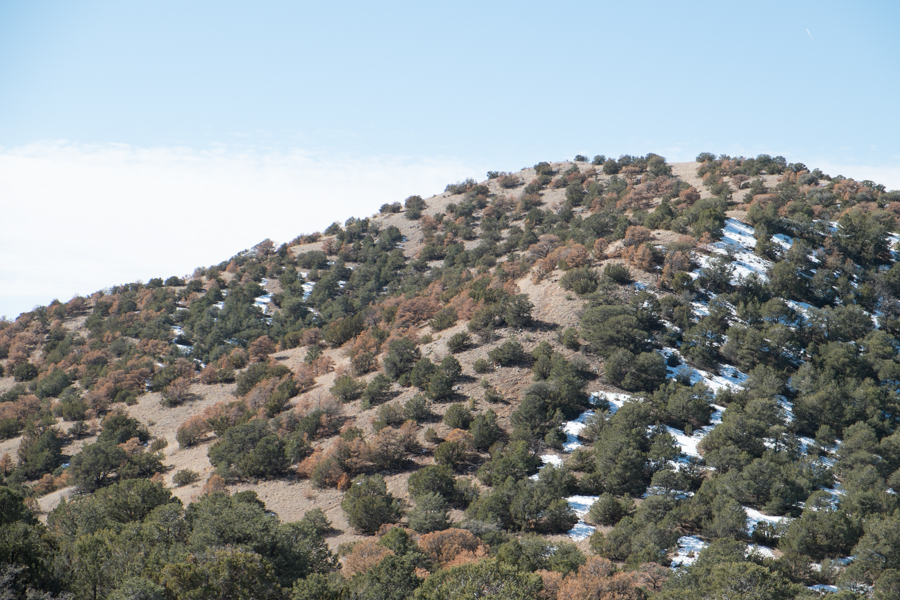
dead piñon

Dead piñon, Sandia Mountains, February 2014

Dead piñon, Sandia Mountains, February 2014

One of the casualties of drought is the piñon in the mountains of New Mexico. I took this picture back in February in the Sandias, the mountains on the eastern edge of Albuquerque. Where you see snow the slopes are generally north-facing. No snow is south-facing, and that’s where you see brown trees.

I tweaked the picture in Lightroom to give a false-color image of the dead trees in red:

Dead piñon, false color, by John Fleck, February 2014

Dead piñon, false color, by John Fleck, February 2014

creosote

Stove Pipe Wells, California, US, by Flickr user n8agrin, CC

Stove Pipe Wells, California, US, by Flickr user n8agrin, CC

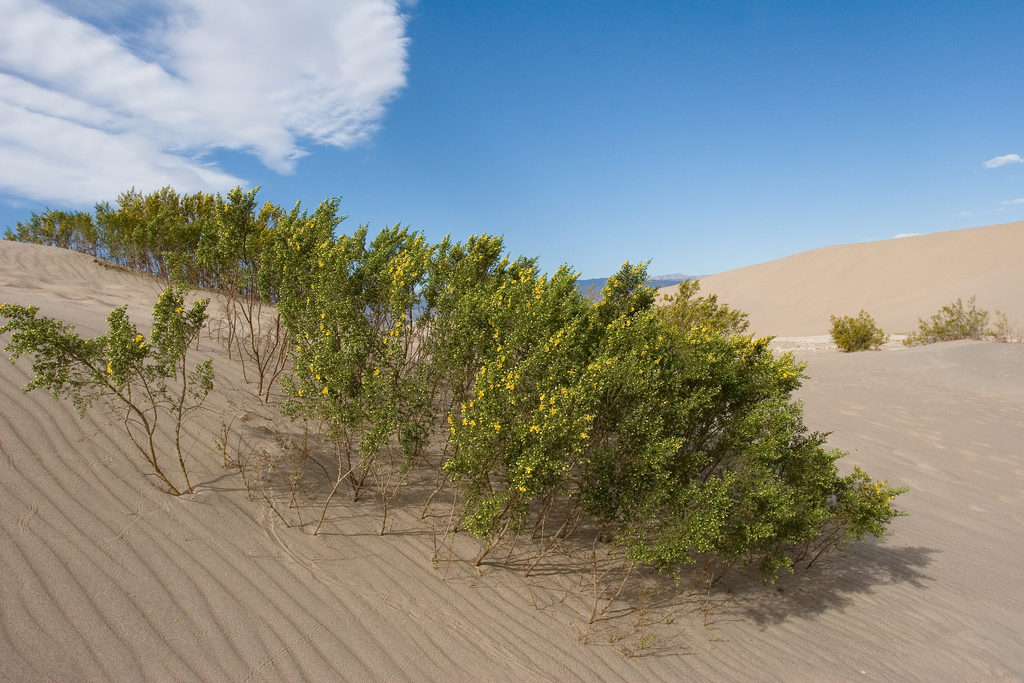
If you have any doubt about it, know that the desert begins with the creosote.

– Mary Austin, Land of Little Rain

Stuff I wrote elsewhere: the WIPP accident that was never supposed to happen

If I was a more clever writer, I’d have a joke here about how the statistics of a WIPP accident change now that we’ve got a Bayesian prior:

The radiation leak that has shut down the nation’s only operating underground nuclear waste disposal site was, for all practical purposes, never supposed to happen.

No one knows yet how or why a waste drum leaked at southeast New Mexico’s Waste Isolation Pilot Plant on Valentine’s Day, triggering alarms, exposing workers and setting off a cascade of events that could cripple the nation’s radioactive waste disposal system.

But a Journal review of Department of Energy records shows that, before WIPP opened, the agency put the risk of such an accident at one chance in 10,000 to one in 1 million during any given year of WIPP operations.

Climate change in the West: it’s not just about more or less rain

Ben Cook at NASA’s Goddard Institute for Space Studies has a new paper that offers a reminder of why the impact of climate change on our ecosystems and water supplies involves more than “will it rain less”?

In some sense this is an old and obvious point, which I link here just to repeat said old and obvious point. Drought is a combination of how much rain and snow falls from the sky and then what happens once it hits the ground. If it’s warmer, more evaporates, and it’s the net left behind after the puts and takes that defines our available water supply and drought or lack thereof. Here’s Cook:

For many regions, focusing on the precipitation response alone will be insufficient to fully capture changes in regional water resources such as soil moisture, runoff, or reservoir storage. Instead, increased evaporative demand will play a critical role in spreading drought beyond the sub-tropics and into the Northern Hemisphere mid-latitudes, regions of globally important agricultural production.

But Ben’s a smart scientist who is doing more than what I usually do here, which is simply restate the obvious. The new in the paper is the use of the latest round of models, known as CMIP5, along with a couple of different measures of dryness, to better flesh out the picture.

There’s been some argument over whether the Palmer Drought Severity Index (the most common measure for this sort of thing) is the best way to analyze future drought scenarios, so Cook and colleagues offer up alternatives, including the Standardized Precipitation Index and a look at “vapor pressure deficit” (a critical measure for thinking about the future of our forest – see Park Williams on this):

PDSI and SPEI projections using precipitation and Penman-Monteith based PET changes from the GCMs generally agree, showing robust cross-model drying in western North America….

update: Dr. Cook kindly shared this link to an ungated copy of the paper (extremely large pdf)

Drought means we should do that thing I already knew we should do

Mark Lubell at U.C. Davis has a fascinating post about the history and politics of drought:

[N]early every scientist, commentator, and politician is using drought to make some call for their preferred political change. Regulate groundwater. More storage. Build the twin tunnels. Pass the long-delayed water bond.

So given that we’ve been here before (click through for useful historical examples), did the hair-on-fire response to previous drought create water systems in California that are more resilient and able to handle the current one?

Therefore, the second key question is whether or not the policy changes stimulated by past droughts have actually improved water management in California. Have we learned anything from our past experiences? Stated more precisely, the question is how much damage will California suffer, given the same level of drought?

I would argue that Southern California’s relative stable situation supports a “yes” answer to the question, but I’d defer to people in the midst of the California drought for a more informed response.