Pat Mulroy, the Hayduke of the 21st century

Nevada journalist George Knapp has a wacky suggestion for Pat Mulroy on her way out the door at the Southern Nevada Water Authority:

[I]t is still possible for Mulroy to make a grand, parting gesture by starting the ball rolling on a plan to drain Lake Powell….

This’d make an excellent final chapter for my book.

Presumably Mulroy would leave Hoover Dam intact

Presumably Mulroy would leave Hoover Dam intact

Imagine having to set water rates for an entire nation

I’ve been writing recently about the struggles to set sane water rates for Albuquerque that take into account conservation goals as well as the need to maintain cash flow for for a largely fixed-cost operation. It’s a tough problem. But imagine sorting this out for an entire nation:

BEIJING—China will roll out wide-reaching reforms in how it prices water by the end of next year, the government said Friday, charging higher prices for the heaviest urban consumers to conserve diminishing resources and spur investment.

The Chinese approach that Brian Spegel and William Kazer report in the Wall Street Journal sounds a lot like an increasing block rate:

Under the plan, the heaviest consumers—or top 5% of households—will pay at least three times the base rate of water. The second tier will pay 1.5 times the base rate, while the lowest tier—roughly 80% of urban households—wouldn’t be affected by the changes….

For more in increasing block rates and the questions of equity that they raise, an interesting David Zetland discussion here.

Moving water to where it’s needed

User “A” has some water rights that he or she would like to put to use for economic benefit, but with the current amount available and the current economics of the business in question, it’s just not penciling out. User “B” comes along offering to pay to put the water to an alternative use. What’s not to like?

New Mexico’s prolonged drought has some Eddy County farmers selling off water to the oil and gas industry.

Lack of water over recent years has made agricultural ventures less desirable for individual water rights holders across Southeastern New Mexico, prompting many to instead sell the water to oil and gas companies to be used for hydraulic fracturing.


Drought, the “ridge” and the Colorado Basin

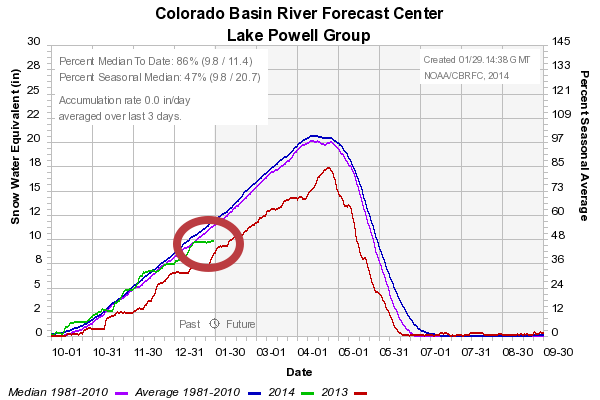
While much of the attention on the “ridiculously resilient ridge” has, rightly, focused on its effect on California’s drought, out here in the intermountain west we’ve been suffering too. Albuquerque is on the brink of its longest precip-free winter stretch on record (these records go back to 1920). And for the Colorado Basin?

Colorado Basin snowpack above Lake Powell, courtesy CBRFC/NRCS

Colorado Basin snowpack above Lake Powell, courtesy CBRFC/NRCS


What had been shaping up to a decent season, with enough snowstorms to keep the accumulation right in the “normal” range (where “normal” means in this case median), has flatlined since since early January.

Bridging the Little Colorado

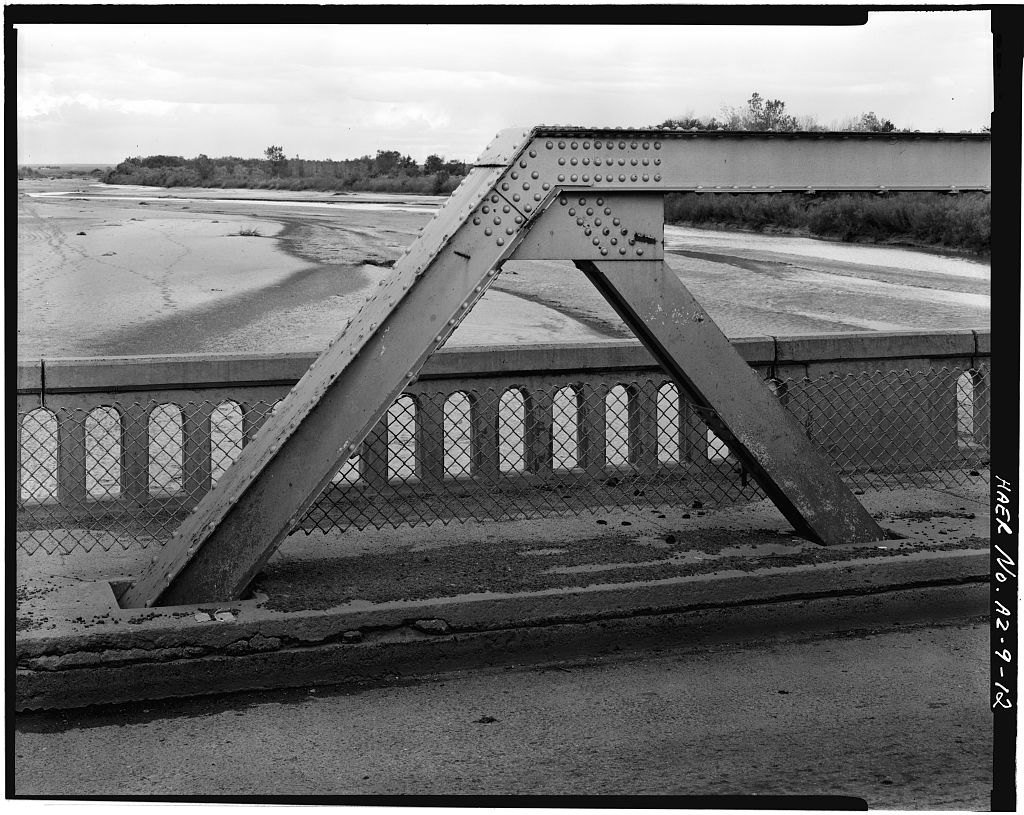
This great old bridge over the Little Colorado River is gone:

END POST / UPPER CHORD / DIAGONAL CONNECTION DETAIL. VIEW TO SOUTHEAST. - Holbrook Bridge, Spanning Little Colorado River at AZ 77, Holbrook, Navajo County, AZ, Courtesy Library of Congress

END POST / UPPER CHORD / DIAGONAL CONNECTION DETAIL. VIEW TO SOUTHEAST. – Holbrook Bridge, Spanning Little Colorado River at AZ 77, Holbrook, Navajo County, AZ, Courtesy Library of Congress

Built in 1928, it’s been replaced a wider and much more boring bridge. Its story, from the Historic American Engineering Record:

In 1914 the El Paso Bridge and Iron Company erected a two-span steel truss to replace the existing timber structure over the Little Colorado River. The bridge stood until the Lyman Dam broke upstream on April 14, 1915, critically damaging its abutments. Although repairable in 1915, ten years later the Holbrook Bridge was deemed no longer suitable to carry traffic when Arizona Highway Department (AHD) engineers began to survey a portion of the Holbrook – St. Johns Highway (U.S. Highway 70) in November 1925. By July 1926 the AHD bridge department had designed this four-span pony truss with sidewalks cantilevered from the webs. The bridge was substantial, consuming over 372,000 pounds of structural steel and 789 cubic yards of concrete. The agency waited over a year for the U.S. Bureau of Public Roads to approve the design before letting bids for construction of the Holbrook Bridge. On December 12, 1927, the agency contracted with the Levy Construction Company of Denver under Federal Aid Project 78-B. Levy’s crew commenced work in February and by April poured piers 4 and 5. The Holbrook Bridge was completed on September 9th.

Many more pictures from a 1968 survey here.


Stuff I wrote elsewhere: Texas v. New Mexico Rio Grande water suit moves to next phase

From this morning’s newspaper:

The U.S. Supreme Court on Monday said Texas can go ahead with its lawsuit that claims groundwater pumping in southern New Mexico is draining the Rio Grande and depriving Texas users of water to which they are legally entitled.

Texas cleared a major hurdle with the decision, which could set the stage for a protracted legal battle. The court did leave New Mexico what could be an escape clause that would allow the case to be quickly dismissed.

“Texas has the upper hand now,” said attorney Steve Hernandez, who represents the Elephant Butte Irrigation District.

Guardians

A detail of the new public art, a sculpture named “Guardians” by Nora Naranjo Morse, in the park around the corner from our house:

Detail from Guardians by Nora Naranjo Morse, 2013. Photo by John Fleck

Detail from Guardians by Nora Naranjo Morse, 2013. Photo by John Fleck

In a drought, who runs out of water, and who pays?

When New Mexico was being entertained to newspaper and television coverage last year of water trucks rolling to the handful of communities that, in the midst of drought, had run out, I did a piece in the paper trying to get my arms around the folks he hadn’t run out of water. What were they doing differently?

Consider the little Fambrough Mutual Domestic Water Consumers Association, outside Hagerman in southeast New Mexico. In June 2003, the community water system’s managers made a desperate call to the state’s drought hotline. Their pump had gone dry.

A decade later, the system is running at full capacity, with no problems delivering water to its 130 customers. The difference, according to office manager Deborah Huckabee, includes new water rights and two new pumps. “We’re trying to be proactive,” Huckabee said. “We’re trying not to fail.”

Among other things, Fambrough raised rates to pay for all this. As a result, Fambrough was having a hard time getting state funding to help them, because on paper they didn’t need it. I guess given a choice, better to have water and be ineligible for state funding, right? But it raises interesting equity questions.

OtPR, back to help us think through California’s drought (have I mentioned how delighted I am that OtPR is back to help in our time of need?), raises this question as Californians look at the prospect of a dozen communities at risk of running out of water by spring:

Were it mine to do, I’d say that we, the people of the State, will help you once. Before a water truck arrives, you show us your new property tax assessment for water infrastructure that can withstand three dry years. The water trucks will arrive the day after you pass a rate structure that adequately funds your water reliability. We will not take your lack of water more seriously than you do.

 

Has California’s probability density function changed?

As California grapples with drought, it’s a good time to revisit Milly et al.’s 2008 Science paper Stationarity Is Dead: Whither Water Management? I’m not statistician enough to answer the question posed by the post’s title, but it’s at least worth considering, as part of the state’s policy responses to this drought on multiple time scales (both direct response this year and long term changes in response) whether we’re in a different climatological world, and what sort of response might be justified as a result. (pdf on Julio Betancourt’s site)

The world today faces the enormous, dual challenges of renewing its decaying water infrastructure and building new water infrastructure. Now is an opportune moment to update the analytic strategies used for planning such grand investments under an uncertain and changing climate.