A Popperian approach to journalism

I happened to be in the midst of reading Kuhn vs. Popper when I ran across this, by Nicholas Lemann, on the sometimes clumsy dance between narrative and analysis in journalism:

Forming a hypothesis. It’s healthier to admit to yourself that you have one than to go into a story with the idea that you have no presuppositions at all – that would be impossible. You should state a working hypothesis (to yourself, anyway), and then ask yourself what would prove the hypothesis false and what would be an alternate hypothesis to explain whatever it is you are investigating. As you report, you should try not just to prove but also to disprove your working hypothesis, and you should engage in a continuing process of revision of the hypothesis, if necessary. If you don’t design your reporting in such a way that if your hypothesis is flawed, you will find that out before you finish the story, then you are leaving yourself open to getting the story seriously wrong.

 

Cool jewelry

We’ve got some cool jewelry in the household thanks to Nora Reed’s work. You might like some too:

swirling mother of pearl jewelry

swirling black and white

I’ve always had a thing for swirls and black and white patterns. This high-contrast piece combines soft mother-of-pearl white with a few kinds of black and white beads; the colors echo themselves throughout it to create a cohesive necklace that is versatile enough to match to many outfits.

OMG, we’re running out of water!

My current water policy obsession is the question of what actually happens – agency by agency, water user by user – when the water starts to run out.

Much of the “OMG, we’re running out of water!” discussion plays out in the form of graphs of the future that extend projected supply and demand curves, pointing to the gap, and running around with our hair on fire. But to the extent that the gap between supply and demand equals negative water, we can’t do that, and individuals and institutions will change their behavior in some way, and the question is how. Who will use less and how, or who will run out?

As one watches the Midwest discussion right now, perhaps the “how” involves reframing our basic approach to water:

“Water has been viewed as a basic commodity, a basic right,” said Les Lampe, a water expert with consultancy Black & Veatch. “You turn on the tap and water comes out and you don’t pay very much for it. That has to change.”


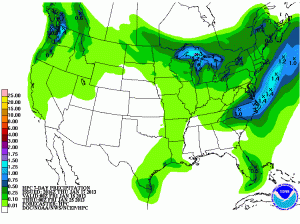
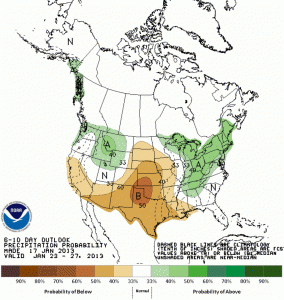
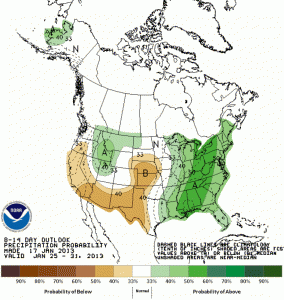
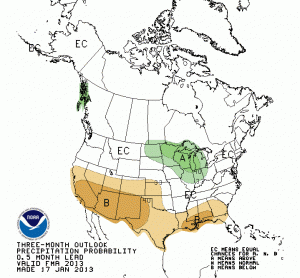
Running the table: dry at all relevant time scales

I confronted a litany of drought when I was making the rounds on my newspaper beat this morning. No doubt this has happened before and I’ve just not noticed it, but the current forecasts are dry at all the basic time scales I watch closely. I lined ’em all up so you could share New Mexico’s pain:

Next seven days:

Five to seven days

Next seven days

Six to ten days:

Six to ten days

Six to ten days

Eight to fourteen days:

Eight to fourteen days

Eight to fourteen days

February-March-April:

February-March-April

February-March-April

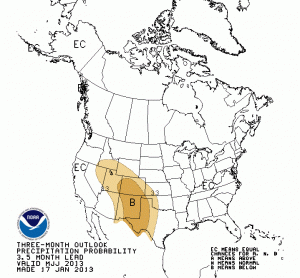
May-June-July:

May-June-July

May-June-July

New West: the economics of immigration

At the peak of the housing bubble in January 2006, when the annual pace of new home construction hit a blistering 2.29 million units, an estimated 14 percent of laborers in the construction sector were undocumented immigrants, including 20 percent of carpet, floor and tile installers, 28 percent of drywallers, and 36 percent of insulation workers. In September 2007, housing starts were down almost 50 percent, prices tumbled, and tens of thousands of migrants had lost their jobs.

Rubén Martínez, Desert America: Boom and Bust in the New Old West

Draining the Colorado River’s reservoirs, 2013 edition

Based on the latest federal forecasts (pdf from USBR here), we can expect Lake Powell to drop 20 feet this year and Lake Mead to drop 10 feet. That’s the midpoint forecast. Could be better if it snows. Could be worse. So far the trend based on the first half of January leans toward worse.

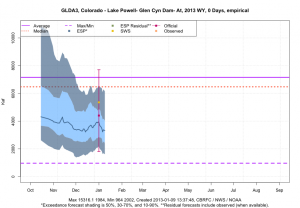
NOAA’s Colorado Basin River Forecast Center has built cool new graphical tools you can use to follow the pain in real time. Click on any of the little colored triangles to get the current forecast for unregulated flows at that river measurement point. The human forecasters expect 61 percent of average inflow into Lake Powell this year. The model “thinks” it’ll be more like 42 percent. Both have big error bars, depending on whether it snows between now and the start of meltoff.

Click on the “more info” link at the top of the little popup window and you get a graph like this:

Lake Powell Inflow, courtesy CBRFC

Lake Powell Inflow Forecast, courtesy CBRFC

Here’s how to read the graph.

  • the dotted red line is median inflow
  • the solid purple line is mean inflow
  • the Y axis is the time the forecast was issued
  • the blue line moving left to write is the model forecast (which I think is run once a week)
  • the vertical red line is the official monthly forecast, with a human in the loop (so the one you see on there now is the January forecast)
  • the light blue area spans the 30 percent and 70 percent exceedence levels
  • the dark blue area spans the 10 percent and 90 percent exceedence levels

A couple of things to note. The human-in-the-loop forecast is more optimistic than the model. The model has shown continued decline since the human forecast was issued. That’s ’cause it hasn’t been snowing much.

Stuff I wrote elsewhere: original jurisdiction

There’s a rich, historical elegance to the tradition of state-v-state lawsuits over interstate compacts. Because each of the US states is constitutionally sovereign, when they sue one another over water flowing down a river from one state to the next, the legal action begins and ends before the US Supreme Court – the court of “original jurisdiction”.

I am happy to report that I’ve got my own original jurisdiction case with the newly filed “Texas v New Mexico“:

Texas moved Tuesday to drag New Mexico before the U.S. Supreme Court, charging that New Mexico is mismanaging the Rio Grande in a way that deprives Texas farms and cities of water that rightly belongs to them.

The lawsuit alleges widespread groundwater pumping between Elephant Butte Reservoir and the New Mexico-Texas border that has effectively reduced flows in the river.

River Beat: Another Bad Year on the Colorado

The bonus water of 2010-11 on the Colorado River, when Lake Mead jumped nearly 50 feet in surface elevation, is looking more and more like an anomaly. The Colorado Basin River Forecast Center issued its January forecast this week, with early snowpack pointing to a mid-point forecast of 61 percent of average flow into Lake Powell. It looks like it’s only about a 15 percent chance of enough snow between now and meltoff to get up to an average year.

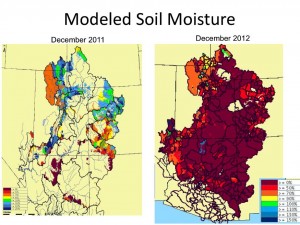
Here’s a look at soil moisture then and now: December 2011 (coming off that unusually wet year) and now:

Colorado River Basin soil moisture

Colorado River Basin soil moisture