Coping with drought – a question of marginal costs

One of the problems with droughts is that, eventually, they end.

That is by definition, because “drought” is the dry part of the range of variability for a given place. When you’re in one, the marginal value of water (and therefore marginal cost you’re willing to pay) is high. When you come out of it? Not so much. But there is a permanence to big water infrastructure that is making this whole thing a bit of a mess right now in Queensland now that Australia’s big dry is gone:

French water giant Veolia is set to reap more than $30 million a year from Queensland taxpayers to babysit billions of dollars-worth of drought-busting infrastructure that is surplus to requirements and set to be switched off.

Oh yeah, and it’s the French.


Stuff I wrote elsewhere: Happy New Water Year!

The typical “out with the old” etc. celebrations don’t have much resonance as New Mexico stares down a new water year. From the morning paper:

New Mexico faces three problems in the new water year.

The first problem is the winter forecast itself. There were signs of an El Niño forming, a climate pattern driven by warm water in the equatorial Pacific ocean that tips the odds toward wetter winters in New Mexico. El Niño is no guarantee, but it improves our chances of extra storms to make up some of the long-term drought shortfall.

But this year’s El Niño has been slow and weak, not offering a very hopeful forecast as a result.

Second, after two consecutive drought years, the state’s watersheds are like a dry sponge right now, King said. A big chunk of whatever snow we get this winter will simply soak into dry ground before runoff can start reaching streams and rivers. “The watershed will take its bite first,” he explained.

The third problem may be the most vexing.

In recent years, for a given size snowpack, water managers have seen substantially less water actually making it into New Mexico’s rivers, King noted.

Scientists at both New Mexico State University and the University of New Mexico are looking closely at the puzzle in search of answers. While the reason behind the runoff drop-off remains a mystery, it is consistent with what you would expect as New Mexico’s temperatures rise, noted UNM professor David Gutzler, one of the scientists looking at the issue.


filler

Political news, and especially the important news that really affects the campaign, proceeds at an irregular pace. But news coverage is produced every day. Most of it is filler, packaged in the form of stories that are designed to obscure its unimportance.

Nate Silver, The Signal and the Noise.

Agriculture and climate change

Lauren Morello at E&E has a fascinating piece about research into the views of US farmers regarding climate change:

“Most of the farmers will admit that climate change is happening,” he said of the growers he advises in western Kentucky, on the Corn Belt’s eastern fringe. “What they don’t want to hear is that it’s global warming induced by man’s activities. In their mind, if we say, ‘Yes, we think climate change is real. Yes, we think global warming is happening,’ then someone is going to say, ‘You are a big cause of it. You use fertilizers and chemicals and big tractors, and we’re going to regulate you.'”

And that means that simply throwing more information at farmers isn’t the answer for scientists and others who want to start a productive conversation about climate change and agriculture, experts said.

Does water really flow uphill toward money?

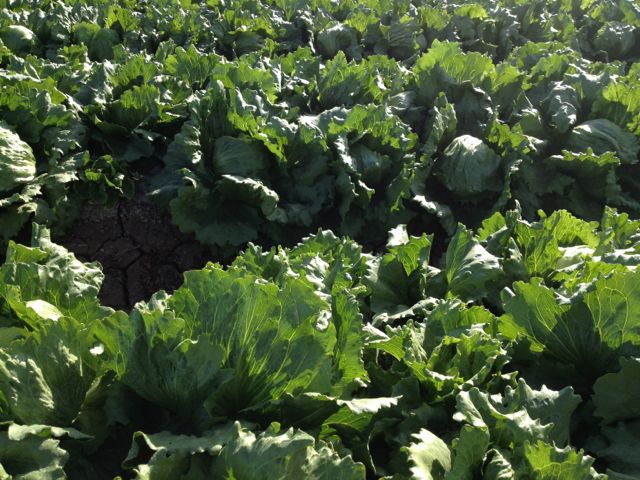
Lettuce being grown with Colorado River Water, Yuma AZ

Lettuce being grown with Colorado River Water, Yuma AZ

There’s a truism in water politics and policy in the western United States that “water flows uphill to money”. But is it correct?

I ran across it most recently in an excellent editorial in the Salt Lake Tribune regarding the Southern Nevada Water Authority’s proposal to build a pipeline to rural Nevada, along the Utah border, to ferry water to Las Vegas. The Tribune editorial board makes a reasonable point – that once folks in Vegas spend all that money to build a pipe, it may be difficult to enforce regulations designed to throttle back the pumping if it looks like it’s harming the “move from” area:

But experts rightly caution that by the time the wells sound the alarm, it could be too late to reverse the damage. Besides, once Las Vegas has invested in a $3 billion pipeline and pumping system, it will not give up the water willingly. In the West, water inevitably flows toward population and money.

As I said, I think it’s a reasonable concern. But is the inevitability described in the last sentence really the case? I’m inclined to think that, in the West, water flows uphill to money, except when it doesn’t.

There are good examples, especially in California, where water is quite literally flowing uphill toward wealthy water users. I’m thinking here about the agricultural users in the western San Joaquin Valley and the urban users of Southern California, who draw heavily on the troubled Sacramento-San Joaquin Delta for their water supplies. They appear willing and quite able to use their wealth and influence to move water to meet their needs.

The Cadiz project in California also appears to have a lot of the “uphill to money” characteristics.

But there are counter-examples. I’ve written in the past about cases in New Mexico, most notably the big Augustin Plains proposal (a lot like Cadiz or Snake Valley in Nevada) where state water law has thus far blocked efforts to pump water “uphill to money”. In fact, as Bettina Boxall wrote last week in the LA Times, it’s not entirely clear that money will be sufficient to move the Cadiz water along its very uphill journey.

And my favorite example, as I’ve written about at some length, is the federal government’s decision back in 2003 to cut LA’s allocation of Colorado River water. That was a decision against shipping water uphill to the wealthiest on two counts. First, on an interstate basis, it represented a decision to cut wealthy California’s overall allocation of Colorado River water in deference to the other less wealthy and politically powerful states in the basin. Second, within California, it represented a decision to cut wealthy urban-suburban Southern California’s water supply while preserving the water rights of less affluent and less politically powerful Imperial Valley farming interests.

In the latter examples, legal structures to manage water rights held firm under the pressure of wealthy and powerful interests that would have preferred to move water “uphill to money”. So what are the characteristics that distinguish between the two outcomes?

Sewage as an asset

Increasingly, around the United States I see more and more of this sort of story, in which agencies view sewage as an asset:

Kenner is seeking state and federal permits to build a 2-mile-long pipeline carrying 17 million gallons of treated sewage a day* into the LaBranche Wetlands. The goal is twofold: Help restore the marsh, and give Kenner a second discharge route from its overburdened treatment plant.

Via Drew Broach at the Times-Picayune

* For those wanting a translation into other uselessly arcane non-metric units, that’s 26 cubic feet per second