Perhaps we shouldn’t call it drought?

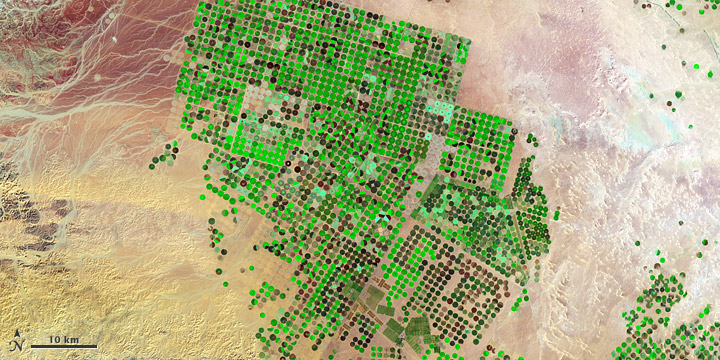
One of the briefs (pdf) in the voluminous filings in the water rights adjudication on the Lower Rio Grande makes this fascinating assertion regarding water for irrigation in southern New Mexico:

The irrigators find themselves in a constant state of drought as compared to the demands of their crops.

Perhaps, then, the word “drought” is not quite right? Perhaps the word we’re looking for is “normal”?

About that gap between Colorado River supply and demand….

Colorado Basin future demand

Colorado Basin future demand

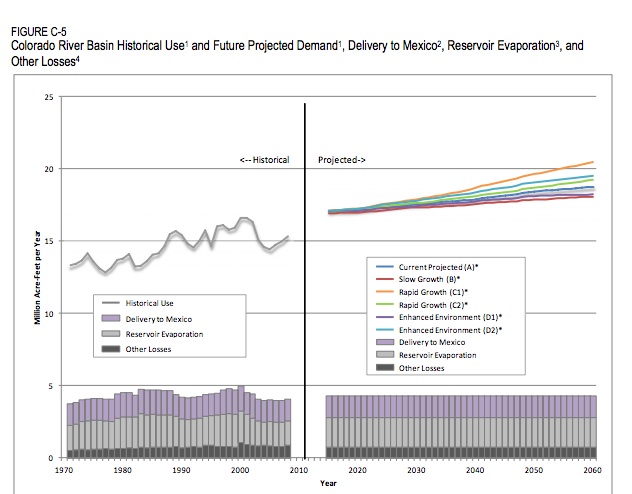
The US Bureau of Reclamation this afternoon released its latest pass at quantifying water demand in the Colorado River Basin. Recognizing that there’s no one answer for what the demand curves might look like in the future, the agency looked at a range of six scenarios, based on input from the seven basin states on what each state thought its long term needs might be. Some highlights:

  • basic US consumptive demand by 2060 will be between 13.8 and 16.2 million acre-feet
  • add in water for Mexico and evaporation and you’re up to 18.1 to 20.4 maf
  • a population of 40 million people by 2015 rising to 49 to 77 million by 2060
  • irrigated acreage, now at 5.5 million acres, drops to 4.6 to 5.2 million acres

With the river having a total of 15-ish million acre feet to work with going forward, this suggests that, absent iceberg towing or a giant pipe from the midwest, we will not be able to do all the things here in the West that our representatives told the Bureau of Reclamation we would like to do.


Another take on Colorado Basin failure mode concludes that Arizona and Nevada are the trouble spots

Wildman and Forde make my last post on this subject look smart, arguing that the supply-demand imbalance on the Colorado River will hit Arizona and Nevada first:

We find that initial shortages will be borne only by the cities of Arizona and Nevada and farms in Arizona whereas the other Basin states have no incentive to reduce consumptive use. Furthermore, the development of a long-term plan is deferred until greater water scarcity exists.

Wildman, Richard A., Jr. and Noelani A. Forde, 2012. Management of Water Shortage in the Colorado River Basin: Evaluating Current Policy and the Viability of Interstate Water Trading. Journal of the American Water Resources Association (JAWRA) 1-12. DOI: 10.1111/j.1752-1688.2012.00665.x

Another anthropogenic influence on sea level: groundwater pumping

The groundwater subsidy – what happens to it after we pump it up and use it – is frequently ignored in policy discussions. When we stop mining groundwater, I’ve often argued, we need to recognize that the share we discharge into our rivers, which becomes water supply to those downstream, goes away.

But via David Appell, here’s a role groundwater pumping plays that I’d never considered – sea level rise:

Groundwater depletion has more than doubled during the last decades, primarily due to increase in water demand, while the increase in water impoundments behind dams has been tapering off since the 1990s. As a result, the contribution of groundwater depletion to sea-level rise is likely to dominate over those of other terrestrial water sources in the coming decades.

That’s from Wada et al, Past and future contribution of global groundwater depletion to sea-level rise, GEOPHYSICAL RESEARCH LETTERS, VOL. 39, L09402, 6 PP., 2012 doi:10.1029/2012GL051230


Las Vegas, look out: A bad year in the Colorado Basin hints at the system’s failure mode

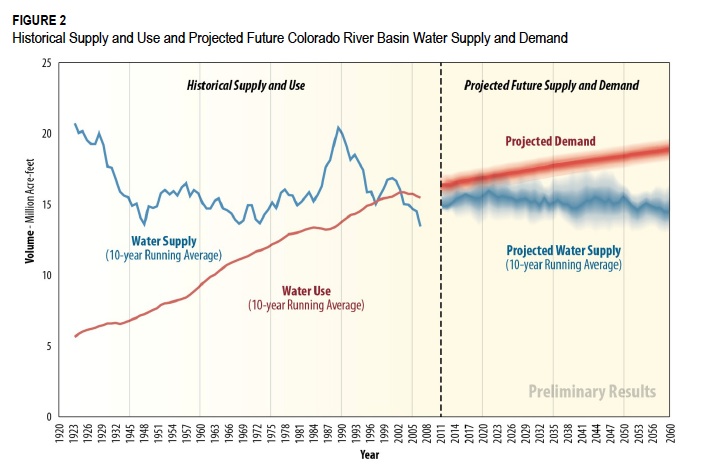
Colorado River supply and demand, historical and projected, courtesy USBR

Colorado River supply and demand, historical and projected, courtesy USBR

In the work I’m doing now on the Colorado River Basin for my book, I’m trying to get beyond simply extrapolating supply and demand curves and then running around with my hair on fire. The hair-on-fire thing is easy to do, because the current supply and demand curves, as the Bureau of Reclamation frankly noted last December, are heading in a direction that’s physically unreal.

The question is what happens in the gap between the projected orange line veering upward and the blue line veering down. I’m interested in the specifics of that failure mode – who will come up short as the gaps between supply and demand become real, and how might we expect them to respond? It’s not enough to simply say “Phoenix (or Las Vegas or Los Angeles or Denver or the Imperial Irrigation District or Albuquerque) is screwed.” Because those water users will do something in response to try to minimize their screwedness. Who are they, and what will they do in response?

Buried in the tiny print of the US Bureau of Reclamation’s latest 24-Month Study (pdf) is a hint about what seems to me to be the most likely answer to my “who” question: Las Vegas, look out. (warning, wonkiness ahead, click through for more)

Continue reading ‘Las Vegas, look out: A bad year in the Colorado Basin hints at the system’s failure mode’ »

Stuff I wrote elsewhere: Las Conchas, 10 months on

I went back two weeks ago to the Las Conchas fire zone, where an unprecedented blaze tore through New Mexico ponderosa forests that will never be the same – “Not in our lifetimes,” as one forester put it. My story:

During a daylong hike last week across an area that once was dominated by ponderosa pines, Allen and his colleagues saw a single clump of live trees. The fire burned so hot as it rolled out of the high country that it completely incinerated vast areas of lower-elevation piñon and juniper woodland.

“That whole landscape, which I’m intimately familiar with, is now foreign to me,” said archaeologist Gauthier.

To help nature along, the Santa Fe National Forest has identified 30,000 acres with either a high or moderate chance of successful reforestation, and carefully chosen ponderosa pine seedlings are being cultivated for planting next year. But that first wave of planting will cover only an estimated 1,500 of those acres.

“We’re going to plug away at this for the next 10 years to see where we get,” said National Forest ecologist Williams. “The limiting factor is going to be how much money we get to do the work.”

Riddle, who oversees the Santa Forest’s Jemez Ranger District, where the fire started, was frank about the prospects for reforestation of the burned landscape.

“Not in our lifetimes,” she said. “It won’t be a forest like it was.”
 

Will taxpayers bail out delta water exporters?

Jeffrey Michael runs the numbers and suggests the marginal cost of water from a new Peripheral Thingie (canal or tunnel beneath/around the Sacramento-San Joaquin Delta) will be prohibitive for agricultural users asked to foot a share of the bill:

According to the draft BDCP, the marginal cost of new water the contractors get out of the tunnel is going to be $1,000 af ($1.2 billion in debt service and new operation cost for an average of 1.2 maf of new water). Environmental deficiencies with the draft BDCP could mean even less new water, driving the marginal cost of new water supplies even higher for the contractors.

My question, posed in a comment on Jeff’s blog, is whether this project will collapse under this economic reality, or whether, as some California water veterans have suggested to me, the project will move ahead anyway in classic Western water tradition, subsidized by state and/or federal taxpayers. I’d love to hear the thoughts of the California water wonks in the audience.