The power of Snopes. Or not.

I’ve always thought Snopes, the debunking site run by Barbara and David Mikkelson, is a treasure. Fighting the good fight and all.

Kinda sad, then, but not surprising, to read this:

When reporters interview us about our work, they often ask us to comment on the notion that we’re engaged in a great public service, making the world a better place by “striking a blow for the truth” and stamping out rumor and misinformation by replacing them with facts. Those reporters usually seem to be taken aback or disappointed when I tell them that I don’t really believe our site makes much of a difference in the greater scheme of things; that the responses we get tend to indicate a good many people are determined to believe whatever they want to believe, and no collection of contradictory factual information, no matter how large or authoritative or impressive it might be, is ever going to dissuade them from their beliefs.

Tree rings tale of Atlanta’s mistake

Neal Neil Pederson and colleagues have a new paper (pdf) using tree rings to reconstruct flows in the Apalachicola–Chattahoochee–Flint that offer another stark reminder of a classic water management dilemma: make water management decisions during a wet time and you’ll be screwed by the regression to the mean.

We’ve seen this story before, with the Colorado River’s allocation, made during the unusually wet 1920s. The new tree ring work on the ACF basin shows a remarkably similar story, according to Pederson et al:

Our results indicate that the era in which local and state water supply decisions were developed and the period of instrumental data upon which it is based are amongst the wettest since at least 1665. Given continued growth and subsequent industrial, agricultural and metropolitan demand throughout the southeast, insights from paleohydroclimate records suggest that the threat of water-related con?ict in the region has potential to grow more intense in the decades to come.

As always, my book has lots more on tree rings.

(updated to correct spelling of Pederson’s name)

Another New West real estate metric: dog pee

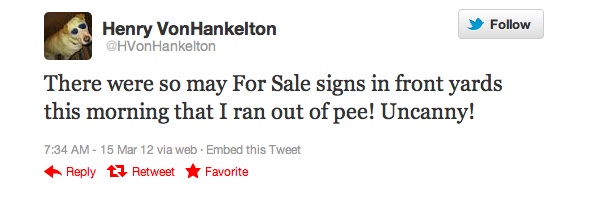
My interest in water lured me into an interest in real estate, because of the way the West’s housing boom ramped up the demand for water, and the way the bust has scrambled the equation. So I’m looking for new ways of measuring the housing market’s recovery. I’m still scratching my head about this one, from Henry VonHankelton, a dog I follow on twitter*:

can dog pee help us measure the housing recovery?

can dog pee help us measure the housing recovery?

Yes, on the Internet we now know you’re a dog.

Atmospheric rivers, in real time

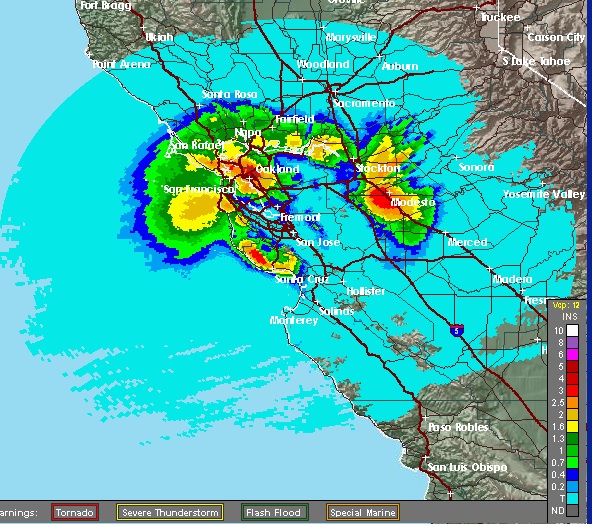
California radar storm estimate, evening 3/14/2012

California radar storm estimate, evening 3/14/2012

As I write this, California’s being pounded by a particularly impressive storm.

According to Mike Dettinger, it’s an “atmospheric river” storm, one of the type he and other climate/water researchers have been studying increasingly closely because of their importance to California’s water supply. As I wrote last year, California has the most highly variable precipitation in the country (as measured with the standard deviation divided by the mean), with annual water supply strongly influence by the presence or absence of a handful of these AR storms. From a paper last year by Dettinger et al:

If just a couple of storms do not arrive in California, or yield significantly less precipitation than needed, in a given year, that year’s precipitation total and water resources suffer disproportionately, compared to other regions. Alternatively a relatively few large or “extra” storms may result in a particularly wet year.

This year, we seem to be having a year that was extremely dry getting a last-minute reprieve by an AR blast.

More reason to hate the Canadians

Canada’s always, frankly, seemed to have a sort of politely understated superiority to the United States. Consider their health care system, for example, and sweaters.

Now comes news that they’re also measurably better than us when it comes to managing their water:

“One-half of Canadians (51%) limit their shower time to eight minutes or less, while fewer than one-in-three Americans (32%) do so.”

They’re more likely to fix leaks and water in the evening rather than during the day, when evaporation is higher.

Also, hockey.

The importance of Albuquerque’s water conservation efforts

I had a story in the morning paper on Albuquerque’s success in reducing per capita water consumption below 150 gallons per person per day, a 40 percent drop from 1994, when our odyssey from water profligacy began. Here’s the bit I slipped in that shows the regional importance:

Albuquerque’s reduced usage is a demonstration that, despite the dry climate and dwindling water supplies, it is possible for cities in the western United States to learn to live within their means, said Michael Cohen, a water policy analyst with the Pacific Institute, a California-based think tank.

“Continued reductions are still possible and achievable,” said Cohen. “At some point there’s a wall, but I think we’re a long way from that.”

By comparison, Santa Fe has reduced its usage to 106 gallons per person per day, according to water conservation officer Dan Ransom.

Stuff I wrote elsewhere: “Lake” Arthur

From the morning paper, the story of Lake Arthur, the pond in the middle of Estancia, a rural New Mexico town that won’t give up on its public water:

The natural flow in the spring feeding Lake Arthur stopped long ago, said 51-year-old Daniel Chavez, Estancia public works director and proud native son.

By the fire station, up a low hill from Lake Arthur, Chavez pointed to the big metal lid over the first well, drilled 170 feet down to pump water up to the spring once it stopped flowing on its own.

When that well failed, they drilled another back in 2004. Just to be safe, they ran it down 400 feet into the groundwater that is the lifeblood of the Estancia Basin. And where the spring once flowed on its own, they now pump 50 gallons a minute, up to a fountain, then down through a little artificial stream to lovely Lake Arthur.

Where the stream enters the lake, Chavez and his colleagues built a lovely little bridge, already a popular spot for weddings.

The tale of Lake Arthur is a story you hear a lot out in the Estancia Basin — where springs once flowed, now we pump. And in most places, the water table keeps dropping.

How Django Reinhardt survived the Nazis – the most interesting thing I read today

From Sociological Images, how Django Reinhardt survived the Nazi effort to exterminate the Roma by playing jazz:

Reinhardt, then, survived because the Nazis loved jazz music, even as Hitler censored the music and, on his orders, people who dared to listen to, dance to, or play it were encamped and members of the groups who invented it were murdered. Irony indeed.

Moorten’s

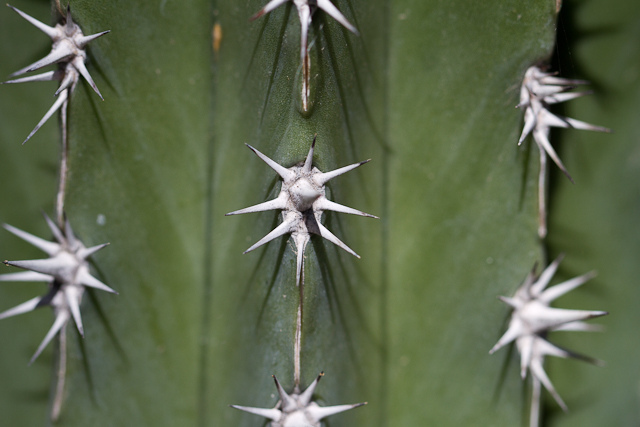
Thorns, Moorten's, March 2012

Thorns, Moorten's, March 2012, by Lissa Heineman

My favorite stop on our California desert vacation was the strange and wonderful little Moorten Botanical Garden “in the heart of Palm Springs”. Between the golf courses and the ill-advised decision to try to coax palm trees out of their desert oasis canyons (they take a lot of water – per capita use here is 540 gallons per person per day), Palm Springs has some problems. But Moorten’s left me willing to forgive a great deal.

It’s probably less than an acre spread out around the old Moorten family house, and since the 1930s Chester “Cactus Slim” Moorten, his wife, Patricia Moorten, and their heirs have offered up a delightful three quarters of an acre of cactus and desert plants, for a small fee that is very much worth it.

Lissa’s late sister Ginnie, who lived up the road in Morongo Valley, first took L to Moorten’s some years ago, but I’d never been. We love cactus, so when we were plotting out our journey around the Salton Sea and nearby points, Lissa added Moorten’s to the itinerary.

A maze-like path winds through the tiny property, hand-lettered signs tell you what you’re looking at, and if you’re there at the right time of year, a Costa’s hummingbird sits on the postcard rack, right above a postcard of a hummingbird. Really.

Full slide show of L’s Moorten’s pictures is here.