Living without water

One of the reasons I’m more optimistic than many about our ability in the western United States to cope with our looming water shortages is the evidence of our ability, when we’re really faced with shortage, to adapt to using far less. (That was the core argument behind my piece last year for Stanford’s Lane Center.) There was a nice piece by Michelle Barker in the Globe and Mail last week that illustrates what I’m talking about. Faced with a broken water system in her home, Barker quickly learned to do with a lot less:

People in Canada do not sing the praises of indoor plumbing anywhere near as loudly and fervently as they should. Living without it all of a sudden is a little like breaking your collarbone – you know in theory that the bone is important, but you don’t understand how much you rely on it for almost every physical movement until you can’t use it any more.

Try living without running water, even for just one day. Forget your morning shower. Forget flushing your toilet, brushing your teeth, making coffee, cleaning clothes or dishes. Washing your hands. Watering your plants. Rinsing your vegetables. To say nothing of drinking a glass of the stuff. You don’t realize how often you reach for that tap until it stops working.

Barker’s piece is a plea to think about such issues before the shortage hits:

We waste water. We pollute it. Climate change is already having an effect on how much water we will have access to in the future. And Canada is a water-rich country. Many other places in the world are already suffering what we cannot yet envision.

Everyone knows this. We’ve all heard it a thousand times. Yet still we water our lawns and wash our cars obsessively. You cannot appreciate the gift of running water until you experience what your life is like without it.

It would be nice if we gave up on our lawns and car washing before the balloon goes up. But I’m confident that when we’re faced with the alternatives, we’ll be willing to give them up when we have to.
The last concrete?

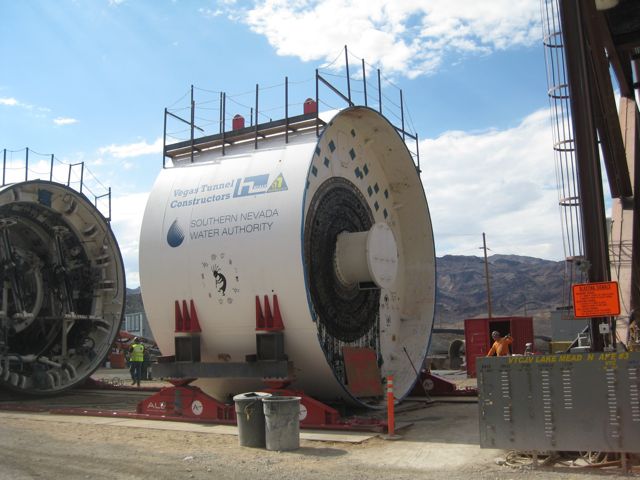
Is the age of big concrete – the dams to store western water and the canals and pipes to move it – really over? Are the projects now underway – perhaps the Southern Nevada Water Authority’s “third straw” into Lake Mead – the last we’ll ever see built?  (I’m working on a piece that in part will explore this issue. See my questions at the bottom.)

tunnel boring machine, Southern Nevada Water Authority third intake

tunnel boring machine, Southern Nevada Water Authority, photo by John Fleck

Three things I’ve read recently have me thinking about this, and I’m looking for some feedback from the smart water wonks in the audience.

The first is a most intriguing essay by Patrick Wilson (pdf here) about the way the existence of big concrete has shaped our western water institutions.

The second is Jay Lund’s analysis of the Bureau of Reclamation’s study of the economics of the $1.1 billion raising of Shasta Dam in California:

This expansion produces an additional 76,000 acre-ft of firm yield (dry year deliveries). This is less than 0.2% of agricultural and urban water use in California. (Modern water engineers will wonder why the antiquated firm yield is still the main water supply indicator.) Average annual deliveries increase by only 63,000 acre-ft. Other traditional benefits (hydropower, recreation, flood reduction) were small.

That’s some mighty expensive water.

The third is Jeffrey Michael’s observations on the latest round of Bay-Delta Conservation Plan analyses:

Given that the incremental water supply being discussed by the conveyance is 0.3 maf to 1.5 maf requested by the water contractors. That comes out to between $3600 and $730 per acre foot of new supply – not counting operations costs – just to get the new water to the Tracy pumps. Add a few hundred dollars more for operating costs and pumping to Los Angeles.

That’s some mighty expensive water.

Big concrete has always meant expensive water, most often subsidized by general taxpayers (mostly federal, but sometimes state as well), but it’s increasingly looking to me like the next marginal increments of water are getting so expensive that these things are going to collapse under the weight of their astronomical costs. I’d be a sucker to bet that the Peripheral Thingie will never be built (I made a bet like that once – never’s tough to collect on), but that’s what I think.

Here’s my quick list of other suggested/proposed/contemplated projects in the western United States subject to this argument:

Question 1 is what else should be on this list? And am I right that these projects are just too expensive to build? Which of the current round of big concrete proposals has the best chance of really being built?

Question 2: If we really are at the end of concrete, what should I call the last project? My vote goes for Vegas’ third straw. But Animas-La Plata has some standing here too. What else is underway now that should be on a list of the West’s last big water projects?


That lone Republican vote against HR1837

While I was away last week, the House passed HR1837, the California Water’s Fer Fightin’ Over Act of 2012 (pdf).

The vote was largely along party lines, with only one Republican voting against the bill. Who was that lone R dissenter? Justin Amash, a 31-year-old Michigan legislator ranked by the Club for Growth as the most conservative member of the US House. Why did he oppose HR1837? From his Facebook page (where this guy seems to explain every one of his votes):

The bill accomplishes many policy goals I support: It reduces the impact of a federal regulation that requires the diversion of California’s water to wildlife protection; it requires a federal fund to be more transparent in the way it spends water users’ money; and it allows water users to purchase longer-term contracts, which could enable California farmland to be more productive.

Unfortunately, the bill preempts (overturns) state water laws. Those laws were enacted by Californians to govern water that originates in California, that is for the use of Californians, and most of which flows through a water system California built and operates. The Constitution does not give the federal government the power to overturn those laws, regardless of whether I as a federal Representative think those laws have or don’t have merit. I voted “no.”


Snowbirds

snowbirds

snowbirds, photo by L. Heineman

During our just-completed trip across the deserts of southern Arizona and southeastern California, the persistence of the snowbirds was one of the most striking features. I’d noticed them when I was down in Yuma in April 2010, but that was late in the season. Late February-early March is earlier, and they were everywhere. Canadian license plates were the most common, but they were from the full range of northern cold places, south for warmer climates just like the migrating birds after which they’re named.

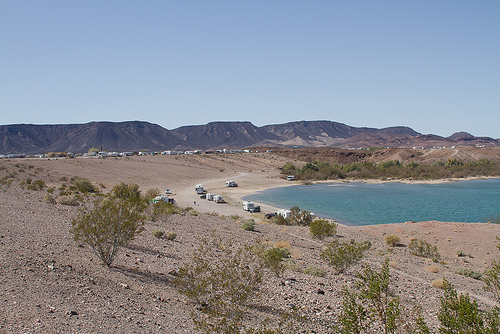
Lissa took this picture at one of the BLM “camping” areas along the Colorado River just upstream from Imperial Dam. It’s just a tiny snapshot, but it gives you a flavor of the way they spread out into the desert. This is an example of the formal government-sanctioned campground version, which seems to really just create large parking areas with vague scenic value. There were also huge commercial ventures, especially among the tribes on the lower river. And then there were the squatters, people who just seem to pull their big expensive RVs off into the desert wherever they want.

I found a reference to a study that put the number in Arizona a decade ago at 300,000.

Moon cake

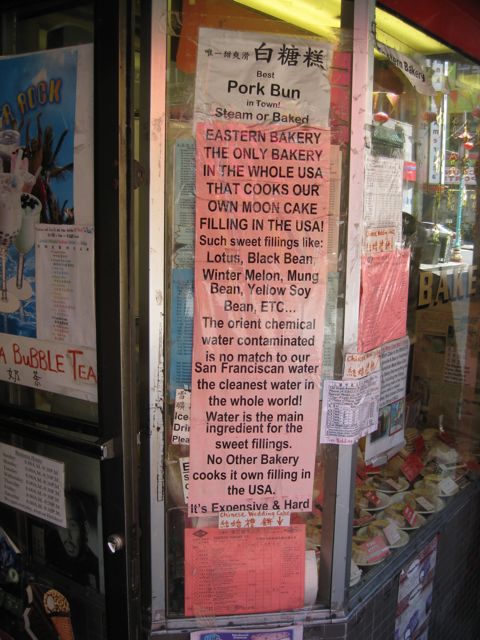
Two of Inkstain’s bedrock principles involve 1) correcting errors of fact quickly, and 2) re-running, as often as possible, the “best pork buns in town Hetch Hetchy” picture I took in San Francisco’s Chinatown last year.

This one’s a twofer.

In the aforementioned “Hetch Hetchy – Best Pork Bun in Town” post, I incorrectly argued that Eastern Bakery’s pork buns depended, per the store’s advertisement, on that sweet, sweet Hetch Hetchy water. As Matt correctly pointed out today in the comments on that post, it is in fact the bakery’s moon cake fillings that would be ever so inferior were it not for Hetch Hetchy’s bounty.

best pork buns, also moon cake filling

"Water is the main ingredient for the sweet fillings. No Other Bakery cooks it own filling in the USA. It’s Expensive & Hard"

I stand corrected.

Black phoebe on the Lower Colorado

Rockwood Gate

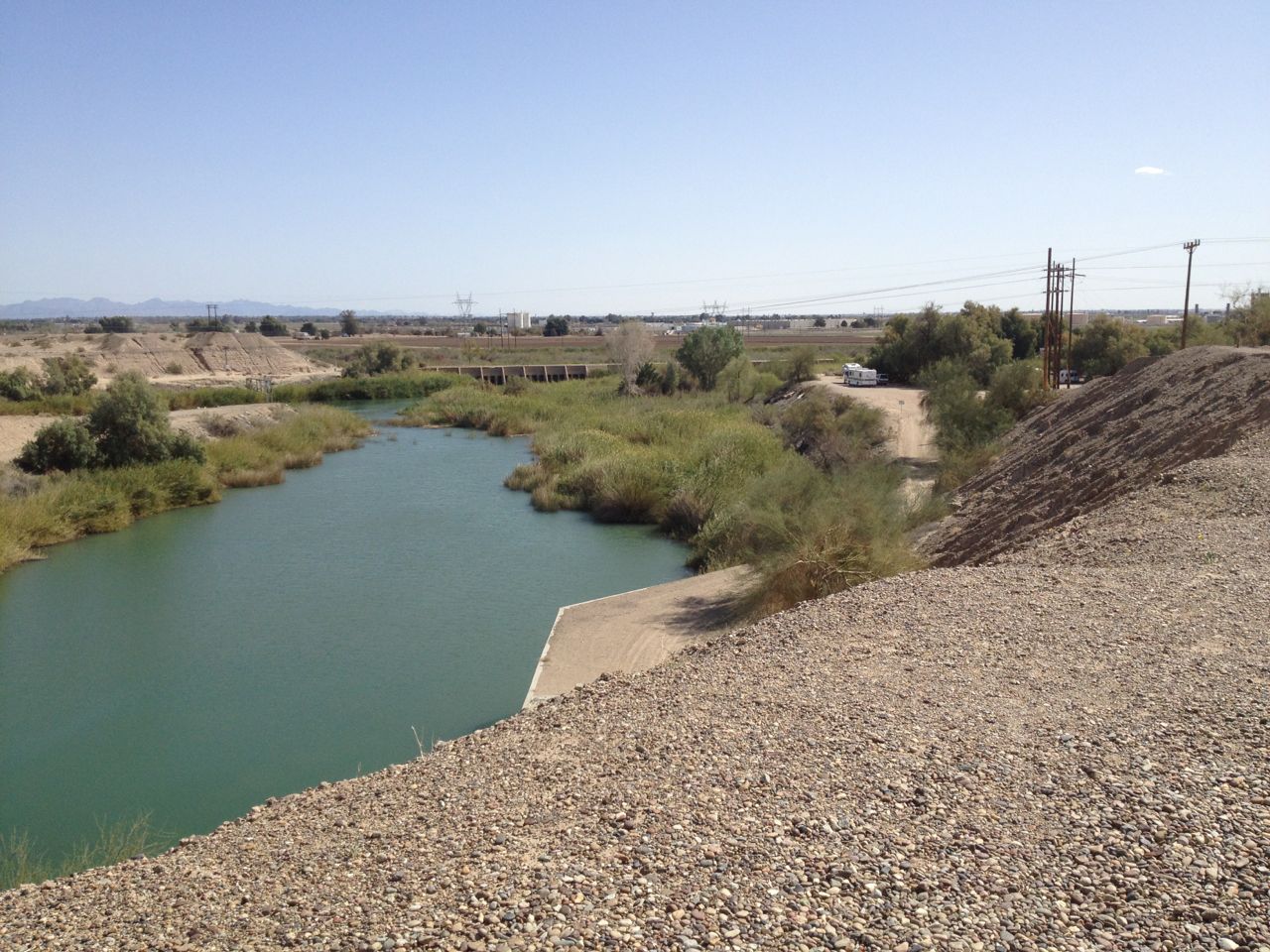
Rockwood Gate, Lower Colorado, February 2012

Samuel Rhoads set out from Yuma to collect specimens from the Lower Colorado for the Academy of Natural Sciences of Philadelphia on Feb. 4, 1905.

Witmer Stone, who later catalogued and wrote about Rhoads’ collection, said this:

The conditions that prevailed during the expedition were peculiarly unfavorable to collecting of any sort, the rain, cold and high water being almost unprecedented.

History tells us (as delightfully captured in Bill deBuys’ Salt Dreams) the impact of that rainy February, when the Colorado River sliced through irrigation intakes with a vengeance, flooding out of control and creating the Salton Sea.
Among the creatures collected for Philadelphia Academy, Rhoads found the Black phoebes particularly delightful:

“One of the most lively bits of bird life, which relieved the tedium of our boat journey, was the frequent sight of these birds sitting on the floating drift and hawking flies and other insects from the steaming surface of Colorado of a chilly morning.”

They’re still very much there, with a particular fondness for trees and shrubs that overhang the water. They sit still out over the water, their heads snapping back and forth until they spy a bug. Darting out, they have a flycatcher’s maneuverability, with a flared tail for steering. Grab bug, return to perch, repeat. One imagines there were more of them in Rhoads’ day, because there was a lot more water. But where we found water on our trip to the Lower Colorado desert trip, Lissa and I found Black phoebes, almost without exception.

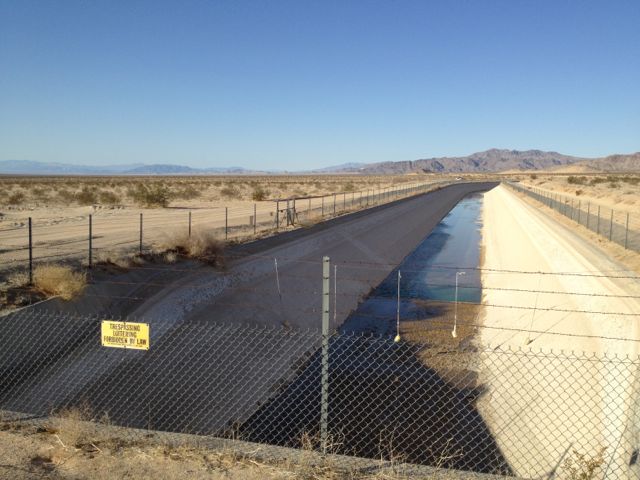
We found them here, for example, along the river at the old Rockwood Gate, one of the now-abandoned structures where grand irrigation schemes a century ago came to naught. The picture captures the modern scene, but not completely. Behind me as I took it, the All-American Canal replaces Rockwood’s failed ventures, carrying most of what remains of the Colorado River on a beeline west and then north to the Imperial Valley. In the foreground, the snowbirds. And across the river in the distance, toward Yuma, the Yuma Desalting Plant.

Desert D’Or

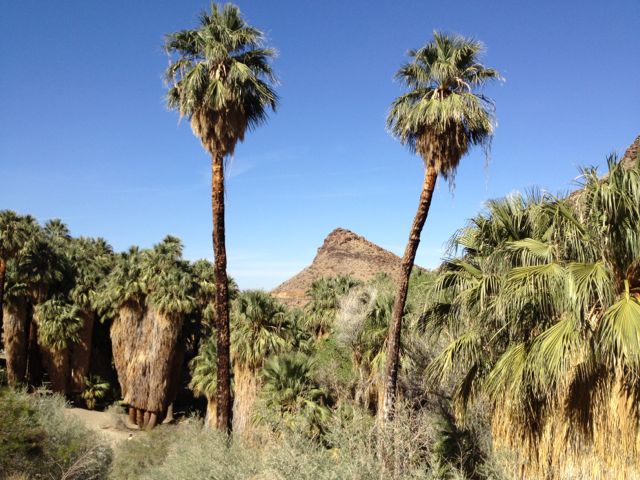
Palm Springs really does have palms, and springs. Tucked in canyons on the east flank of Mt. San Jacinto, they’re lovely oases in the truest sense. Lissa and I sat for a while this afternoon next to a trickle of a stream, watching squads of western bluebirds work over the tiny dates hanging from the palms. Looked like feast day.

The real palm springs

The real palm springs

We’d largely discarded this place, without meaning to, but realized we can’t. That much was clear as we drove yesterday up through the Pinto Basin in what is now Joshua Tree National Park. By “place” here I mean something big and a bit complicated, but we’ll start by defining it as the deserts of southeastern California. Lissa and I did some of our falling in love here – living in LA and wandering these deserts when we were young and poor and carefree. But that’s only a piece of it, and not the beginning, and certainly not the end. Mom and Dad brought me here from the beginning, camping in one of those big canvas tents. In Boy Scouts – ah, glorious Boy Scouts, where I learned all those unintended lessons – we hiked the desert canyons. When we were old enough to con adults out of car keys (how did we do this?), my friends and I would do the same on our own, freedom defined.

Lissa’s sister Ginnie lived here and died here, a refugee of the city settled into the strange culture that is desert living on society’s fringe. Returning to cope with her death 10 years ago was our last visit, and arguably the most important.

I never lived here, but I learned a lot by visiting.

So we ended up here this late winter, Lissa and I, not realizing we were going on a pilgrimage. We wanted to see the Salton Sea, which never quite figured in either of our family stories (save for an odd childhood fishing trip with my grandfather in his neighbor Ralph Kamansky’s boat). Lissa wanted to show me the Moorten Botanical Garden, where Ginnie had taken her to see cactus. And we figured we might as well go see Joshua Tree while we were here.

Norman Mailer’s “Deer Park” is set in the fictional Desert D’Or, a thinly veiled Palm Springs, all Hollywood decadence plopped down in the desert. This is where the palms spread out from the mountains, fed not by natural springs but, for all practical purposes, by imported Colorado River water. If thrift stores are a useful measure of things, the one we stopped in this afternoon had a busted down old golf cart on display in the front window. I don’t know golf carts, so I don’t know if $1,899.99 is a deal or not. My guess is not.

So here Lissa and I are, part anthropologists picking our way through the modern Desert D’Or trying to fathom that which lies at the intersection of Bob Hope and Dinah Shore drives, part hydrologists (my obsession, trying to understand how the plumbing works), and part desert rats, looking for our past.

Save the pelicans, the Salton Sea was a bit of a disappointment – not quite the ruin porn that makes it such a popular Flickr destination, not quite the monument to water folly I imagined, mostly just a big empty at the end of a very large lettuce patch. Desert D’Or is just weird in a way that is fully entertaining as long as we don’t stay to long.

Joshua Tree is still sublime.

Stuff I wrote elsewhere: on the implications of a low snowpack on the Colorado

Over at the Lane Center, my latest on the progression of our Colorado River showpack:

In December, I paid a visit to Boulder Harbor on the west shore of Lake Mead to see the results for myself. Boulder Harbor is one of those places where the dropping reservoir is made tangible. Two years ago, its boat ramp was closed, its shrinking harbor abandoned to an epic flock of American coots feasting on the critters left in the muck and an osprey that entertained me with a spectacular dive to pick off a stranded fish. Now, thanks to last year’s big snowpack, the water’s back, and boaters have displaced my osprey and coots.

But things appear to be headed back in the other direction.