Stuff I wrote elsewhere: on the implications of a low snowpack on the Colorado

Over at the Lane Center, my latest on the progression of our Colorado River showpack:

In December, I paid a visit to Boulder Harbor on the west shore of Lake Mead to see the results for myself. Boulder Harbor is one of those places where the dropping reservoir is made tangible. Two years ago, its boat ramp was closed, its shrinking harbor abandoned to an epic flock of American coots feasting on the critters left in the muck and an osprey that entertained me with a spectacular dive to pick off a stranded fish. Now, thanks to last year’s big snowpack, the water’s back, and boaters have displaced my osprey and coots.

But things appear to be headed back in the other direction.

What’s Devin Nunes up to?

There are three interlocking fundamental federal water policy/politics principles that are important to understanding current discussions over California congressman Devin Nunes’ legislation aimed at reshaping the distribution of water flowing through his state’s Central Valley.

First, federal subsidy has long been necessary for the big water projects that make the West as we know it work. Second, the money available for federal subsidy is limited, and there are always other competing demands, especially from other places. That leads to the third principle, which is the longstanding tradition of states settling their differences internally, then approaching Congress united.

Now comes Rep. Devin Nunes, with legislation that passed yesterday out of the House Natural Resources Committee that seems intent on ignoring these principles. McClatchy’s Michael Doyle does a nice job on the bill’s specifics, and I’ll entrust you to his care for those details. I’d like to point you in particular to this bit in Doyle’s story:

Senate rules and traditions give Democratic Sen. Dianne Feinstein, the Senate’s author of the original San Joaquin River restoration plan, considerable clout in blocking home-state bills. In a joint letter delivered Thursday, Feinstein and Democratic Sen. Barbara Boxer reiterated their “strong opposition” to the House bill, which they called “troubling.”

“Unless we’re willing to work with (Feinstein), the measure will never become law,” stressed Rep. Jim Costa, D-Fresno, who voted for the bill even as he complained about a “disappointing” lack of bipartisan collaboration.

Adding to the political impediments, the Brown administration’s top resources officer warned that the overall House bill “wreaks havoc” with ongoing efforts to balance water use.

In other words, this bill is dead. It’s not real. It’s theater. Nunes seems to be intentionally blowing up the necessary preconditions for California to work with the federal government on arranging the necessary water subsidies for his constituents who, frankly, really need subsidized water.

What’s the point of the theater? Devin Nunes is not a stupid guy, so he obviously knows his bill goes nowhere. What’s his end game?

Over at On the Public Record, I suggest one hypothesis – that Nunes is trying to move the “Overton window”, laying out an extreme position that, while untenable, moves the framework of what counts as acceptable over in his direction. OtPR entertains another possibility, taking the legislation on its face as an effort to rewrite California’s internal water distribution hierarchy.

Dunno what’s right here. Other ideas?

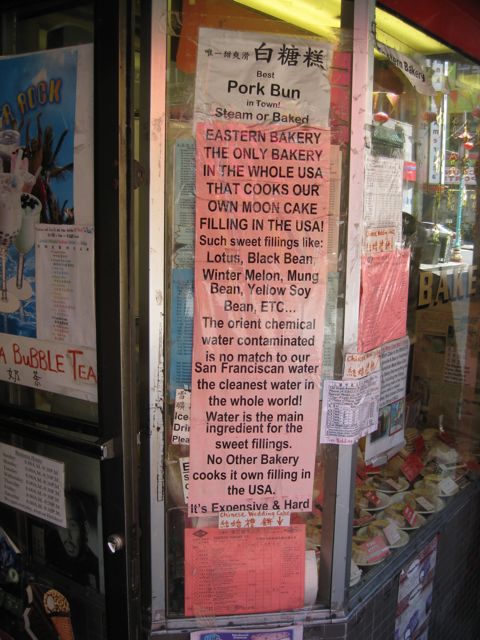
“our San Franciscan water the cleanest water in the whole world!”

Best Pork Bun in Town!

Best Pork Bun in Town!

Just when you thought the clown car that is California water politics was empty, out pops a San Francisco ballot initiative to drain Hetch Hetchy:

The measure, which would be submitted to the San Francisco city attorney next week, would require the city to embark on a process to put itself “on a path toward reforming San Francisco’s 19th century water system … and reversing the damage done to the environment over the last 100 years,” said Mike Marshall, executive director of Restore Hetch Hetchy.

The bar for placing a measure on the San Francisco ballot is ridiculously low, 9,500 valid signatures. Marshall figures the campaign would cost $500,000, tops. They already have a bona fide celebrity, who narrates a campaign-style video that opens with a majestic shot of Yosemite.

“How would you feel if someone suggested building a dam in Yosemite Valley, flooding a priceless treasure under a giant lake? Well, that’s exactly what happened to the Hetch Hetchy Valley. …

“This is Harrison Ford inviting you to join in the historic campaign to restore the Hetch Hetchy Valley. Help us return this national treasure to the American people.”

Stuff I wrote elsewhere: not-Twain bait and switch

From the morning newspaper:

One of the problems I have with the persistence of the not-Twain quote is a long history in the West of not fighting over water. Faced with potential conflicts among states over the rivers they share, for example, we developed a series of “compacts” — essentially treaties governing how to distribute scarce water. To say that water is primarily for fighting over is wrong. In many of the largest conflicts, disagreement over scarcity has led to sometimes tense, often suspicious but ultimately successful cooperation. There’s been fighting along the way, but ultimately the compacts and the state water rights doctrines built around them have created cooperative frameworks for resolving our conflicts over water.

Art as a verb

I am not a visual person. I’m a word guy. But I’ve lived essentially my entire life with visual artists. My dad’s a painter. My wife, Lissa, has worked in an enormous range of media in the nearly three decades I’ve known her.

This has given me a life spent watching art happen. Art as process, rather than object. Art as a verb, if that makes any sense.

Lissa has always been interested in textures. It was an absolute delight to go out wandering with her Saturday afternoon while she experimented with her new macro lens, seeing things up close. Here’s her favorite from the outing:

Cactus

Cactus, February 2012, L. Heineman

Check out the full slideshow to get a feel for what my “art as a verb” afternoon was like.

Stuff I wrote elsewhere: nuke budget setup

As a journalist, I learned early to pay attention to the budget. It’s where we take all our policy ideas, goals and plans and make them real. Which makes tomorrow my journalistically favorite day of the year – the day the President’s annual budget proposal starts the process of deciding how our nation’s government will spend its money.

Here’s a setup in the Sunday newspaper on the largest single-ticket item for New Mexico:

Budget reality could come crashing down Monday on Los Alamos National Laboratory and the most expensive construction project in New Mexico history.

Faced with risings costs for two proposed multibillion-dollar nuclear weapons-related projects, one in Tennessee and the second at Los Alamos, the National Nuclear Security Administration may be forced to choose. President Obama’s administration, set to release its proposed fiscal year 2013 budget Monday, is widely expected to send the money to Tennessee.