Abandoning the whiskey quote

Mark Lubbell at UC Davis makes the case for abandoning the Mark Twain “whiskey’s for drinkin’, water’s for fightin’ over” quote, and not just because Twain didn’t say it:

Unfortunately, perpetuating water wars and the language of conflict will never solve California’s water problems. Water wars are equivalent to the “tragedy” aspect of managing common-pool resources. What is instead needed is for all the various water stakeholders to find some type of agreement or cooperation to sustainably manage water over time (more to come at later time).

It echoes a point I made in my Lane Center piece about the search for cooperation on the Colorado:

The quote lives on in descriptions of water politics in the arid Southwest, invariably with Twain’s name attached, because of the power of the idea behind it: that the allocation of scarce water is an enduring source of conflict.

But the history of Colorado River management is a more complex story. It is easy to focus on the fighting, and the battles make for some great yarns. But there also is a remarkable history of not fighting – of negotiated agreements – that suggests there is more than one path for dealing with the West’s water problems. Westerners have done their share of fighting, but they also have a remarkable record of cooperation. “History has shown that collaboration is a necessary ingredient for action in the Colorado River basin,” Jennifer Gimbel of the Colorado River Water Conservation Board told members of Congress in a 2010 hearing .
As Southern California eyes the Delta, a question of cost

John Bass has been pushing an excellent question about the direction of the Bay Delta Conservation Plan:

Why isn’t the “fortress Delta” solution the most cost effective way of pursuing the co-equal goals question.

John’s come to this line of thinking based on a cost-benefit argument: Couldn’t armoring the Sacramento-San Joaquin Delta levees achieve the goals of reliability of water supply and environment protection at a fraction of the cost of building a peripheral canal/tunnel thingie?

Timm Herdt had a piece in the Ventura County Star yesterday that comes at this from a different direction: will the folks down south be willing to foot the bill for a multi-billion dollar conveyance to carry water around the delta?

Before the process advances, some are arguing that it’s time for a cost-based reality check.

“They’re devising a project without first determining what the customers can afford to pay,” said Dennis Cushman, assistant general manager of the San Diego County Water Authority.

“The real Achilles heel is the financing,” said Sen. Lois Wolk, D-Davis, of the planning for a new conveyance system that would be part of a comprehensive delta fix.

2012: back to draining the Colorado River’s reservoirs?

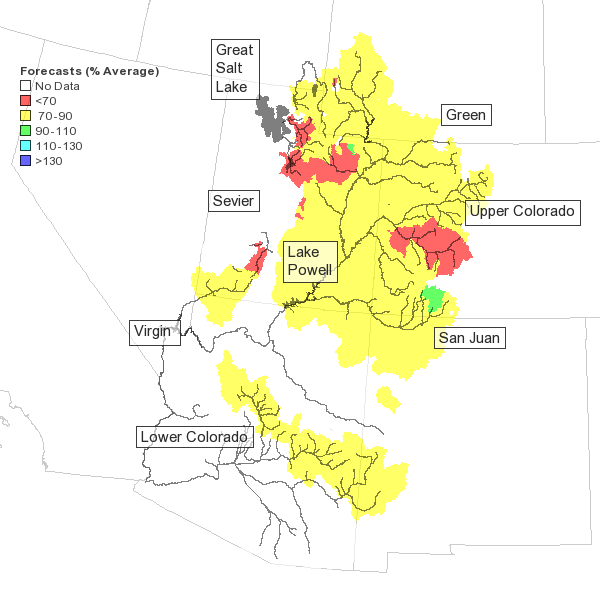
January 2012 Colorado Basin Forecast

January 2012 Colorado Basin Forecast, courtesy CBRFC

Well that was fun while it lasted, eh? Looks like it’s back to draining reservoirs on the Colorado!

2011, a big sloppy wet kiss of a water year, pumped up total storage in the reservoirs behind Glen Canyon and Hoover dams by some 5 million acre feet. But the first forecast of the year suggests a turn back in the opposite direction.

The largest single water user on the Colorado River, the Imperial Irrigation District in southeast California, diverted 2.9 million acre feet from the river at Imperial Dam in 2011. Arizona’s entire consumptive use was 2.7 million acre feet.* Scale matters here, and I use those numbers to give some sense of the meaning of a 2.6 million acre drop in forecast Colorado River flows in 2012.

That 2.6 million acre foot drop is the headline number that came out of this week’s release of the first forecasts from the Colorado Basin River Forecast Center. The forecast calls for flows into Lake Powell, which captures the bulk of the Colorado’s supply, of 71 percent of the mean during the key April-July time period, which is when most of the snowmelt arrives. We’re talking here about paper water, estimates codified in the monthly planning documents prepared by the US Bureau of Reclamation for the management of the water under its stewardship. But on paper, when the next Bureau monthly report comes out next week, the anticipated balance sheet for the year will be down 2.6 maf from what the December report showed. The 2.6 maf represents the difference between a projection made back in October, when we had essentially zero information to go on, and the first preliminary forecast based on actual snow falling (or not falling) on actual mountains.

We’ll have some clearer numbers next week when the Bureau takes the new CBRFC numbers and plugs them into its water management model, but during a conference call Friday to discuss the forecast, one of the Bureau officials on the line uttered the 2.6 maf number, which is the difference in Lake Powell inflows this year under the new forecast as compared to the October projections.

* Source: USBR provisional water use report, 2011 (pdf)

Stuff I wrote elsewhere: What seven states can agree to do

When I was writing this, the working title was “optimism”.

Central Arizona Project, photo by John Fleck

It’s a piece for Stanford’s Lane Center, based on work I’ve been doing on Colorado River Water management. It was spawned by a conversation last summer with Jon Christensen, the Lane Center’s executive director. I was talking about my optimism about our problem-solving ability, and he asked me if I’d ever written a piece about it. I had to acknowledge that I hadn’t. I’ve done bits and pieces of this argument, especially on the blog. But my optimism is so out of step with so much of the literature on the Colorado Basin that I’ve been timid in advancing the argument.

It’s easy to write gloom about the situation in the Colorado River Basin. The supply and demand curves have crossed, and not in a good way. Population and therefore water demand continues to grow. Climate change seems to already be eating into water supply, but if the eating into hasn’t started yet, it appears likely that it will. Communities dependent on the river, most of them anyway, seem oblivious to the problem.

It is easy to extend out the supply and demand curves and conclude we’re doomed as a result. But I’m increasingly prepared to argue that, when the balloon goes up, we have demonstrated an ability to comprise and constrain our water use. Consider 2003, when California’s Colorado River allotment was rolled back:

The ax fell Jan. 1, 2003, with an edict from the Secretary of the Interior: California would get 4.4 million acre feet that year, and no more.

The Metropolitan Water District, Southern California’s primary water wholesaler, had been running its Colorado River Aqueduct full bore since it was built, moving 1.2 million acre feet of water per year. That number was cut to 500,000 acre feet, literally overnight.

Remarkably, the deal stuck.

At the Colorado River Water Users Association meeting last month in Las Vegas, I ran into one of the people who was in the room for the negotiations. This person still smiled in amazement recalling the events of nine years ago, because no one thought that politically powerful California would see its allocation cut.

California’s experience – in shifting to more locally developed supplies, in conservation, in better managing its storage – shows how much slack there is in our profligate water usage, and how much room there is in our approach to water management to use less and still have the sorts of communities and productive economies we seem to want. It would be perhaps better if it could be done proactively. I’m not optimistic about that. Change takes crisis. But I’m optimistic that, when crisis comes, we’ll be successful in adapting to our changing situation rather than abandoning this region that we love.

Special thanks to Jon and John McChesney at the Lane Center for their support of this effort.

This is what happens when you have more water than you need

It would be easy to look at this Arizona Republic story as another example of the profligate water wastefulness that will ultimately doom Phoenix:

Valley homeowners’ excess citrus fruit, often picked by volunteer gleaners, can’t be shipped across state lines this year after a fungal disease known as sweet orange scab was found in some citrus orchards in Arizona and other states.

You mean they have so much extra water that they can grow citrus and just throw it away?

I have a more optimistic view. When faced with abandoning a lifestyle of lawns and wasted citrus or abandoning Phoenix, I’m thinking the lawns and citrus trees will go. This is evidence that they have a long way to go in the direction of water efficiency before folks have to pack up and move to Cleveland.

Stuff I wrote elsewhere: rainwater harvesting, the bounding scenario

In water policy terms, this is one of the most important stories I’ve done in a while:

The steady dripping into Carl Axness’ cistern is the sound of next spring’s water supply.

The snow melting from his Rio Rancho roof is the bounty of December’s storms. For the better part of four years, that roof runoff has provided the entire source of supply for Axness and his family.

It’s not that I expect everyone to follow Carl’s path. His situation is unique in a couple of ways. The first is the way his Rio Rancho lot was bypassed by water infrastructure. The second is Carl himself – an energetic tinkerer, willing to fiddle to make his off-the-water-grid life possible. It’s obviously not for everyone. But I think of him as a sort of bounding scenario for what is possible when we’re faced with apocalyptic visions of life in the Southwest with dwindling water supply and growing population. Carl’s a living demonstration that it is possible to live with far less developed water than we use today. Given a choice between apocalyptic abandonment of Phoenix or Las Vegas or Albuquerque as water supplies run low or the widespread adoption of some part of the suite of things Carl’s doing (especially for outdoor watering, which is far less finicky), it seems clear to me what we’ll see.

Stuff I wrote elsewhere: football

Really. I wrote a newspaper piece about football (the pointyball kind). The backstory is the recent departure of a chap named Mike Locksley, who had a less than successful record coaching the University of New Mexico’s football team. I took to the front page of the morning paper to be what is almost certainly his only defender:

Here’s the problem. If I or anyone else were to suggest ending our beloved cultural ritual of fall football, we’d be laughed off the front page of the newspaper. (I know, there’s a good chance a lot of you will have that reaction to this column.) As Clotfelter has written, “Tailgating rituals, painted faces, and screaming fans are part of American higher education as surely as physics labs and seminars on Milton.”

Therein lies the genius of Mike Locksley’s tenure. We need to have football, so I have someplace to eat Miguel’s brats. We just need to help our students’ academic performance by mostly losing.


The year of the budgie

I’d have to call Emma Marris’ The Rambunctious Garden the most influential book I read in 2011, in large part because it fell on fertile ground.

Budgerigar, December 2011

Budgerigar, December 2011

I’ve been puzzling for a long time over the question of what counts as “nature”, both in our political discourse and in my own heart of hearts. Why is it, I’ve long puzzled, that the Arctic National Wildlife Refuge represents land worth laying down on the tracks to protect, but not the patch of what used to be desert scrub that is now my very much altered backyard?

I’ve mulled this issue for a long time, but it’s mostly been an inchoate puzzlement. Maris, in her treatment of the history of our cultural ideas about wilderness and preservation and current ecological science, put some meat on the bones of the ideas. As did our neighborhood budgerigar, a feral parakeet that’s been hanging around of late.

I spotted one in the neighborhood a couple of years back, and this year I’ve got four sightings on my yard list – in July, November and twice this month. The budgie’s clearly “unnatural”, an escaped or abandoned pet. But what, exactly, does that mean? My 2011 yard list includes pigeons, house sparrows, starlings and Eurasian collared doves – none of them native to North America, all feral immigrants that hitched a ride in some fashion with humans to get here. The difference is that, on arrival, the latter birds did better.

My backyard is similarly unnatural, with five different types of feeders and a pond for the birds. It’s a xeric garden, with plants adapted to the arid climate, but we do add more water than nature would otherwise provide. We’ve got a pear tree.

The budgie seems to be well across the line separating natural from unnatural, but as you pull back toward the center it’s not clear where the boundary lies.

What Maris makes clear is that the boundary is a human construct, that there is no untrammeled wilderness but rather a world of ecosystems bearing a world of human footprints.

Which is a long-winded way of introducing my 2011 Yard List – 40 species of birds this year, plus one mysterious swallow. Three were new to my yard life list:

  • red-winged blackbird
  • house wren
  • dusky flycatcher

That brings my yard life list to 59.

This year’s ecological puzzle is the mourning dove, which was ever present in 2008 (that’s when I started listing), ’09 and ’10, but is now only an occasional visitor. A second ecological puzzle is the pigeon. A flock lives at the supermarket and Indian restaurant two blocks away, but until this year they almost never came to my yard. They’re regulars now. I don’t mind. I’ve always been a bit of a pigeon fan. Sadly our state bird, the roadrunner, was a rarity this year. Click through for my year’s yard list. The numbers represent the percent of observations for which the named bird was present.

Continue reading ‘The year of the budgie’ »

Finishing out a dry 2011

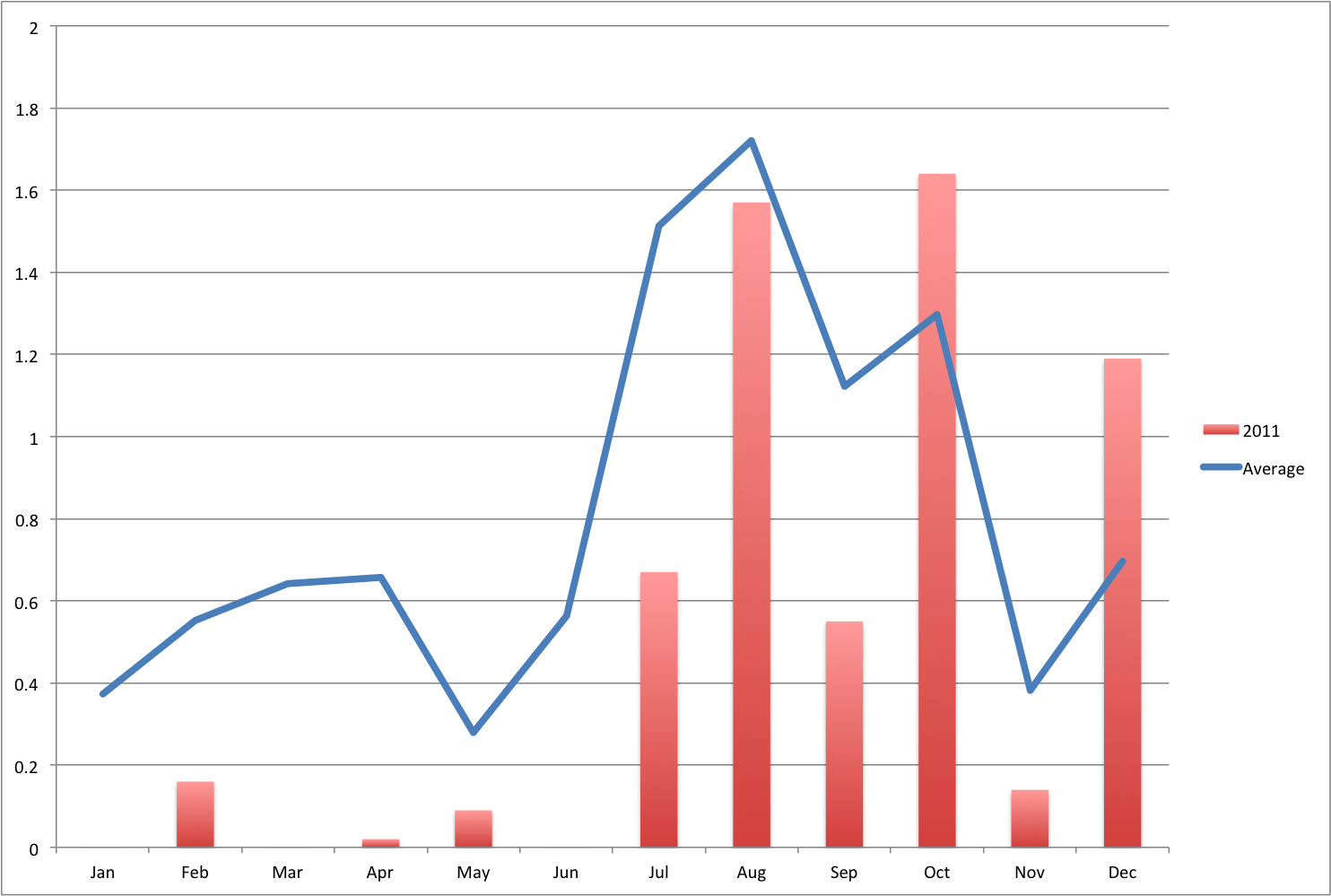
The final Heineman-Fleck backyard precip tally for 2011 is 6.03 inches (15.3 cm). That’s 61.5 percent of the long term average, where by “long term” I mean back to 2000. It is the driest year in my record, just a smidge under 2002’s 6.21 inches (15.8 cm). Only two months, October and the just-completed (I take my measurements at 7 a.m.) December:

2011 Heineman-Fleck precip

2011 Heineman-Fleck precip

Housing and water: a year later, are we closer to an answer?

A year ago, I puzzled over the implications of the collapse of the southwest housing business for our long term water future.

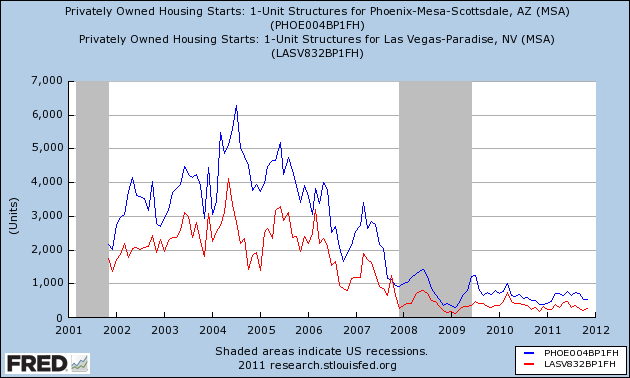
We’ve got another year of data, and no real sign that the southwestern growth engine in Phoenix and Las Vegas, the two cities closest to the edge of the water cliff, are coming back:

Phoenix, Las Vegas Housing Starts

Phoenix, Las Vegas Housing Starts, courtesy St. Louis Fed

What’s funny here is that it wasn’t the reasoned arguments of smart growth advocates, implemented through a wise political and policy process, that achieved this end, but rather the internal contradictions of the overheated housing business itself. Whatever. To what extent does this simplify the water policy dialogue in the southwest? Sure seems like it makes Pat Mulroy’s job easier, though I doubt she’s happy about the circumstances.