Faster Internet:
(I don’t really hate Colorado. I’m just enjoying playing with Data Explorer.)
Another reason for New Mexicans to resent Colorado
It’s not enough that Mesa Verde is on their side of the border. (We all know it really belongs, for all practical purposes, in New Mexico.) Now I discover, playing with Google Data Explorer, that Colorado just passed New Mexico in natural gas production. Man! I thought that was the one thing we were good at.
The forecast language dilemma
River forecaster Tom Pagano, late of Portland, Ore., and Australia, is on the road working on a book about river forecasting, so naturally he’s ended up in Thailand. In a post today, he talks about a language dilemma forecasters face:
A phrase like the “worst case scenario” is a double-edged sword. This is the kind of information that decision-makers crave and request from forecasters. But what is the chance of this worst case scenario happening? 1 in 3? 1 in 10? 1 in 100? History is filled with examples of where the actual outcome was above the worst case scenario and decisionmakers ended being very resentful of this. Of course, forecasters could instead conjure up a wildly high scenario (e.g. take the above map and multiply it by 3), but this leads to wasteful overplanning and its own form of resentment.
(Tom was one of the water-climate scientist characters in my book, The Tree Rings’ Tale
The rent on Hetch Hetchy is not high enough

John Muir and Theodore Roosevelt
Just when you think the great comedy act that is California water politics has exhausted itself, another white-faced, red-bulb-nosed, big footed character climbs out of the Golden State’s Great Clown Car.
Comes now the Honorable Devin Nunes, he of the muscular, fiercely independent southern San Joaquin Valley, suggesting that the Department of Interior up the rent it charges San Francisco for the effete liberal city’s use of Hetch Hetchy Valley from the current $30,000 per year to $34,000,000 per year.
In a Nov. 4 letter helpfully posted by Michael Cannon, Nunes wrote to the congressional deficit-cutting “super committee” suggesting legislative language and the argument for making the change:
The Raker Act, enacted nearly 100 years ago, mandated that the City of San Francisco pay the Department of the Interior a meager annual charge of $30,000 for the easement to use Hetch Hetchy Valley in Yosemite National Park as a water reservoir. Even with the negative effects to the environment, this annual charge, set in the early 1910s, has never increased. Furthermore, since the construction of the Hetch Hetchy Water and Power System a century ago, the environmental damage to our nation’s flagship National Park has never been mitigated.
Is it wrong of me to see this as a first step toward restoring Hetch Hetchy to its great glory, and to think of Devin Nunes as a great environmental champion? Is Nunes showing his true colors, his inner John Muir?
Dam Hetch Hetchy! As well dam for water-tanks the people’s cathedrals and churches, for no holier temple has ever been consecrated by the heart of man.
Teddy Roosevelt was a Republican, too.
I’ll see your “peripheral thingie” and raise you a “punnel”
I’ve been using “peripheral thingie” to talk about a California Delta water conveyance but Jeff Mount has done me one better: “punnel” (a peripheral tunnel).
Save water, rates go up, episode III
In which Carmichael, CA, residents find that upon using less water, their rates go up:
If you’re worried about water bills and you use less water, you should get a lower bill, right?
But that’s not happening in the Carmichael Water District.
The district has announced it wants to raise water rates 18 percent starting Jan. 1 – on top of an even bigger rate hike already imposed through mid-2014.
The reason: Water use in the district has fallen below historical average by an astonishing 25 percent, thanks to a mild and wet weather year, foreclosed homes and ratepayers using less water because of rising water bills.
With the cut in use, the water district’s revenue has dropped sharply.
The Endangered Species Act as a water management tool – case for the defense
Here and elsewhere, I’ve been arguing lately that the Endangered Species Act has become the de-facto water management tool of choice (necessity?) in the western United States, but that it has shortcomings as both an environmental policy instrument and a water policy instrument. My thinking on this has been formed in large part by the two case studies I’m following right now, the Rio Grande silvery minnow and the Sacramento-San Joaquin Delta and its much-loved, much-maligned Delta smelt. In both cases, the ESA has become the focus of political and policy discussions, with results that I argue don’t make for very good water policy or environmental policy.

silvery minnow and humans, courtesy USFWS
I’m on the hunt for counter-examples, and ran across a good one in Cynthia Barnett’s Blue Revolution
Judge Lucius D. Bunton III told the Texas legislature it must come up with a way to regulate pumping in the Edwards. While he was ruling on the endangered-species case, Bunton set out a much larger vision for a water ethic.
And then she quotes the pertinent passage from Bunton’s decision:
Without a fundamental change in the value the region places on freshwater, a major effort to conserve and reuse Aquifer water, and implemented plans to import supplemental supplies of water, the region’s quality of life and economic future are imperiled.
Pretty bold stuff, frankly. Barnett notes that the ruling led to the creation of the Edwards Aquifer Authority to manage the groundwater system. So this looks like a case in which an ESA battle led to a sane water policy outcome.
More reading:
- Endangered species, endangered ecosystems, from Inkstain last year
- What’s all this fuss about a fish, from the work blog (might be adwalled, sorry), about the issues lurking behind the silvery minnow process now underway on the Rio Grande
- A look at the California Bay Delta Conservation Plan process, with some great qualifying comments – also Inkstain
- Over at Delta National Park, some back-and-forth between John and commenters on the issue
- Raiders of the Lost Aquifer (pdf) a history of the Edwards issues by one of the participants in Sierra Club v. Babbit
A bit of history – when US Colorado River water users feared Mexico
There’s a tangent in Henry Brean’s Las Vegas Review-Journal story about desalination and Las Vegas this morning that provides a reminder of just how far we’ve come in the power structure surrounding the management of the Colorado River in the last century.
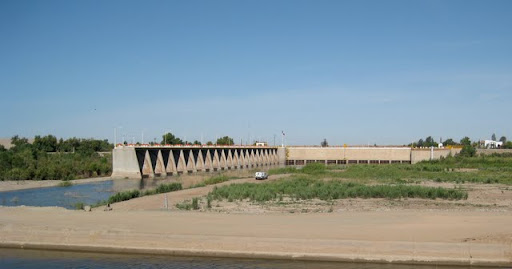
Morelos Dam, on the US-Mexico border, where the Colorado River for all practical purposes ends
The main thrust of the story is a discussion of the possibility of coastal desal as an alternative to the controversial Las Vegas groundwater pipeline proposal. Pipeline opponents have been arguing that desal is a reasonable alternative – not directly, but through water swaps through which Vegas would fund coastal desal for California or Mexico water users, and get a share of their Colorado River water in exchange.
The tangent is this: Brean quotes Mexican official Jose Gutierrez on how “fiercely” Mexico will defend its share of the river – a share that’s frankly paltry. Its 1.5 million acre feet of water is roughly ten percent of the river’s flow. Given how little Mexico gets, that ferocity is understandable. It also makes it hard to believe that there was a time when US water users feared Mexico would dominate the river’s allocation. But in the 1920s that was, in fact, the case.
One of the great early Colorado River water management histories is a doctoral thesis done by Reuel Leslie Olson in 1926 – after the Colorado River Compact was signed, but before any of the big infrastructure was built to begin moving water around. It’s a fun read because it captures a lot of early uncertainties about things that have long since been settled in ways that in hindsight seem inevitable – as, for example, Mexico getting largely screwed in the allocation of Colorado River water. From the vantage point of the mid-’20s, it seemed anything but inevitable.
At the time, the water needed to irrigate the Imperial Valley flowed through Mexico on a looping path before heading north. There was pressure to build an “All American Canal” (which has long since been done) because of fears that the southern California farmers were at the mercy of Mexico for their water. In fact, it was U.S. landowners in Mexico, most famously Harry Chandler of the LA Times, who were providing the pressure for a larger Mexican share of the river. Here’s Olson:
Mr. George H. Maxwell, long interested in irrigation problems, declares that a great part of the trouble encountered in present plans for development of the Colorado River, arises from the fact that much is now being done to attempt “to nail the Colorado River down for Mexico.”
Species by species, system by system
Dennis Wyatt, in the Manteca Bulletin, points to some intriguing language in the California Delta Protection Commission’s recent draft Economic Sustainability Plan (linked here) regarding my current hobby horse – the shortcomings of the Endangered Species Act as an environmental protection tool/water management tool:
While a $12 billion investment in isolated conveyance may allow for somewhat larger water exports, it doesn’t protect other critical infrastructure and billions in additional investments would still be required to protect highways, energy, and other water and transportation infrastructure. Just as a species by species approach is an inefficient and ineffective way to protect ecosystems, a system by system approach is an inefficient and ineffective way to protect the state’s infrastructure. (emphasis added)
Imperial Valley – What’s Plan B?

Imperial Irrigation District
Tony Perry has a nice take-out in the Los Angeles Times this weekend outlining the state of play in discussions over the fate of the Quantification Settlement Agreement and the water deal contained therein between the Imperial Irrigation District and San Diego. It does a good job of highlighting the dilemma – San Diego has become dependent on the water it gets from Imperial, and Imperial has become dependent on the money it gets from San Diego. But the whole thing’s in serious jeopardy in the California courts. Which is where Albuquerque water lawyer Chuck DuMars comes in:
To look for its own Plan B in the event the water deal dies, the Imperial board has hired one of the nation’s top water lawyers, Charles DuMars, a professor emeritus at the University of New Mexico law school.
Even by the standards of other Western water cases, DuMars said, the dispute over the Imperial district’s share of the Colorado River is complex in its details and intense in its passions.
Imperial Valley’s share of the river — greater than that of any other agency or state that uses the river — comes from a principle in water law called “first in time, first in right.”
Farmers in the valley were pulling water from the Colorado in the early 1900s — long before the rise of modern Los Angeles and San Diego and the thirsty suburbs in between.
“It’s more than just water, it’s cultural,” DuMars said of the dispute. “To most people in Southern California, water is something that comes out of the tap. In the Imperial Valley, it’s the lifeblood of the people.”
It’s not clear yet what Plan B might look like. A set of “organizing principles” approved by the IID board back in August makes clear that any modified water transfer plan will have to look out for the existing economic base in the valley:
In its role as a careful steward and in deference to its fiduciary responsibility as trustee of the Imperial Valley’s water rights, IID will ensure that the net result of any water transfer agreement to which it is a party does more than make the region whole: It must also make it better.
How that will be done remains to be seen.