Taking a straw out of the Colorado?

The premise of a piece I wrote recently over at the Lane Center was that folks in the Colorado River’s Upper Basin are all elbowing up to the front of the line to try to get the next straw slurping water out of the big river before it’s too late. The focus was on the state of Colorado’s discussions of a running a giant, multi-billion dollar straw up to Flaming Gorge:

Colorado’s dilemma is the same one found all across the states of the Colorado River Basin. The water is in one place, while the people are in another. Thus you have what amounts to artificial rivers all up and down the Colorado, siphoning and draining and pumping the water away from the Colorado as the basin states try to maximize usage of their legally allotted shares of the river.

In response, an alert reader pointed me to an interesting counter example – a Salt Lake Tribune editorial arguing against a similar project up there:

The Legislature should close the floodgate on any scheme to finance the Lake Powell Pipeline with state funds. Utah can’t afford the pipeline in the current weak economy, the water for the project may become unavailable due to climate change, and other state demands must have higher priority, beginning with education and transportation.

Anyone know if this would be a first?


Irony defined: Barnett’s “Blue Revolution” at the office pond

Irony defined: sitting in the shaded courtyard at work yesterday at lunch, next to a lovely fountain/pond flanked by lush lawn, reading the opening chapter of Cynthia Barnett’s Blue Revolution:

Sacramento landscape architect Ronald Allison tells of a two-and-a-half-acre residential design in Granite Bay with a waterfall, a grotto, a cave, six fountains, a pool with a bridge and an island, and a ninety-foot water slide: “It’s fun for the grandkids.”

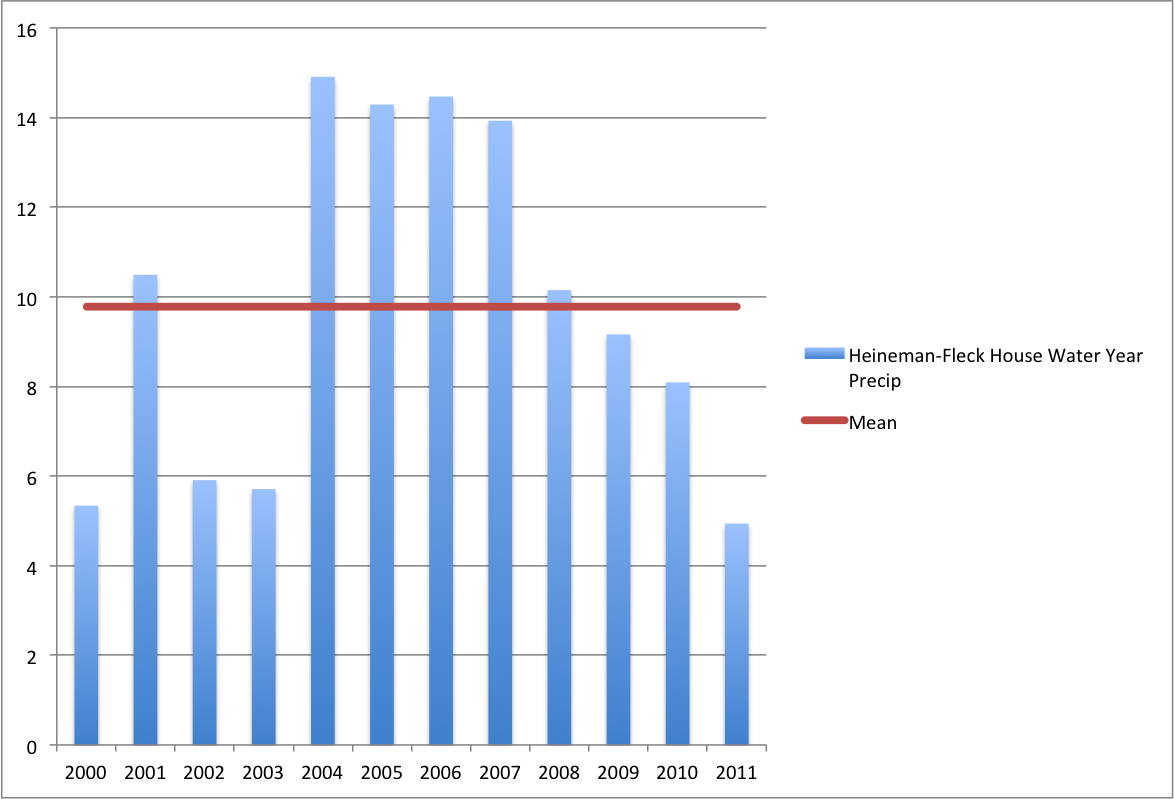
Irony multiplied: After lunch, walking back to the newsroom to write about Albuquerque finishing up its driest water year on record, at 3.26 inches (8.28 cm)  since last Oct. 1.

This morning I totaled up and double-checked the numbers for my house, a couple of miles from the official airport gauge that yielded that depressing 3.26. I had a whopping 4.94 inches (12.55 cm).

The international implications of U.S. water subsidies

While we all understand the market distortions caused in the United States by government subsidies for irrigation water, Michael Campana raises an interesting question about the international implications. Quoting a talk at the XIV World Water Congress by Paul Stanton Kibel of the Center on Urban Environmental Law (“CVP” is the Central Valley Project in California):

[S]ome countries, Brazil in particular, are upset because they feel that export crops like cotton (in Brazil’s case) are receiving subsidies from the US because of cheap CVP water. They claim that the cheap water represents ‘foregone revenue’ on the part of the Federal government, which is disallowed by the WTO. Kibel said that other exported crops like pistachio nuts and a few others might also come under the purview of the WTO should someone file a claim. So also might other crops like rice (China and India) that are grown in the Sacramento Valley.

We’re in trouble when we’re arguing about the numbers

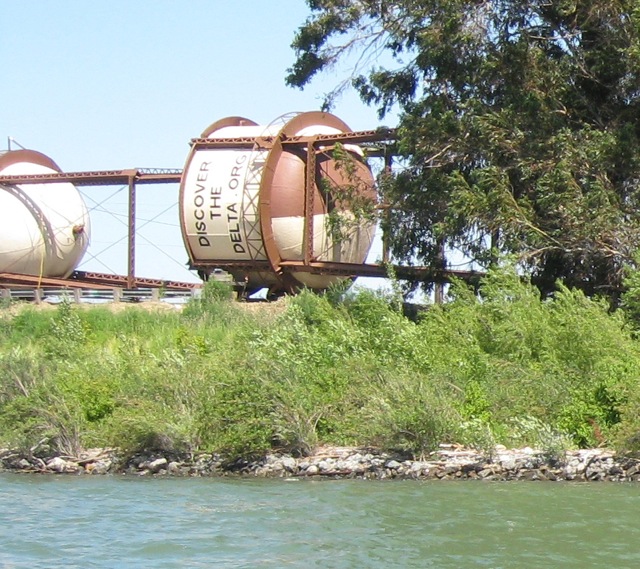
Discover the Delta

Discover the Delta, June 2011

John Bass made a great point in a recent comment thread at Delta National Park that highlights one of my frustrations about California water discussions:

[I]f basic facts are contentious, then the problem isn’t facts.

The comment was triggered by a point the California Farm Water Coalition’s Mike Wade made regarding an editorial that ran in the Oakland Tribune. To solve California’s water problems, the Tribune wrote, “sacrifices by water users will have to be made, particularly by agriculture, which uses more than 80 percent of California’s water.” To which Wade replied (in the comments):

The Department of Water Resources identifies water use in California during a normal year as environmental, 48%, agriculture, 41% and urban, 11%.

John’s response:

It may not be that Ag uses 80% of the state’s water, and Mr Wade’s number of 41% may be close to a reasonably accurate percentage of Delta water use by Ag, but only if calculated as the theoretical/ideological total amount of water available to export.

The fact that these discussions get tangled up in numbers, different versions of which serve to frame the issue in very different ways, is unsurprising. That’s the way this game is played. See Sarewitz 2004 for some great case studies of how arguing over numbers is used as a proxy for the real arguments at hand:

[S]cientific uncertainty, which so often occupies a central place in environmental controversies, can be understood not as a lack of scientific understanding but as the lack of coherence among competing scientific understandings, amplified by the various political, cultural, and institutional contexts within which science is carried out.

That it is common doesn’t make it any less unhelpful.

My Fake Rio

In honor of World Rivers Day, I rode my bike down to check out the Rio Grande through Albuquerque this morning. That’s really a bit of a cheat. Most weekends I end up riding my bike down to check out the Rio Grande at least once, but it’s World Rivers Day, and water nerds are supposed to think about their rivers, so I did.
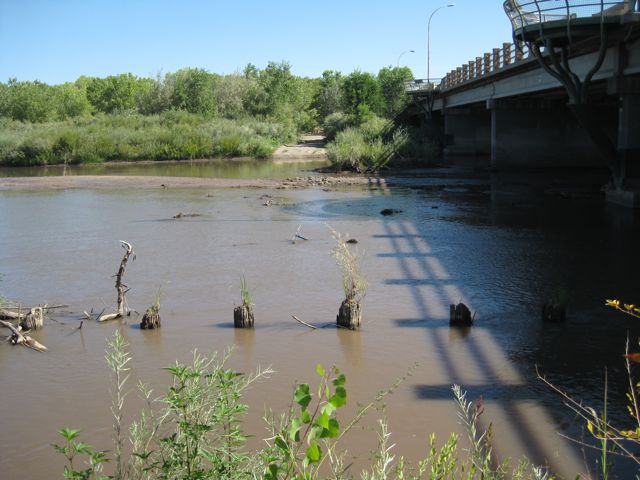
Pilons in the Rio Grande, Central Avenue, Albuquerque NM, September 2011

Posts in the Rio Grande, Central Avenue, Albuquerque NM, September 2011

I was thinking about it anyway after my USGS stream gauge alert started firing off Friday when the Rio Grande at the Central Avenue Bridge dropped below 150 cubic feet per second. This is always the dry time of year, with the snowmelt done and the summer rains over and mostly just base flow in the river. But between the dry year and the upstream irrigation diversions, the Rio would probably be dry completely through Albuquerque were it not for the US Bureau of Reclamation releasing water from storage to meet flow targets for the endangered Rio Grande silvery minnow. (more on that over at the (probably adwalled) work blog)

N. Reed and and I were discussing what I should choose as my favorite river for my World Rivers Day blog post. I said “Rio Grande”, to which she responded, “But I thought your favorite river was the Colorado?” But then she pointed out that, because of the San Juan-Chama Project importing water from the Colorado Basin, the Rio Grande has a bit of both. So I guess I’m cool.

In fact, right now, one might argue that it’s mostly Colorado River water in the Rio Grande thanks to the USBR minnow flow releases, though the distinction between paper water and wet water makes this very quickly a confusing question. But it’s clear the flows as I stood on the river’s bank this morning were the result of human intervention, as is essentially the entire system – pinned between levees, channelized when it used to meander, buffered by dams upstream.
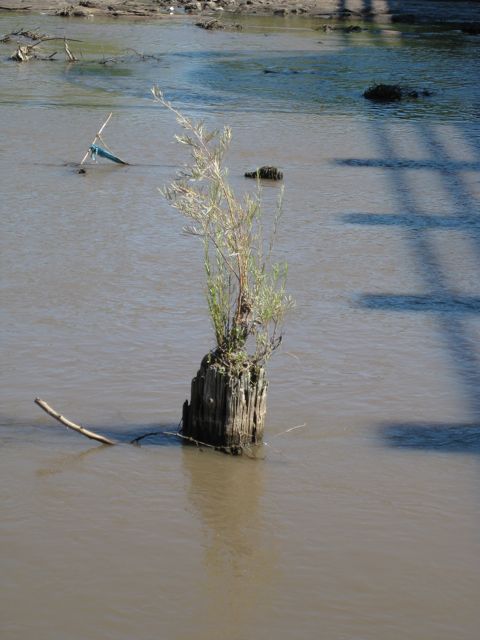
Willow

Willow, Rio Grande, September 2011

All the cool kids are reading Emma Marris’s Rambunctious Garden, which argues that we need to accept and even embrace the fact that there is no pristine nature, no ecosystems left devoid of human engagement and alteration. The book, which I loved, touched a nerve with me, given my fondness for the Rio Grande, however unnatural this vast riverside park through Albuquerque’s middle has become.

I rode my bike across the Central Avenue Bridge (old Route 66) and turned into the woods, down a dirt road to the west side of the river. Out in the shallow water beyond the USGS gauge, I saw these five posts sticking out of the river bed. I assume they’re the remains of the old Route 66 bridge. (Those who have lived around rivers know the central role bridges, or the lack thereof, play in the life of a community.)

Look more closely at the second post from the right. Growing directly out of its top is what looked to me like a willow. That’s a rambunctious garden if I’ve ever seen one.

A sign of drought I never thought of: hay theft

The CBS affiliate in Dallas-Fort Worth had a report this week on what it characterizes as a growing hay theft problem:

Yes, hay, is the new target for thieves. Round bales that used to sell for $20 are now topping $175.

The night watchman at Master Made Feed in Grapevine has scared off a half dozen prowlers already, and Lockridge says he’s lost more than 150 bales from a Grand Prairie Field – a $26,000 loss.


Climate change and California water: a bad situation likely to get worse

If you think California’s water problems look bad now, just wait.

California water and climate change

California water and climate change

That seems to be the message of a new study by a team from the USGS, Scripps, Berkeley and elsewhere who ran detailed simulations of climate change scenarios on the Sacramento-San Joaquin Delta/San Francisco Bay system.

The project provides a useful exercise, not in prediction, but rather in sketching out possible scenarios that give a feel for the envelope of uncertainty decision-makers face going forward:

We emphasize that such model-based projections are not predictions but instead are plausible depictions of how this complex landscape might respond to prescribed model- and emissions-specific future climates.

Using a couple of different model runs, with varying greenhouse gas emission trajectories, the scientists found:

  • warming temperatures
  • reduced runoff
  • rising sea level
  • rising salinity

One of the key findings is that not all climate change trajectories look alike – both because of uncertainty in the models themselves (in the so-called “sensitivity” to rising greenhouse gases) and, more importantly, in the irreducible uncertainty of greenhouse gas trajectories. The latter is the biggest problem. One might hope that science will reduce the uncertainty in the models, but or inability to predict future human economic and societal development means we’ll always have an irreducible level of cluelessness about future greenhouse gas emissions trajectories. If both models agree on a key feature, policy makers can be more confident they’ll have to deal with it. In areas where the models highlight fundamental uncertainties, policies need to be robust to the possibilities of different outcomes:

This classification of projected responses to climate change suggests that regional planners and resource managers should consider: (a) strategies for adaptation to progressively increasing air and water temperature, sea level and salinity intrusion in the SFEW, and further shifts toward more runoff in winter and less in spring-summer; but (b) planning for a broad range of future water supply because GCMs differ widely in their projections of precipitation trends. Effective strategies will be flexible and responsive to new data and assessments of climate change as they emerge.

Given the current situation, this stuff is worth serious consideration:

California’s water supply (annual unimpaired runoff) is projected to decline or remain steady (Fig. 3), and demands are likely to increase as populations and temperatures rise. Deficits of surface runoff are now met with groundwater pumping. However, pumping between 1998 and 2010 depleted 48.5 km3 of water from the Central Valley groundwater system, and continued groundwater depletion at this rate is unsustainable [66]. Future strategies of water management will require adaptations such as aggressively increasing water-use efficiency, reducing surface water deliveries, capturing more runoff in surface storage or groundwater recharge, and implementing programs of integrated regional water management [67]. Model results suggest that the inherent large annual variability of precipitation will persist (Fig. 2), even as longer-term trends of warming and possibly drying take hold. Therefore, water-resource planning should also include contingencies for longer dry seasons, extended droughts, and extreme floods due to shifts from snow to rain. Diminishing snow packs result in earlier reservoir inflow, so reservoir operations must adapt to a shift toward more water being managed as a hazard (flood control) and less as a resource (reservoir storage). Additional freshwater releases to mitigate increased salinity intrusion into the estuary will be required to maintain quality of drinking water to communities that use the Delta as their municipal water supply. These adaptations to maintain water supply for human consumptive uses will potentially constrain availability of water to meet objectives of habitat conservation plans, such as restoring natural flow and salinity variability to promote recovery of native biota in the Delta [13].

Tamarisk: It’s a fair cop

A wise scientist once remarked on the burnable properties of wood:

BEDEMIR: Tell me, what do you do with witches?

VILLAGER #2: Burn!

CROWD: Burn, burn them up!

BEDEMIR: And what do you burn apart from witches?

VILLAGER #1: More witches!

VILLAGER #2: Wood!

BEDEMIR: So, why do witches burn?

[pause]

VILLAGER #3: B–… ’cause they’re made of wood…?

burn her

burn her

And what is also made of wood? Tamarisk, the invasive salt cedar that is the scourge of the river basins of the arid southwest. (Sorta. Click the link.) And what do we do with Tamarisk? Cut it down and burn it! But what if…


Both green and dead tamarisk chips were good fuels for gasification, performing more efficiently than a sample of mixed softwood. Further, the data suggest that significantly more energy can be recovered from tamarisk when harvested green, compared to waiting for the tamarisk to die and age. When incorporated into a comprehensive restoration plan, tamarisk appears to have potential to be used as a valuable energy source rather than viewed as unwanted waste.

It’s a fair cop.

Stuff I wrote elsewhere: my latest nuclear weapon automotive metaphor

The use of automobile metaphors in descriptions of nuclear weapon technology is somewhere between comedy and cliche.

Here’s my latest entry (sub/ad req):

You could think of the B61 as the Volkswagen bug of the U.S. nuclear arsenal — reliable, adaptable and very, very old.

I also said some other, more substantive things:

The risk, according to the report from the Senate Appropriations Energy and Water Subcommittee, is that the labs and NNSA are going too far in their effort to bring the aging B61s into the 21st century. In an effort to improve the bombs’ safety and security, the weaponeers may actually be jeopardizing its long-term reliability, the Senate report suggests.

“NNSA plans to incorporate untried technologies and design features to improve the safety and security of the nuclear stockpile,” the report says. “The committee supports enhanced surety of weapon systems to avoid accidents and unauthorized use, but it should not come at the expense of long-term weapon reliability. New safety and security features should be incorporated in weapon systems when feasible, but the primary goal … should be to increase confidence in warhead performance without underground nuclear testing.”


Fiendfyre and the summer of 2011

Fiendfyre

Fiendfyre

A guest post from my child, N. Reed Heineman-Fleck, which grew out of our conversations about my work chronicling the southwest’s fires of 2011:

When Dad told me about the Los Conchas fire, and how it was different than normal fires–in some places it turned everything to black dust; it rolled instead of catching, it sometimes left pockets of trees baked but not burnt because of lack of oxygen– a scene from Harry Potter and the Deathly Hallows came to mind. (Minor spoilers for Deathly Hallows, including a character death, follow.)

“It was not normal fire; Crabbe had used a curse of which Harry had no knowledge: As they turned a corner the flames chased them as though they were alive, sentient, intent upon killing them. Now the fire was mutating, forming a gigantic pack of fiery beasts: Flaming serpents, chimaeras, and dragons rose and fell and rose again, and the detritus of centuries on which they were feeding was thrown up in the air into their fanged mouths, tossed high on clawed feet, before being consumed by the inferno.”

The spell is called Fiendfyre, and in the end it kills Crabbe. They’re in the Room of Hidden Things when he casts it, and it’s hot and destructive enough to completely destroy the nigh-indestructible Dark magical item known as a Horcrux.

But what’s relevant here is that it manages to completely wipe out everything in the Room of Hidden Things. This room was used by students and teachers to hide all kinds of items, from booze to broken furniture, and in the hundreds of years that Hogwarts has been around it’s built up piles upon piles of magical detritus, like the kindling on the forest floor.

Afterwards, Ron asks a question: “Blimey, d’you reckon it’ll still work after that fire?” And from what Dad tells me, everyone’s asking the same thing about the forests that Los Conchas destroyed: are they going to still work after that fire?