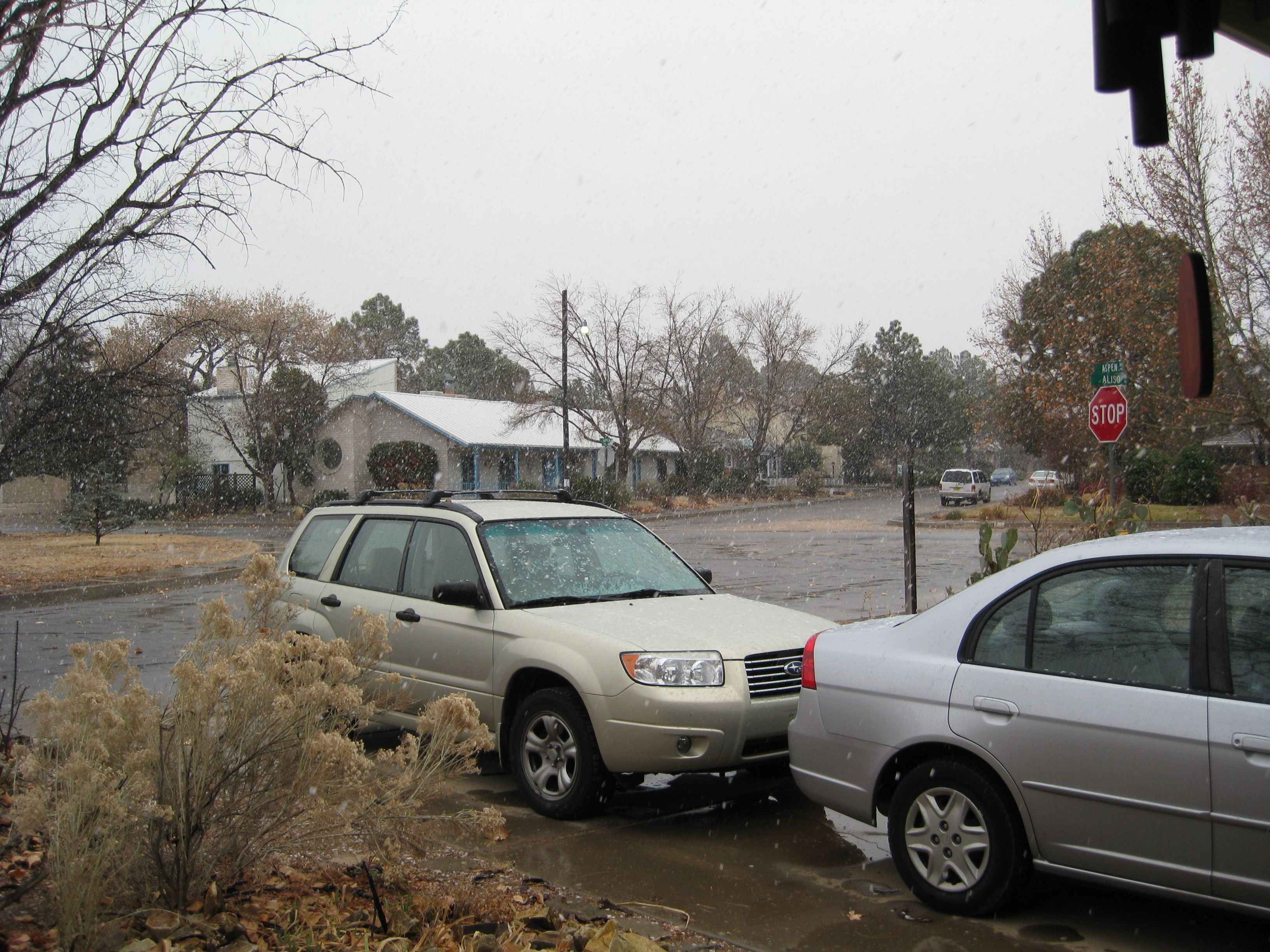
Once, an impossibly long long time ago, it rained at my house.
Rain
Once, an impossibly long long time ago, it rained at my house.
Rain
Also from this morning’s paper, a story documenting Albuquerque’s 60th consecutive day without measurable precipitation. We’ve got an outside chance of breaking the streak this evening, and then again mid-week. But the forecasts are basically bleak.
But the real import was tucked in near the end of the story (sub/ad req):
Meanwhile, the U.S. Bureau of Reclamation last week began releasing supplemental water currently in storage in Abiquiu Reservoir to ensure there is enough water in the Rio Grande to keep the river’s population of endangered Rio Grande silvery minnows alive.
Warm weather and a meager snowpack, along with early irrigation by farmers because of the dry weather, are driving the need for supplemental water for environmental flows, said Leann Towne, head of water operations for the bureau’s Albuquerque office. The bureau has water in storage at Abiquiu that was imported from the San Juan Basin via the San Juan-Chama Project and is available to supplement Rio Grande flows, to help the endangered fish. This is unusually early in the year to see the extra water needed, according to Towne.
Lissa and I were down at the river yesterday morning scouting out a nesting great-horned owl. Cute little fluffy white baby. Did I mention cute?
On the way back, we stuck our heads through a break in the bank to look at the river itself, which is remarkably low. A pair of killdeer were hanging out on sand flats in the middle of the river, calling. I don’t usually see them there. They tend to like shallow, slow water, which doesn’t usually describe the Rio Grande as the snowmelt rises this time of year. But the snowmelt isn’t rising.
This is a big deal – having to use imported Colorado Basin water this early in the year to keep the Rio Grande wet.
From the Sunday Journal, a look at two proposals to pump and pipe water from rural New Mexico to the state’s rapidly developing Rio Grande corridor (sub/ad req):
Ray Pittman pulled his 1994 F-150 pickup to the top of a thinly wooded hill, a short walk from the water tank he built back in 1999 on his 1,300-acre ranch.
A mile down the hill, Pittman’s 540-foot-deep well pumps groundwater, pushing it up to the tank to provide for the cattle on this remote patch of central New Mexico landscape.
Pittman pointed to the west, to the vast plain that makes up the Augustin Plains Ranch. There, a commercial venture has proposed sinking 37 wells to pump up groundwater and pipe it to the Rio Grande Valley to supplement dwindling water supplies of central New Mexico’s farms and cities.
The Augustin Plains Ranch proposal would move 54,000 acre-feet per year of water to the Rio Grande Basin 50 miles away — enough water to meet the needs of a city the size of Albuquerque.
You can’t go there without remembering what happened in California a century ago:
The proposals inevitably raise the specter of the Owens Valley, the area in eastern California dried up early in the 20th century to bring water to Los Angeles. Taking that water “just devastated” the Owens Valley, D’Antonio noted, a problem that raises important issues about how such requests should be handled in New Mexico.
In economists’ terms, we have here an argument over whether the market (in this case several land owners’ desire to sell water to New Mexico’s cities) properly takes into account the externalities (the folks left behind, who argue their neighboring water supplies and community economies would be harmed).
From today’s Deseret News, a sigh of relief for this year’s beneficent snowpack, which has has eliminated (for now) the possibility of a shortage declaration on the lower Colorado River:
If Lake Mead drops a little further, it would force a declaration of a shortage and a potential cascade of orders to cut water use. But a good winter snowpack seems to have saved the day, according to Malcolm Wilson, water resources chief of the U.S. Bureau of Reclamation.
“It is highly, highly unlikely that we’ll see a shortage declared for the lower basin,” Wilson said. “It is a good year. It’s one of the better ones we’ve seen certainly in the last decade, and we’re looking to a really good inflow.”
That’s short run. Long run? Trouble, as climate change reduces flows in the river and we set agin t’ fightin’:
Many expect hard bargaining in the future over the river’s water supply. McCool thinks there are pluses and minuses for Utah: Extended drought might wipe out proposals for Lake Powell pipelines, but Utah farmers might get rich by selling water to Las Vegas.
Can’t do that sort of thing, a Utah-Vegas transfer, under the existing river laws. But who’s to say that’s not one of the reasonable models for a recasting of the rules?
Shasta Dam
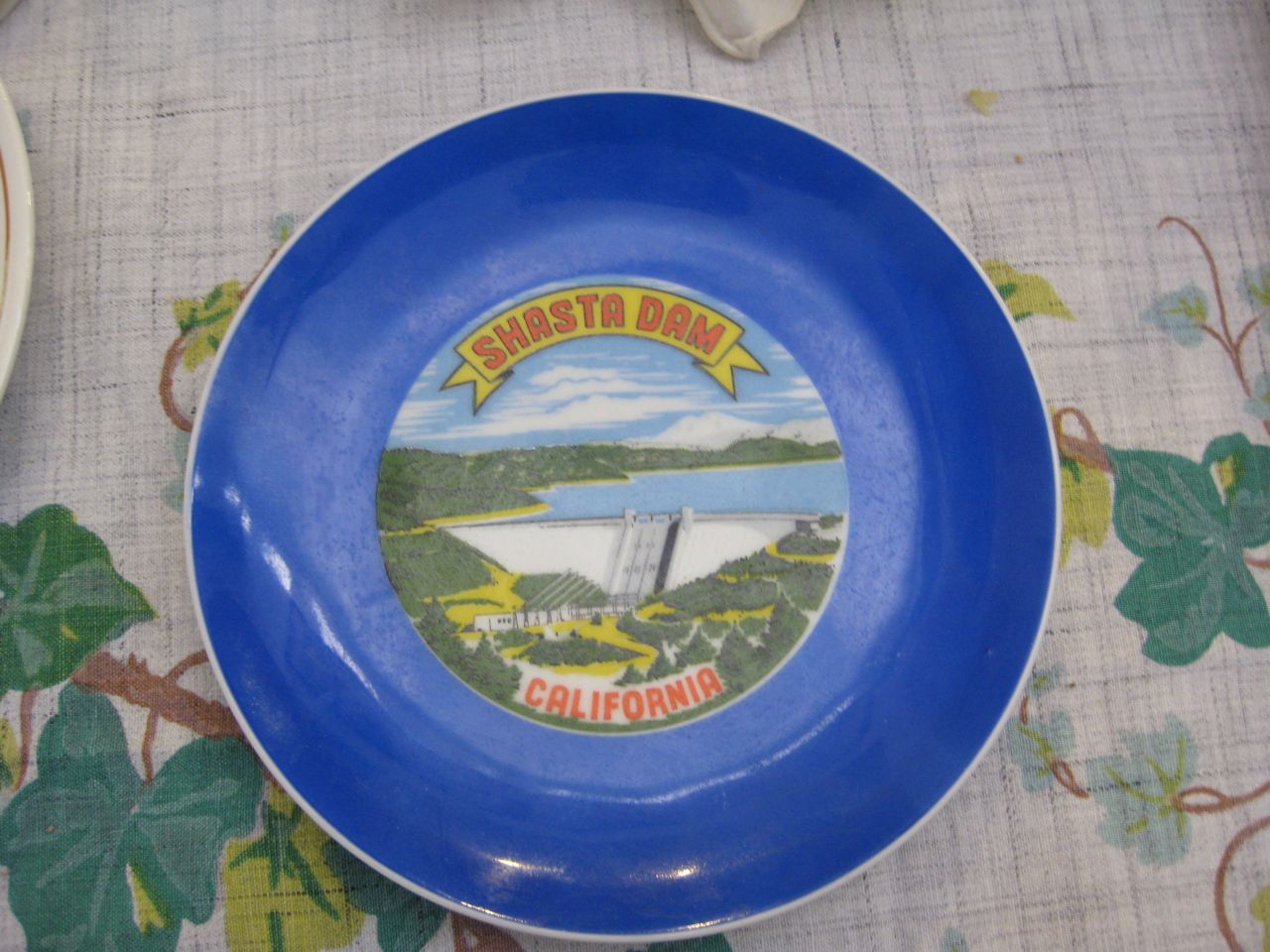
Our friend Alison, who is a shopper of profound skill, scored this Shasta Dam tourist plate on a recent expedition.
Built by the U.S. Bureau of Reclamation between 1938 and 1945, Shasta is part of the first post-Hoover Dam generation, a concrete arch structure capable of storing more than 4.5 million acre feet of water.
Located on the Sacramento River north of Redding, Calif., it is part of the Central Valley Project. It works in tandem with the smaller Keswick Dam, located just downstream, which re-regulates flow from the more erratic up-and-down releases associated with Shasta’s power plant (such a two-dam configuration is not uncommon).
Thanks to California’s bodacious snowpack, Shasta currently holds 4 million acre feet of water, 6 percent above average for the beginning of April.
references
From Thursday’s newspaper (sub/ad req), a look at what is increasingly looking to be a very dry year on the Rio Grande, which has become entangled in a Byzantine governance issue involving allocation and distribution of Lower Rio Grande water:
In recent years, dry conditions have made managing the river more difficult. Eight out of the past 10 years have seen below-average flows at the Otowi river gauging station between Santa Fe and Los Alamos.
Sharing water south of Elephant Butte, among farmers in southern New Mexico and Texas, was a major topic of discussion at Wednesday’s meeting.
Because of a new agreement between El Paso and Las Cruces-area irrigators for division of Rio Grande water, most of this year’s water coming out of Elephant Butte reservoir is flowing past New Mexico farmers for use in Texas.
New Mexico irrigators agreed to the deal in an effort to head off interstate litigation with Texas in a dispute over the effects of New Mexico groundwater pumping on Rio Grande flows.
State officials object to the deal. D’Antonio told members of the Compact Commission on Wednesday the agreement, which has resulted in an increase of water going to Texas farmers while New Mexico farmers’ share decreases, was “demonstrably lopsided and not sustainable.”
Rio Grande at Otowi source: New Mexico Interstate Stream Commission
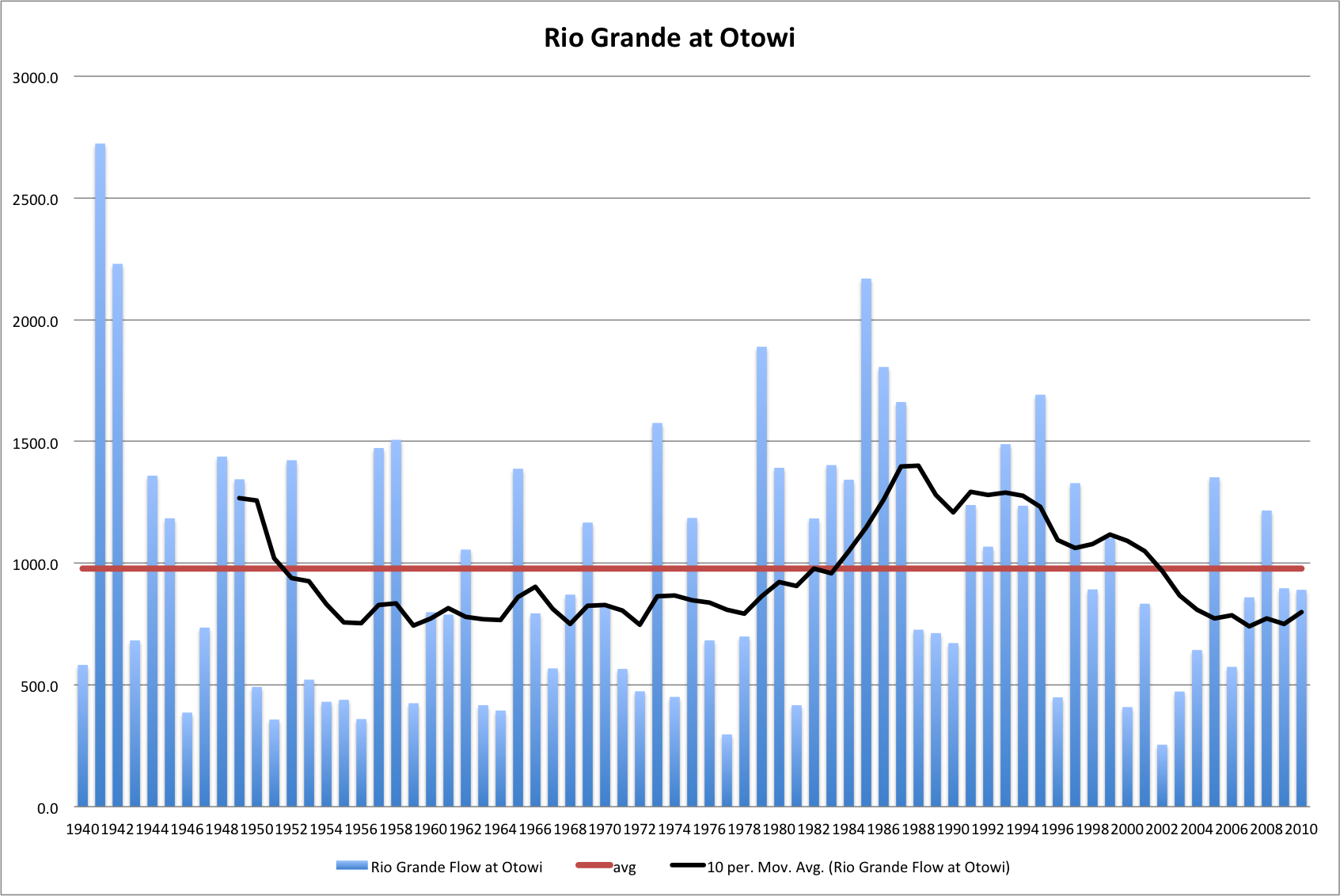
The latest numbers from the New Mexico Interstate Stream Commission show how remarkably dry the ’00’s have been. This is what’s called the “Otowi Index Flow”, which is the natural flow past the Otowi gauge in north-central New Mexico, as used for calculating Rio Grande Compact accounting. (It doesn’t count water added to the system from the Colorado Basin via the San Juan-Chama project. It’s also not a true “natural flow” estimate, because it doesn’t make any effort to adjust for water removed for irrigation upstream, in Colorado and Northern New Mexico. So not perfect, but the best we’ve got. Click on it to see it larger.)
A couple of key points here. First, note that the sustained drought of the 1950s is worse than what we’ve seen so for in the ’00’s. But also note that a lot of New Mexico’s population growth occurred subsequent to the 1950s drought, during a period that was unusually wet. Fourteen of the years in the 1980s and ’90s were wetter than the long term average.
During that time, New Mexico’s population grew by 40 percent. Including me.
John McChesney, former NPR guy now at Stanford’s Bill Lane Center for the American West, has jumped into the Law of the River discussion with a look at Doug Kenney’s work on rethinking the Law of the River:
Kenney doesn’t believe the law of the river needs to be tossed out, but he says it should be revised. Kenney stresses that the 11-year drought is not the most important problem on the river; the game changer, he says, is that demand now exceeds the river’s supply, and climate change will likely to make matters worse.
McChesney’s interest is very much focused on the effect the basin’s water problems will have on rural communities. From another post:
What you don’t often hear in these discussions is any concern about what happens to agriculture and rural life as these transfers become more common. Bruce Finley of the Denver Post took a look at that issue here. His piece focuses on the Front Range in Colorado where “about 400,000 acres in Colorado dried up between 2000 and 2005, according to U.S. Geological Survey data…
And Colorado natural resources planners anticipate losing another 500,000 to 700,000 acres of irrigated cropland by 2050.” Several small towns in the area have practically disappeared. Finley quotes Pat O’Toole, president of the Colorado-based Family Farm Alliance: “Denver’s going to double, and so is India and China and everybody else. What are we going to do to feed people if we keep taking agricultural land out of production?”
I look forward to him joining the conversation. (Disclosure: I’ve been discussing these issues with John and his colleagues, and hope to get out to Stanford later this year to continue the conversation in person.)
(see here for some stuff I wrote earlier this year on Kenney’s analysis)
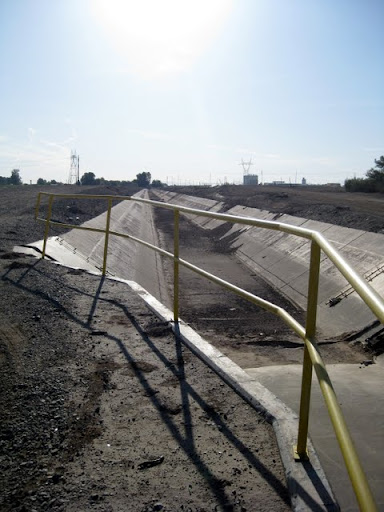
Yuma Desalting Plant Outfall
The US Bureau of Reclamation announced today that they’ve completed the pilot run of their Yuma Desalting Plant, cleaning up 30,000 acre feet of really crappy ag drain water. (“Crappy ag drain water” – my words, not theirs).
From Joyce Lobeck in the Yuma Sun (and seldom was their a more appropriately named newspaper):
Undertaken because of the 11-year drought in the Southwest, the pilot run started on May 5, 2010, to test the viability of the plant to augment Colorado River water supplies. In collaboration with The Metropolitan Water District of Southern California, Central Arizona Water Conservation District and Southern Nevada Water Authority, Reclamation operated the plant to gather cost and performance data needed to consider potential future operation of it.
In return for their funding support, the water agencies received credits in proportion to the water produced during the pilot run and each of their funding contributions.
The plant recycled 30,000 acre-feet of irrigation return flow water that was returned to the Colorado River.
As I’ve written before, the put-your-money-where-your-water-needs-are aspect of the YDP project are a great measure of who’s the most desperate for water from the Colorado River:
MWD is paying 80 percent of the cost. CAP and SNWA are each kicking in 10 percent. That willingness to pay on the part of MWD tells me something about who needs water the most in the near term.
Links:

Jerry Brown: "Drought's over."
When the science team working on the National Integrated Drought Information System (NIDIS) invited me to give a media-communication perspective at a meeting back in the summer of 2006, I titled my talk “Maybe We Shouldn’t Call It `Drought'”.
The problem is that the word is used in so many different ways, meaning so many different things, that if not approached with care it can cause all kinds of trouble.
Kelly Redmond, from the Western Regional Climate Center (who, as it happens, was in the audience at my talk and made fun of my ill-fitting suit) wrote a great piece in the Bulletin of the American Meteorological Society back in 2002 taking on the problem of definition, and offering up a framework for thinking about the problem that has served me well:
Most concepts of drought involve a water balance. This implies that both supply and demand must be considered, as well as the question of whether there is “enough” (and, enough for what?). Thus, through time I have come to favor a simple definition; that is, insufficient water to meet needs.
There’s a second problem with the word “drought” that I think represents a more insidious problem: the fact that we don’t really have a word for the opposite of “drought.” Well, we do, I guess – “pluvial”? But when was the last time you saw that in a newspaper headline? The result is that when we’re on the dry side of the natural range of variability, we call it “drought” and go hunting for government bailouts. But when we’re on the wet side of the natural range of variability, we just treat it like it’s normal, getting all fat and happy.
Which brings me to today’s announcement by Jerry Brown that California’s drought is over. I love the language of the formal proclamation (all caps in original):
NOW, THEREFORE, I, EDMUND G. BROWN JR., Governor of the State of California, in accordance with the authority vested in me by the Constitution and the statutes of the State of California, do hereby PROCLAIM THE DROUGHT TO BE AT AN END.
I understand it’s very easy and a little cheap to make fun of a gubernatorial proclamation regarding such a natural phenomenon. I get that there are underlying legal and policy issues – that a formal legal declaration of “drought” triggers certain governmental actions, and that an anti-declaration is needed to unwind them.
But the turn-it-on, turn-it-off declaration issue really seems to me to highlight the underlying problem – it’s not that “droughts” are some unfathomable anomaly and now that it’s over we can all get back to normal. Consider this language in Brown’s statement:
“While this season’s storms have lifted us out of the drought, it’s critical that Californians continue to watch their water use,” Brown said. “Drought or no drought, demand for water in California always outstrips supply. Continued conservation is key.”
Whether we call it “drought” or not, the problem Redmond so gracefully highlighted – “insufficient water to meet needs” – has not gone away for Californians.
links:
I sometimes feel a twinge of guilt about the water issues that so obsess us here in the Southwestern United States. Most of us have running water in our homes. It’s remarkably free of contaminants and pathogens. The arguments we have are generally about how to distribute this bounty, not whether we have it at all. Today’s reminder, from the Economist:
Pigs rootle fastidiously through the foothills of the mountain of rubbish dumped at Tuol Sen Chey on the outskirts of Phnom Penh, Cambodia’s capital. A few metres away, cross-legged amid the clouds of flies and shaded from a fierce sun by a broad-brimmed hat, Tim Chan Tha is sifting and flattening used plastic bags for recycling. A widow with three children, she earns about 6,000 riels ($1.50) a day for this. She lives nearby down muddy dirt roads, in a cluster of ramshackle huts of corrugated iron, salvaged wood and tarpaulins. Ms Tha’s life seems as miserable an example of urban poverty as could be found anywhere.
In one respect, however, she is lucky. Her home has a constant supply of running water, drinkable straight from the standpipe outside.
The substance here, if you’ll allow a pivot to the underlying issue we and Tim Chan Tha have in common, is that our success or failure in dealing with our respective water issues is a matter of governance.
(h/t the Water Wonkette)