River beat: what a difference a month makes

The latest USBR monthly Colorado River is out, and just wow. From Shaun McKinnon:

In its latest 24-month report, the U.S. Bureau of Reclamation added almost 1 million acre-feet to the estimated amount of water that will be released from Lake Powell downstream into Mead, the wetter forecast possible because of near-record snowpack on the upper Colorado system.

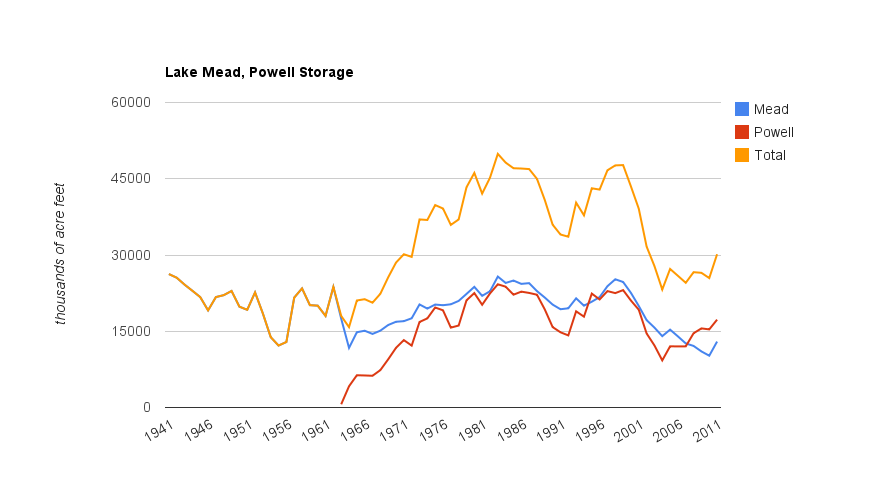
Total Storage in Lake Mead, Powell

Total Storage in Lake Mead, Powell

This is unquestionably good news. And yet there’s something disconcerting about the numbers that should give us pause.

First the good news:

The current estimated year-end storage in Mead and Powell, the Colorado’s two main reservoirs, is now estimated at 30 million acre feet, up nearly 5 maf from last Oct. 1. Back then, Mead had dropped to record low levels, and there was talk of the first ever formal shortage declaration on the Colorado River as early as 2012. Shaun reports that now “no shortage is likely for at least five or six years, probably longer.” Mead would end the year under the current forecast with a surface elevation of 1,115 feet above sea level, the highest it’s been since 2006. Powell would be up to 3,650, its highest since 2001.

Now the disconcerting part:

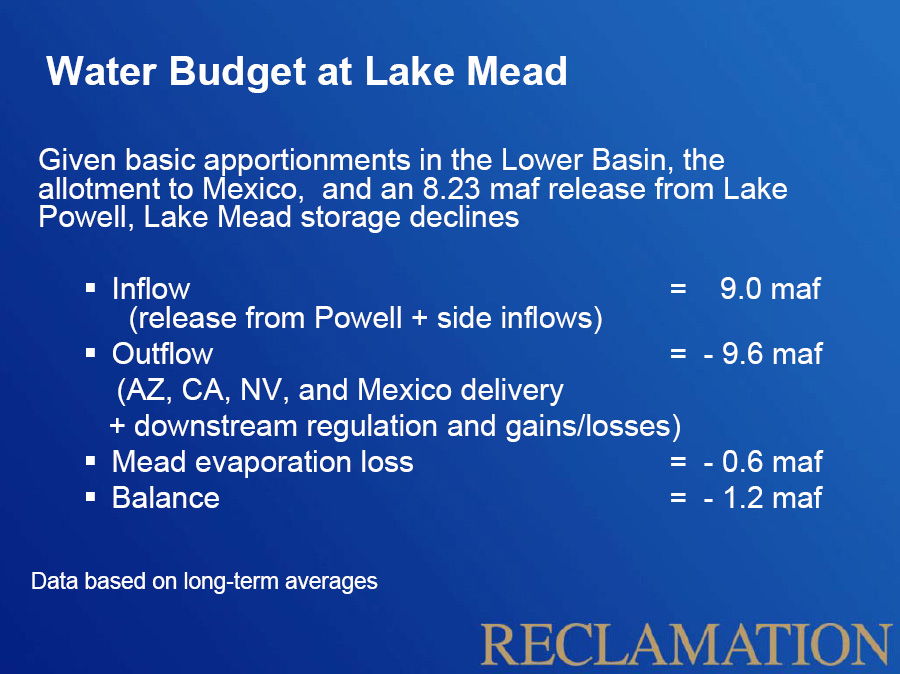
Supply-Demand Imbalance

Supply-Demand Imbalance, courtesy USBR

Under the Colorado River Compact and related “Law of the River” accretion of laws and operating procedures, the Lower Basin is legally entitled to a delivery of 8.23 maf each year, to be released from Lake Powell for water users in Nevada, Arizona and California. If there is extra, either because it snowed like hell or because the Upper Basin states aren’t using their full allotment, the Lower Basin states can get extra, “bonus” water.

This year, according to the latest 24-month study, there’s enough slopping around in the system for a Lake Powell release of 12.46 maf, the largest since 1998. That’s 4.23 million of acre feet of bonus water. But the year end storage in Lake Mead is estimated to rise only 2.78 maf from last year. That disparity is evidence that the Lower Basin is continuing to live beyond its means – that is, beyond the 8.23 maf that it can legally count on over time in deliveries from Lake Powell. As you can see from the slide, the supply-demand imbalance averages about 1.2 maf per year in the Lower Basin.

So good news, yes, but the bonus water could be gone in a hurry.

(see here for my review of the supply-demand problem)


About that whole peripheral thingie…

Matt Weiser reports the Brown administration* is backing away from a giant “Peripheral Tunnel” option for solving California’s bay-delta mess, or at least backing away from the notion that the big tunnel is The Plan:

Gov. Jerry Brown’s top water official revealed Tuesday that a giant tunnel diverting water from the Sacramento River is no longer the leading option to solve the Delta’s chronic water and environmental problems.

Jerry Meral, deputy secretary of the state’s Natural Resources Agency, told an Assembly committee that a range of alternatives will now be considered by the Bay Delta Conservation Plan, an effort to balance water supply and environmental stresses in the Sacramento-San Joaquin Delta….

Meral did not say the large tunnels would be ruled out for consideration. But he did say the Brown administration will consider much smaller options, including a 3,000 cfs tunnel proposed by environmental groups that never got traction during the Schwarzenegger administration.

* The dude was governor when I was in high school. I just can’t get over that.

Flood memory half-life

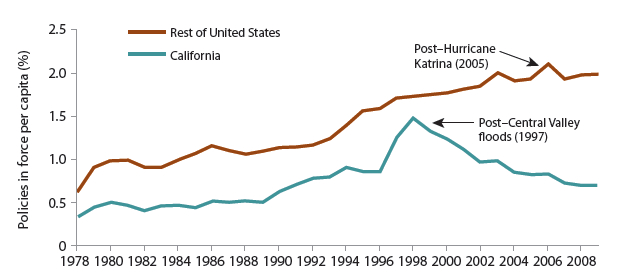
Given the current flooding on the Mississippi, this from the Public Policy Institute of California’s discussion of flood risk in that state seems relevant:

Perception of risk directly changes pressure for improving flood management. Longer periods of time since a natural disaster reduce the perception of risk—a phenomenon referred to as the “flood memory half-life.” The problem is well in evidence in Californian’s flood insurance coverage behavior, which peaked soon after the 1997 floods—the last large floods within the state—and has declined ever
since. (p.300)

The data:

Flood Insurance Over Time

Flood Insurance Over Time source:PPIC

update: Discussion on twitter (see here and here) suggests interesting questions about where else this might apply, and what data one might use to examine the extent to which it generalizes to things like earthquakes and drought. Any suggestions for a) other areas this might apply, and b) data one might use?

Thinking about the Sacramento-San Joaquin Delta: click your heels together three times…

In trying to understand California’s efforts to deal with its Bay-Delta water problems, I’ve been digging into the Delta Stewardship Council and Bay Delta Conservation Plan processes, and frankly have been left feeling a bit like Dorothy upon her descent into Oz – lots of familiar cues, but over and over again things weren’t quite making sense. (And, like Dorothy, I’m finding the people delightful, but the place is scary, and they keep sending me on my way, thinking I’ve got enough information to make it through. I don’t.)

Dorothy

It landed on the Wicked Witch in the middle of a ditch

People I talked to and things I read didn’t seem quite capable of explaining what these two processes are, and how they might lead to physical infrastructure and agreed-upon, binding plans for managing the region’s oversubscribed water resources. The light bulb finally went off as I was reading the draft National Research Council panel report on BDCP science: the reason I was having such a hard time was that the processes themselves are not clearly defined. From the report:

The legal framework underlying the BDCP is complex, as are the challenges of assembling such a large habitat conservation plan. Nonetheless, the BDCP’s purpose or purposes need to be clearly stated, because their nature and interpretation are closely tied to the BDCP’s scientific elements. The lack of clarity makes it difficult for this panel and the public to properly understand, interpret, and review the science that underlies the BDCP. (p.3)

Some background for those not already steeped: Most of California’s water flows through the delta formed by the San Joaquin and Sacramento Rivers as they make their way to San Francisco Bay. Much of California’s water falls in the north, and much is used in the south. So at the south end of the delta, giant pumps suck water and push it to south-of-delta users. This has been enormously successful, if you happen to be a south-of-delta farmer making the desert bloom, or an ubermetropolis like, say, the Los Angeles-plex. But it’s left some problems behind – for the people and ecosystem in the delta itself. Sorting out the conflicting values and interests in and around the delta has occupied California water politics for decades, precisely because it’s a really hard problem.

From the NRC:

There is simply not enough water to serve all desired uses. The situation surrounding the Delta is a symptom of scarcity. (p.8)

The underlying basics of the BDCP seem simple – the creation of a Habitat Conservation Plan for the management of the effects of continued Delta water withdrawals to meet federal Endangered Species Act requirements, and a Natural Community Conservation Plan to meet parallel requirements under state law. But as I’m coming to understand, much is hidden behind that deceptively simple facade.

For starters, hidden behind that is a multi-billion dollar notion that a Peripheral Something (tunnel? pipe? canal?) would be built to shunt the water coming down from the north around the delta to the pumps in the south. So instead of fouling up the delta itself by sucking water through it to the pumps, you let the delta function in a more natural way (albeit with a lot less water). For water engineering types, the Peripheral Something is the One Answer, and I have no reason to doubt them. There is opposition to the idea, though I don’t have a feel yet for how substantial it might be (see Brett Baker’s arguments last week in the San Francisco Chronicle, for example). But the BDCP process makes clear that, for California officialdom, the Peripheral Something is Plan A, and there doesn’t really seem to be a Plan B. Notes the NRC, in the money quote (“isolated conveyance” is jargon for “Peripheral Something”):

The lack of an appropriate structure creates the impression that the entire effort is little more than a post-hoc rationalization of a previously selected group of facilities, including an isolated conveyance facility, and other measures for achieving goals and objectives that are not clearly specified. (p.43)

So what we have here, it appears, is an effort to create the framework to somehow implement a decision made, rather than a process of making a decision? That seems to be the NRC’s central complaint.

That decision, to build big infrastructure to move more water around California, may be the right one. But in my guise as the naive Dorothy having just dropped into this strange world of California, it’s not clear to me that decision has, in fact, been made, and by who.

And herein lies the problem, so clearly spelled out in the NRC report (expanding on the bit quoted earlier):

Water scarcity in California is very real, the situation is legally and politically complex, and many stakeholders have differing interests. The effective management of scarcity requires not only the best science and technology, but also consideration of public and private values, usually through political processes, to arrive at plans of action that are scientifically based but also incorporate and reflect the mix of differing personal and group values. (p.8)

To reiterate a question I posed a while back right after my house fell on the witch and I began wandering this strange land, where is that political process, wherein competing values and interests are genuinely sorted out, taking place?

OtPR, whose insights into these processes are invaluable, suggests implicitly that the answer to my question is “nowhere”:

It (the BDCP) was well developed along a few lines; it had a long wishlist of restoration projects and fantasy of a Peripheral Canal and a notion of adaptive management. But nothing controversial, like flows, or the purpose of the Plan itself (is a habitat conservation plan or a way to justify a Peripheral Canal?) or priorities, was settled. Without the external review, I bet that could go on for another decade.This is how we do stuff and honestly, I understand why. Wading into the controversial realms is so painful. We just saw ACWA and a bunch of water districts act like thugs when the Delta Stewardship Council got into the controversial issue of regulating local control for consistency with their plan. We’ve seen Westlands and the State Water Contractors shut down BDCP by withdrawing funding. The legislature itself has punted; wisely realizing that they can’t weather the political storms that come with making Delta decisions, they delegated their power to a Delta Council made up of people who will never again run for office. As a subjective professional experience, the political storms suck.

But so do the products of processes that avoid them.

For you California water gurus in the audience, I’m happy to stand corrected or have help clarifying any of this.

What I did on my spring vacation

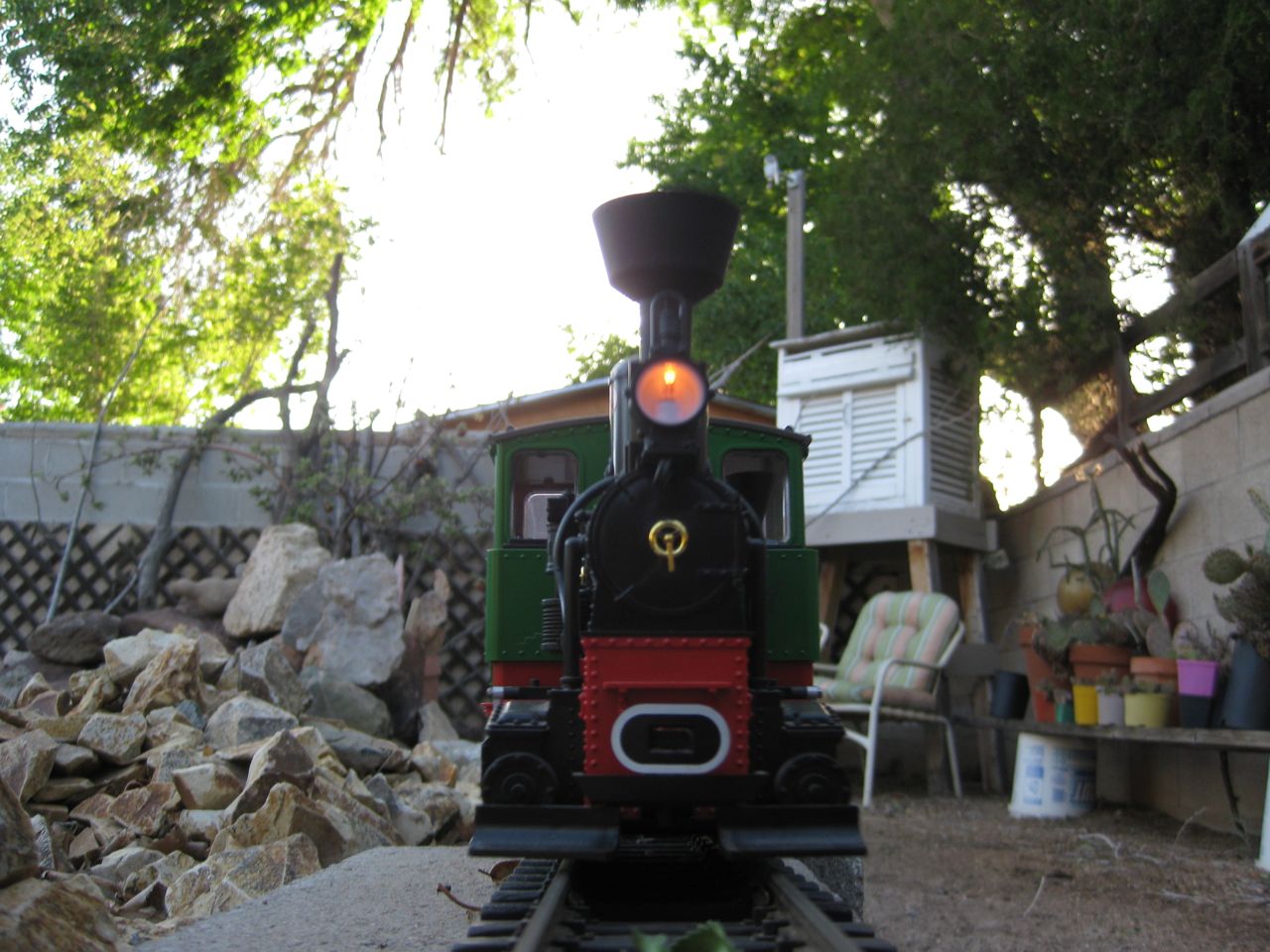
What I did on my spring vacation:

Backyard Train, May 2011

Backyard Train, May 2011

  • Lissa and I got the backyard train running (track needed a bit of post-winter sprucing up)
  • We rode the big people train to Santa Fe
  • I got new glasses
  • We got far more work done to the car than I expected
  • Slept in some, but got up early some too
  • I became more confused, not less, about the California Bay Delta Conservation Plan. (This is a good thing. Exposing and sorting out confusion leads to insight. More to follow.)
  • Did a ton of birdwatching. It wasn’t exactly the plan, but the spring migration is running full throttle, and did I mention that I got new glasses? Last night at the bosque ponds near Tingley Beach, new glasses perched on the bridge of my nose, the trees were alive with black-headed grosbeaks and summer tanagers and all other manner of tweeting winged things. I even saw bats. You don’t realize how badly you need new glasses until you get them, I guess.

LTRR’s New Home

I’m excited to see my friends at the University of Arizona’s Laboratory of Tree Ring Research moving to their new home. (The LTRR people were instrumental and hugely generous in helping me with my book.) But I’ll miss the hilarious stories associated with one of America’s great research institutions stuck inside a football stadium:

Great science has been accomplished in the stadium. Now we are looking forward to another century of discovery in a new building designed for us. We hope you will come and visit.

Dust Bowl Rhetoric Watch

From today’s New  York Times, a story about Boise City, Oklahoma:

Survivor of Dust Bowl Now Battles a Fiercer Drought

As I said before:

No.

No, no, no.

The Dust Bowl was decadal in scale. In the Oklahoma Panhandle, where Boise City is located, the dry went on for year after year – nine consecutive years in the 1930s with below-average precipitation. In the 2009-10 water year, the Panhandle had average precip. This year is, indeed, extreme. But the average over the previous decade is slightly above average. This is a very bad one-year drought. It is nothing like the Dust Bowl.

C’mon, Simone, let’s talk about *your* big “But”.

The Los Angeles Times reports that tragedy has struck the dinosaurs of Cabazon.

Looming over Interstate 10 on the way to Palm Springs, they are the sort of cheesy roadside attraction that makes this country great, an icon of childhood road trips to the desert. It’s the place Pee-wee and Simone cemented their lasting friendship, where she shared her dreams of Paris and Pee-wee asked about her “big but”.

And now, as Ashley Powers reports, they have been overtaken by the forces of darkness:

Dinny’s new owners, pointing to the Book of Genesis, contend that most dinosaurs arrived on Earth the same day as Adam and Eve, some 6,000 years ago, and later marched two by two onto Noah’s Ark. The gift shop at the attraction, called the Cabazon Dinosaurs, sells toy dinosaurs whose labels warn, “Don’t swallow it! The fossil record does not support evolution.”


Is Desal Really Only an Option at the Margins?

Rob Davis at Voice of San Diego has a nice overview of the proposal being considered to build a desalination plant on the coast of Baja, near Tijuana, to provide water for U.S. and Mexican users:

Together with the Mexican government, the agencies supplying San Diego, Los Angeles, Las Vegas, Phoenix and Tucson are studying whether to build a seawater desalination plant in Mexico capable of producing 50 million gallons of water daily, enough to supply 112,000 homes, as a way of reinforcing water reliability in both countries. Water would either be pumped to the United States or swapped for the rights to some of Mexico’s share of the Colorado River.

One hears a lot of talk about desal in discussions of augmentation of Colorado River supply. David Zetland calls its cost the “backstop price” for water in the southwest, meaning that once other options get more expensive, people will just build a bunch of desal plants on the coast and then swap around water inland.

But what struck me about this project, as Rob describes it, is how small it really is. 50 million gallons per day is about 56,000 acre feet per year. The average Lake Mead shortfall during the ’00s was 1.2 million acre feet per year. That’s the supply-demand imbalance we’re talking about. That would mean 20-plus desal plants just to close the current gap.

As Rob’s article notes, there are two currently under discussion of similar size – the Rosarita project and Poseidon up the coast in the U.S. Both have very long time lines.

Does this suggest desal is unlikely to be a very big piece of the long term supply picture?

(Rob’s article also has some interesting discussion of U.S. and Mexican regulatory issues, and the idea that putting the plant in Mexico is just easier. Good read for that issue as well, separate from the issues I’m raising here.)