
Headed toward the river on my bike yesterday, I ended up riding for a while with an acquaintance I hadn’t seen in a while. I mentioned I was working on a Colorado River book (it’s my standard excuse for “not having a lot of miles in my legs”, as the cyclists say) and talk turned to solutions.
My friend suggested growing less alfalfa – a whole lot less – might be one good option for addressing the basin’s supply-demand imbalance.
It was a great setup for what I’m trying to accomplish in the book. But I still have to work on the out-of-breath five minute version of my premise.
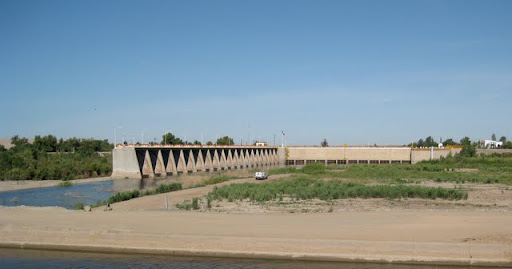
Morelos Dam, US-Mexico Border - the end of the Colorado River
It goes something like this: Sure, growing a lot less alfalfa and lettuce and the like is one solution. Or halting growth in Phoenix and Vegas (and Albuquerque?). Heck, how about abandoning those crazy southwestern cities? Or at least ending the practice of outdoor watering in them. Or massive investment in desal could do the trick.
The arithmetic version of the solution set is open-ended, but you get the idea. There are lots of ways to make the supply-demand equation balance.
The interesting part to me is how we get there. Because none of them are easy, and all will have opposition. What are the institutional processes by which we will go about choosing from among the various options, the political and legal framework with which we’ll either succeed or fail at this tough problem?
That’s why the new “Thinking Like a River Basin” report from Sarah Bates and the folks at the University of Montana’s Center for Natural Resources and Environmental Policy and Carp Carpe Diem West so interested me.
If you’re looking for answers to the Colorado River Basin’s growing supply-demand problems, you’ll be disappointed. But if you’re looking for an exposition of the problem space, from the perspective of the people in the institutions responsible for working the problems, the report is invaluable.
Bates and her colleagues interviewed 29 experts and decision makers. We get the list of folks interviewed, but all the comments in the report are anonymous, which has the result of giving a terrific flavor for the range of views held by the players at the table. There’s no effort to be prescriptive – to say what ought to happen. Instead, Bates and her colleagues simply plumbed the depth of two great questions:
- If the Colorado River continues to be managed pursuant to current laws, including the Interim Guidelines [contained in the 2007 Record of Decision], what conditions do you foresee in 15 years in terms of water shortages, water security, and interstate conflicts?
- What might be necessary to achieve a more satisfactory outcome in this time period and beyond? We’re interested in your thoughts about how to improve decision-making processes, certainty, meaningful participation by stakeholders, and political/financial support for innovative management solutions.
Key results include the fact that, while not everyone agrees that climate change is the reason, there is widespread agreement that water supply stress will only increase over time. Everyone seems to get that the river’s use is maxed out, and that shortage, both in the literal meaning of the word and also as formally defined in the 2007 shortage sharing agreement, is likely sooner rather than later.
Bates found widespread fear of litigation, while at the same time a widespread commitment to try to avoid litigation.
No one seems to want to reopen the Colorado River Compact, but there is a great deal of interest in continuing the processes embodied in the 2007 shortage sharing agreement – the continued tweaking of the Law of the River, which is more flexible and less fixed than many realize.
The most interesting part, to me, was the interest (at least on the part of some) in the creation of some sort of forum “to facilitate basinwide conversations”.
One of the report’s key conclusions:
Although some of the water management challenges facing the Colorado River Basin are physical, many are political. The division of the basin into two halves at Lee Ferry, and the allocation of entitlements based on that division, offers both a firm anchor for enforcing responsibilities and an arbitrary separation of a single river basin. At least some of today’s conflicts could be alleviated by a basinwide approach to water management, optimizing use of the basin’s extensive storage facilities to meet an overall water budget rather than focusing on water deliveries at Lee Ferry, and considering additional agreements similar to the Interim Guidelines to address shortages.
updated: Fixed one of my all time favorite typos – “Carp Diem” instead of “Carpe Diem”. Seize the fish? Fish the day? Thanks to GJ for pointing it out.


