
“the largest artificial watershed in the world”

I sat in the audience dumbfounded last month listening to Pat Mulroy speak at the 16th Annual Water Conservation/Xeriscape Expo here in Albuquerque. Mulroy is the head of the Southern Nevada Water Authority, the agency that wholesales water to the Las Vegas, Nev., area, and is arguably the most prominent figure in western water politics and policy right now.

Powell on the Colorado

Powell on the Colorado, USGS

I’d arranged for an interview after her talk, and I’d stayed up late the night before re-reading some ancient history that I wanted to talk to her about – John Wesley Powell’s ideas about organizing government in the West around watershed boundaries. There’s a theme I’ve been kicking around – the notion that, in building the system of dams and diversions we now use to manage western water, we’ve created in effect one uber-watershed that extends from San Francisco to Albuquerque, but that our systems of governance haven’t caught up.

I was hoping to get Mulroy to talk in our interview about some of the implications. So I sat there slightly dumbfounded when, in the talk itself, she invoked Powell’s ideas about watershed government and then said this (sub/ad req):

“We created the largest artificial watershed in the world,” said Mulroy… “That has created an environment of extreme interdependence.”

The problem, according to Mulroy, is that we do not have the political institutions and policies in place to manage the vast plumbing system we’ve created, leaving a risk of shortages and litigation.

OK, guess I can check that interview question off my list. 🙂

But in really diving into the details of what Powell was talking about this weekend, I’m beginning to wonder whether I’m not quite thinking correctly about this – or whether the differences between Powell’s formulation and the “artificial watershed” governance idea Mulroy and I are talking about exposes a problem in my thinking.

Powell apparently first sketched this out testifying before a congressional group, the Committee on Irrigation, in March 1890. There’s a lot I haven’t read yet, but the first reference I can locate (hat tip to Bill DeBuys’ Powell reader Seeing Things Whole, which has a nice discussion of this with references) is a discussion of the Rio Grande. And the watershed concepts he’s describing involve very small, self-contained units.

Here’s his elaboration, in Institutions for the Arid Lands, published in Century Magazine later that year:

[T]here is a body of interdependent and unified interests and values, all collected in one hydrographic basin and all segregated by well-defined boundary lines from the rest of the world. The people in such a district have common interests, common rights, and common duties, and must necessarily work together for common purposes. Let such a people organize, under national and state laws, a great irrigation district, including an entire hydrographic basin; and let them make their own laws for the division of the waters, for the protection and use of the forests, for the protection of the pasturage on the hills, and for the use of the powers. This, then, is the proposition I make: that the entire arid region be organized into natural hydrographic districts, each one to be a commonwealth within itself for the purpose of controlling and using the great values which have been pointed out. There are some great rivers where the larger trunks would have to be divided into two or more districts, but the majority would be of the character described. Each such community should possess its own irrigation works; it would have to erect diverting dams, dig canals, and construct reservoirs; and such works would have to be maintained from year to year. The plan is to establish local self-government by hydrographic basins.

Clearly “local” is a critical piece of Powell’s formulation that I haven’t been giving sufficient attention in my thinking.

I’m musing out loud here for two reasons. The first is journalistic. For the same reason Mulroy invoked Powell’s ideas in her talk, I like to invoke them as a story-telling device, a way to help make people make sense of this idea I’ve been working on that people all across the West are interlinked by common water systems in a web of interdependencies that are very real in a physical sense, but which our governance can’t quite handle.

But I’m also in that dangerous journalism no-man’s land, where I’m actually trying to advocate a policy approach. If I use it that way, it’s incumbent on me to get the history right.

$12 buys a lot these days

In the elevator at Mazano del Sol, the retirement apartments where Mom and Dad live. Lady gets in with a fabulous cane – wooden, lightly carved and lovely bright paint job.

Me: That’s a great cane? Does it have a story?

Her: Got it in Old Town. Twelve bucks. It works.

And she spryly strode out onto the third floor.

Science Communication

So I’m not sure how this happened, but apparently I’m all over the Internet this week as the token science journalist trying to defend my entire profession. Good luck with that, me.

  • Eli started it, and I tried to discuss things with him there. I figured I would get an indulgence since he was kind enough to single me out in the post as being, I think his words were “not a fucking idiot”. What was I thinking trying to engage in a thoughtful conversation? It’s Eli! I forgot. Stupid on my part. But there were some other participants in the comment thread who were pretty interesting, so it wasn’t a waste.
  • Stoat jumped in with a “me to too” to Eli. He also gave me a shoutout as being, I think he said, “not a fucking idiot“, one of the few “telling the truth”, but he has to say that, we’ve been co-authors. (I stand corrected)
  • Keith Kloor picked up the conversation, mostly to poke Eli (Eli and Keith don’t like one another – it’s kind of a soap opera), and the conversation thread was fun, though no one should have to read 100 comments. So forewarned. If you want to skip, though, the thread was my introduction to Andy, who was the smartest guy in the whole conversation. He excerpted his comment on his own blog.
  • Then Tom Yulsman joined in (disclosure: Tom and I once dined together on haunch of some forest creature – see link to photo at bottom of Tom’s post for a picture of the meal). I said mean things about Eli in the comment thread that I’m sure I’ll regret, but as I said, it’s a soap opera.
  • Michael Tobis and “willard” collaborated on an adaptation of Waiting for Godot that seems to have something to do with the discussion, though I’m not sure what. But the comment thread extended the conversation, for which I thank Michael.
  • Now I see Bart also has done a nice job of skipping through all the ill-tempered things we said and assembled a nice summary of the discussion that actually makes it look somehow reasonably coherent, putting Bart on par with Andy for actually having something useful to contribute to the whole affair.

There’s already six threads going with enough comments for a lifetime, so I’d prefer you don’t say the sames thing here that you’ve already said everywhere else. Unless it involves praise for my wisdom. Then please do come in and set a spell.

update: Clearly one way in which journalists suck is that we really badly need editors 🙂

River Beat: Bonus Water Likely

The March forecast out today (pdf) for this year’s operations on the Colorado River is looking very good for the chances of extra water to be shipped downstream to help top off the dwindling supplies in Lake Mead. The magic word here is “equalization”, which means that under the river’s operating rules, there is sufficient extra water upstream in Lake Powell to allow some extra water to be released to raise Mead’s levels in the direction of “equalizing” the amount stored in each reservoir:

Reclamation estimates that an April adjustment to the Equalization Tier is very likely to occur in 2011. For this adjustment to not occur, the April-July inflow forecast volume would have to decrease from the current level (9.2 maf) to approximately 7.1 maf which would be a decrease of about 2.1 maf. In the past 32 years, only once has the forecast decreased by at least this volume from one month to the next. For this reason, Reclamation estimates the probability of an April adjustment to the Equalization Tier in 2011 to be approximately 97 percent.

Mead, Powell Storage

Mead, Powell Storage, data courtesy USBR

Equalization, importantly, allows the Lower Basin states to get extra water above and beyond the Colorado River Compact’s requirement.

As you can see from the graph (click to biggen), which I’ve updated to include estimated storage volumes for the end of the current water year, Powell is now forecast to end the year ever so slightly below last year’s level, while Mead will see the largest increase in storage volume since the 1990s. In elevation terms, the surface of Lake Mead is now forecast, thanks to the extra water, to end the water year (Sept. 30) at 1105 feet above sea level, 21 feet above last year’s level.

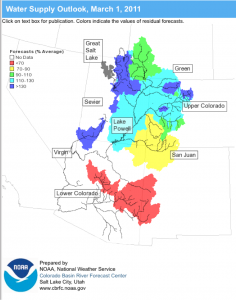
The runoff is the result of a snow season that has left much of the southern Colorado Basin terribly dry, made up for by a decent snow pack in the north.

Colorado Basin Map

Colorado Basin Map, courtesy CBRFC

As Shaun McKinnon reported today, Arizona is sucking a very dry dusty wind right now:

The numbers — especially the runoff forecasts — spell bad news for Arizona’s streams and rivers. With so little snow in the mountains, the streams and smaller rivers will dry up sooner, leaving less moisture for riparian systems. Rivers like the San Pedro, which is dry for long stretches in good years, and the Little Colorado could have particularly bad summers.

I had much the same to say about New Mexico in a story yesterday morning (sub/ad req):

The outlook for New Mexico’s water supplies this spring is grim, federal forecasters say, after a dry February sapped what little snow the state received earlier in the winter.

“It’s not looking real great at this point,” said Wayne Sleep of the Natural Resources Conservation Service.

Tallying up the snow at a network of measurement sites around the state, Sleep and his colleagues last week forecast just half the normal flow this year on the Rio Grande into Elephant Butte Reservoir.

But the farther north you get, the better things look, and all that snow melts and flows downstream in our direction. Yay nature.

Stuff I wrote Elsewhere: A Visit to Work Case 82B

From this morning’s paper, a visit to Work Case 82B (sub/ad req) at the University of New Mexico’s Museum of Southwestern Biology, where they keep that which has gone extinct:

The Carolina parakeet on the top shelf of Work Case 82B, green with a dingy red head, looks little different from the other 30,000 stuffed birds in the research collection at the Museum of Southwestern Biology.

The most noticeable difference — the case is locked.

The special care needed in curating and caring for the Carolina parakeet and the other residents of Work Case 82B is, from a museum management perspective, entirely practical.

“You can’t get new ones,” said Andy Johnson, collections manager of the bird collection at the University of New Mexico research museum.


Fighting for Atlanta’s water: what was it I was saying about lawyers?

In a thread last month, Francis offered this as one explanation for the prominence of lawyers in western US water policy discussions:

The states are co-equal sovereigns, and the feds have not invoked federal supremacy.

It applies elsewhere. In Georgia, the Atlanta Journal-Constitution reports, the state will go to court next week to argue for nothing less than Atlanta’s water supply:

On Wednesday, the state of Georgia will ask the federal appeals court in Atlanta to overturn a judge’s ruling that found it illegal for the Army Corps of Engineers to draw water from Lake Lanier to meet most of the metro area’s needs.

In that shock-and-awe ruling in 2009, Senior U.S. District Judge Paul Magnuson set a doomsday clock ticking. If Georgia, Alabama and Florida cannot arrive at a water-sharing agreement that is approved by Congress by July 17, 2012, metro Atlanta can only take the same amount of water it received in the mid-1970s.

That this may come down to lawyers arguing in court is an interesting outcome. The other potential solution is an agreement among states, which as I’ve discussed before in a post on former Reclamation commissioner Bob Johnson’s comments on the issue, seems to this westerner a perfectly reasonable approach given how wet it is out there:

The ACT and ACF basins have far more unallocated water to play with in sorting out the conflicts. “They’ve got 60 million acre feet of excess water,” he said. “On the Colorado River, we’ve got zero.”

But as a direct result of that lack of water on the Colorado, we’ve got a rich legal framework – the Law of the River – and accompanying personal and institutional relationships to go with it. “We have 80 years of fighting and working together,” Johnson said to the audience of Colorado River Basin water officials.

By comparison, in the wet climate of the southeast, water officials had few relationships with their colleagues in other states, and few institutional structures through which they could deal with problems when they arose, Johnson argued. In other words, they have plenty of water, but lack the tools they need to approach the problem of sharing. Because they’ve never had to think of it that way.

So while it may be true that we’ve got a lot of lawyers involved out west, the lawyering has so far avoided a major city going dry. But here we are, watching a federal court in Atlanta next week looking for a solution to what could be the nation’s biggest water problem: Atlanta (average rainfall 50 inches/125cm a year) going dry.

Links:

On Fear

Daniel Treisman:

Among the countries for which I have data, the most robust correlates of fearfulness relate to countries’ religious traditions. Fear tends to be higher in countries where more people believe in Hell and where fewer believe in Heaven.

Flood Irrigation

Chris Corbin argues that flood irrigation isn’t the bogeyman it’s frequently made out to be.

Some footnotes Chris and I came up in a twitter conversation:

This is all related to a post I’ve been cooking up, not yet completed, on the water policy version of the Jevons paradox. Its common formulation involves energy, and the assertion that efficiency measures don’t save as much energy as you think. Given groundwater recharge and return flows, the principle also applies to water.