River Beat: Yuma Plant Completes Pilot Run

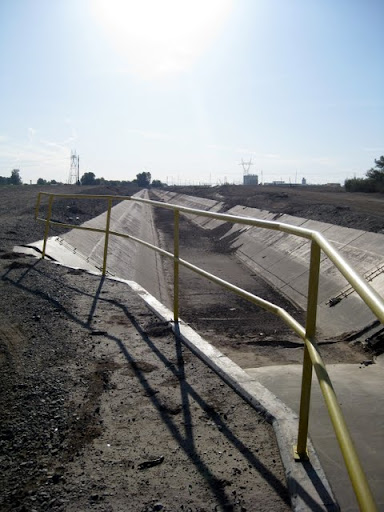
Yuma Desalting Plant Outfall

Yuma Desalting Plant Outfall

The US Bureau of Reclamation announced today that they’ve completed the pilot run of their Yuma Desalting Plant, cleaning up 30,000 acre feet of really crappy ag drain water. (“Crappy ag drain water” – my words, not theirs).

From Joyce Lobeck in the Yuma Sun (and seldom was their a more appropriately named newspaper):

Undertaken because of the 11-year drought in the Southwest, the pilot run started on May 5, 2010, to test the viability of the plant to augment Colorado River water supplies. In collaboration with The Metropolitan Water District of Southern California, Central Arizona Water Conservation District and Southern Nevada Water Authority, Reclamation operated the plant to gather cost and performance data needed to consider potential future operation of it.

In return for their funding support, the water agencies received credits in proportion to the water produced during the pilot run and each of their funding contributions.

The plant recycled 30,000 acre-feet of irrigation return flow water that was returned to the Colorado River.

As I’ve written before, the put-your-money-where-your-water-needs-are aspect of the YDP project are a great measure of who’s the most desperate for water from the Colorado River:

MWD is paying 80 percent of the cost. CAP and SNWA are each kicking in 10 percent. That willingness to pay on the part of MWD tells me something about who needs water the most in the near term.

Links:


Drought’s Over

Drought's Over

Jerry Brown: "Drought's over."

When the science team working on the National Integrated Drought Information System (NIDIS) invited me to give a media-communication perspective at a meeting back in the summer of 2006, I titled my talk “Maybe We Shouldn’t Call It `Drought'”.

The problem is that the word is used in so many different ways, meaning so many different things, that if not approached with care it can cause all kinds of trouble.

Kelly Redmond, from the Western Regional Climate Center (who, as it happens, was in the audience at my talk and made fun of my ill-fitting suit) wrote a great piece in the Bulletin of the American Meteorological Society back in 2002 taking on the problem of definition, and offering up a framework for thinking about the problem that has served me well:

Most concepts of drought involve a water balance. This implies that both supply and demand must be considered, as well as the question of whether there is “enough” (and, enough for what?). Thus, through time I have come to favor a simple definition; that is, insufficient water to meet needs.

There’s a second problem with the word “drought” that I think represents a more insidious problem: the fact that we don’t really have a word for the opposite of “drought.” Well, we do, I guess – “pluvial”? But when was the last time you saw that in a newspaper headline? The result is that when we’re on the dry side of the natural range of variability, we call it “drought” and go hunting for government bailouts. But when we’re on the wet side of the natural range of variability, we just treat it like it’s normal, getting all fat and happy.

Which brings me to today’s announcement by Jerry Brown that California’s drought is over. I love the language of the formal proclamation (all caps in original):

NOW, THEREFORE, I, EDMUND G. BROWN JR., Governor of the State of California, in accordance with the authority vested in me by the Constitution and the statutes of the State of California, do hereby PROCLAIM THE DROUGHT TO BE AT AN END.

I understand it’s very easy and a little cheap to make fun of a gubernatorial proclamation regarding such a natural phenomenon. I get that there are underlying legal and policy issues – that a formal legal declaration of “drought” triggers certain governmental actions, and that an anti-declaration is needed to unwind them.

But the turn-it-on, turn-it-off declaration issue really seems to me to highlight the underlying problem – it’s not that “droughts” are some unfathomable anomaly and now that it’s over we can all get back to normal. Consider this language in Brown’s statement:

“While this season’s storms have lifted us out of the drought, it’s critical that Californians continue to watch their water use,” Brown said. “Drought or no drought, demand for water in California always outstrips supply. Continued conservation is key.”

Whether we call it “drought” or not, the problem Redmond so gracefully highlighted – “insufficient water to meet needs” – has not gone away for Californians.

links:

Water: It’s All About the Governance

I sometimes feel a twinge of guilt about the water issues that so obsess us here in the Southwestern United States. Most of us have running water in our homes. It’s remarkably free of contaminants and pathogens. The arguments we have are generally about how to distribute this bounty, not whether we have it at all. Today’s reminder, from the Economist:

Pigs rootle fastidiously through the foothills of the mountain of rubbish dumped at Tuol Sen Chey on the outskirts of Phnom Penh, Cambodia’s capital. A few metres away, cross-legged amid the clouds of flies and shaded from a fierce sun by a broad-brimmed hat, Tim Chan Tha is sifting and flattening used plastic bags for recycling. A widow with three children, she earns about 6,000 riels ($1.50) a day for this. She lives nearby down muddy dirt roads, in a cluster of ramshackle huts of corrugated iron, salvaged wood and tarpaulins. Ms Tha’s life seems as miserable an example of urban poverty as could be found anywhere.

In one respect, however, she is lucky. Her home has a constant supply of running water, drinkable straight from the standpipe outside.

The substance here, if you’ll allow a pivot to the underlying issue we and Tim Chan Tha have in common, is that our success or failure in dealing with our respective water issues is a matter of governance.

(h/t the Water Wonkette)

A story worth telling

Spending a weekend (mostly) unplugged (I’m writing this on my iPod), Lissa and I ended up this afternoon at the Georgia O’Keeffe in Santa Fe.

In one alcove, photos of O’Keeffe on the Colorado River in Glen Canyon, circa 1964 – the year they closed the dam and began flooding it.

Apparently her friend Eliot Porter, the photographer, took her down the river. Note to self: There’s a hell of a story there worth telling.

Stuff I Wrote Elsewhere: latest on the jet fuel plume

From the morning paper (sub/ad req):

Groundwater contamination from a Kirtland Air Force Base jet fuel spill has spread farther than previously believed, according to a report presented to municipal water officials Wednesday.

A new test well drilled by the Air Force last year beneath a southeast Albuquerque neighborhood shows evidence of contamination, two blocks north of what was previously believed to be the spill’s northern-most reach, according to a consultant for the Albuquerque Bernalillo County Water Utility Authority.

The tests, done by the Air Force on water collected last October, show the contamination is “much farther along than we had anticipated,” David Jordan of INTERA Inc. told the water utility’s board of directors.


Stuff I Wrote Elsewhere: In Uncertainty Lies Risk

This week’s column, in which I play the national security card (sub/ad req):

These are the same folks responsible for maintaining our nuclear deterrent. They are thinking this way because the language of risk and uncertainty is familiar to people in the national security community, and it is their job to think about and help us prepare for bad things that might hurt our nation.

Theirs is a world in which thinking about “high-consequence, low-probability” events, things such as accidental nuclear explosions or potential enemies bent on our destruction, is a way of life.

And it is a world that is increasingly taking climate change seriously, not because of what we know about it, but rather because of what we don’t.


Never Mind

About that whole Colorado River shortage thing? Chill.

From a Central Arizona Project statement sent ’round to reporters today:

According to the Bureau of Reclamation, current conditions on the Colorado River indicate a 97 percent probability that more than 2.5 million acre-feet (more than 850 billion gallons) of additional river water will flow from Lake Powell into Lake Mead in 2011. The higher than normal release from Powell would raise water levels in Lake Mead about 25 feet, and delay a potential shortage for several years.

“Compared to where we were a few months ago,” stated CAP General Manager David Modeer, “this is really welcome news. We were looking at the possibility of a shortage as early as 2012, which would have caused CAP to lose access to nearly 20 percent of our Colorado River supply. With the larger projected release in 2011, it is highly unlikely we would see a shortage before at least 2016.”

So waddy’all think I should write about instead? Baseball season’s about to start. Maybe I could try my hand at sportswriting?


The Longest, Straightest Roads

Out on assignment yesterday we found ourselves on the stretch of New Mexico Highway 60 that crosses the Plains of San Agustin, out by the Very Large Array, I got to thinking about long straight roads. Between Magdalena and Datil, 60 runs 23 miles of absolute straight, not a single bend or deviation:


It’s the longest such stretch of road I could think of, but when I thought about it this morning, 23 miles doesn’t seem nearly as long in words as it did looking out across the plains from one edge to the other. Other examples, anyone?

Water in the Desert

Via the work blog, a hilarious tidbit from this morning’s New Mexico Drought Monitoring Working Group meeting – a Special Weather Statement sent out Saturday by the El Paso office of the National Weather Service:

For the last several weeks parts of the Rio Grande have gone completely dry…especially on El Paso’s west side. Many people have taken advantage of this and have been using the river bed as a place to ride all-terrain vehicles or horses. But on Friday the USBR began to release water from Caballo Dam. This water is slowly making its way down the sandy and dry Rio Grande. The water is expected to arrive in El Paso late on Monday. People who have been using the Rio Grande for recreational purposes should be aware that water will once again be flowing in the river late on Monday.

You know it’s a desert when you have to warn people ahead of time when there’s going to be water in their river. (Hat tip to Ed Polasko, the Albuquerque NWS hydrologist, who a well-developed sense of the ironies of the task of tracking water in the desert.)