
Fishin’ for help in thinking about NM’s water-population future.
Stuff I Wrote Elsewhere: Armageddon Edition
On the horrifying simplicity of the H-bomb, and the possible unmasking of “Perseus”:
Reed and Stillman suggest that the Soviets, desperate to solve the riddle of the H-bomb, returned to Perseus for one last favor in 1954.
However they got the idea, by late 1955 the Soviets had built and tested their own H-bomb.
h/t Bill Broad
Who Is Eli Rabbett?
Today’s Inkstain Search of the Day:
who is Eli Rabbett (sic)
I’m happy to note that I’m in good company in misspelling the good Dr.’s “name”. But I’m hoping that with this post I’ll claim the number one Google ranking.
The Predictability of Oil Prices
Economist James Hamilton, in his recent NBER paper, argues for economists’ inherent inability to predict oil prices. Luckily, we have Ana Anaya:
“Gas prices will definitely go up, I have to tell you,” she said. “I’m sorry to say.”
(ht Somegye)
What I Learned Before the Sun Came Up This Morning
My Christmas toy is a Kill A Watt, a cool little goober that you plug into an outlet to see how much electricity something uses. Today’s calculation: the desktop computer, despite being off, is responsible for about 2 percent of my average household electricity consumption.
Die, vampire! With my power strip that has an off switch, I drive a stake through your heart!
Gasoline Consumption Still Down
I remain amazed at this graph from EIA:

gasoline consumption
Consumption for the third week of December (the most recent available) jumped over the previous week, but it’s still 6 percent below the same week a year ago. Look at the right-hand tail on that graph!
The price, meanwhile, is $1.44 per gallon below last year at this time. You’ll recall from that economics class that you took many years ago that, ceteris paribus, (Gawd I’ve been wanting to say that!) a reduction in price leads to an increase in the quantity demanded. But ceteris is not paribus currently, on account of the whole economy being in the crapper and all, which means that income elasticity has taken hold, and we’re demanding an awful lot less gasoline.
The Energy Costs of Desalination
From my colleague Sean Olson, in today’s Albuquerque Journal (ad gated):
While desalinating water could become a valuable tool to support a growing New Mexico, residents will have to be ready to bite the bullet when it comes to the huge energy cost associated with the technique.
Experts say that cost comes in two forms: on water bills and in the environment.
“Here we are, trying to reduce energy use, and we’re looking at (water) options that use significant amounts of energy,” said Santa Fe water policy analyst Consuelo Bokum.
Feral Pigeons: Notes From a Blog Post I Never Got Around to Writing
- Went bicycling looking for killdeer. Found one, but in the process also saw more than a hundred pigeons. (I counted. Somewhere I wrote down the number. It was something like 167, but when the subject is counting pigeons, you shouldn’t trust three-digit accuracy.)
- There’s a great book about feral pigeons, called Feral Pigeons. Google books has it.
- Pigeons do well in cities in part because they’re cliff-dwelling creatures. We build artificial cliffs for them.
- Feral pigeons arrived in North America circa 1606 in Nova Scotia and Virginia.
- Darwin wrote about pigeons.
- Pigeons are the Warren Buffetts of birds. What they do looks absolutely ordinary, yet they do it with a spectacular success that is unmatched.
- My sister, Lisa, hates pigeons.
In a perfect world, I’d have the time to sketch out a path through story space that touches all those bases, but I’m off to bed, so I’ll let you imagine the line of argument I might use.
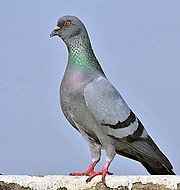
pigeon
Food Prices Rise
Has the global food price slide finally stopped? The Economist food price index is up 10 percent over last week.
Deflation
I’ve never lived through deflation, and don’t much understand its implications, so I’m reading Ben Bernanke’s Essays on the Great Depression
Consumer Price Index, with and without energy