Cheap Oil and the Investment Problem

Over at the day job, I’m finished looking at solar tax credits (to be printed on paper and thrown on driveways this weekend) and on to the oil price collapse. The question that interests me is the issue of infrastructure investment. Now that oil is under $50 a barrel, what’s happening to the investment in stuff like holes in the ground and big pipes to carry oil hither and yon? Let us turn to our friends at Bloomberg, who did some of the necessary heavy lifting earlier this week:

The biggest oil companies including Saudi Aramco, Royal Dutch Shell Plc and Petroleo Brasileiro SA are accelerating spending cuts and delaying projects as the world enters a recession, said Morgan Stanley & Co.

As many as 44 projects have been delayed and faced cuts in investments as of Nov. 18, compared with 19 in a Nov. 5 report, analysts Theepan Jothilingam and James Hubbard said in a note today.

Which brings us to the IEA’s recent report which, Richard Kerr summarized nicely in today’s Science (sub. req.):

Although price spikes and drops may recur for years, says economist Fatih Birol, “we think the era of cheap oil is over.” He and colleagues at the Paris-based International Energy Agency (IEA) just released their World Energy Outlook 2008. IEA analysts see enough oil still in the ground to satisfy ever-rising demand for decades to come–assuming the price continues to rise. But they aren’t at all sure that the Middle Eastern government-owned oil companies sitting on most of the remaining oil will be pumping it fast enough a decade or two from now to meet the unbridled demands of the rest of world.

The Problem of Hindsight

Great comment on an Arnold Kling post on the dangers of looking back to see who successfully predicted this mess:

People talking about a bubble is not the same thing as “knowing” there is a bubble…. Just as with the stories about pre-9/11 warnings of a terrorist attack, there are always those issuing warnings of one sort or another. The hard part is knowing when such warnings should be heeded and when they should be ignored.

U.S. Energy Mix

I’d been curious about what this graph might look like. From EIA:
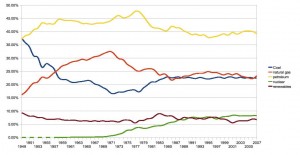
US Energy Mix

US Energy Mix

(Source: EIA – click through to see it bigger)

The interesting thing is that the U.S. energy mix largely stabilized, in terms of the share of total consumption from the main sources, in the late 1980s, and has been relatively unchanged since. Why is this? Did it essentially converge on a stable economic optimum? What role, if any, did government policies have on the shape of the our energy mix pie chart over time, both in arriving at the post-1980s equilibrium and before?

I don’t know whether this graph is telling us anything profound, but as we head into what is billed as a serious attempt to change our energy mix in dramatic ways, it’s worth thinking carefully about what federal policies, if any, have had the ability to shape our energy mix in the past.

Those Wacky Californians

For a journalist, making fun of California is a fish-in-a-barrel sort of thing, especially when it comes to water. But this piece from the AP takes the fun an extra mile. Love the picture:

Cookie Smith was surprised to learn the fake lawn that earned her a home-beautification award violated a city ban on artificial grass.

Her neighbor was shocked when he complied with a state order to conserve water and was instead threatened with a $50 fine for letting his grass wither to a brittle brown.

Running Low on Food

FAO thinks we should not be sanguine about falling global food prices:

[T]he gradual return to equilibrium in food markets should not be taken to assume that the world’s food problems have been fixed, neither in the short-run nor with a view to the longer-term challenges. Cereal stocks still need to be replenished and lower prices will again divert more supply from food to fuel. With only 433million tonnes in opening stocks, the cereal stocks-to-use ratio in 2008/09 is at its second lowest in three decades. To bring stocks back to their pre-crisis levels will require 40percent of the production increase in 2008. Bioenergy has already absorbed 100million tonnes of cereals in 2007/08. Falling feedstock prices and new bio-ethanol production capacities arriving, could stimulate new demand and thus moderate an otherwise more drastic decline in prices.

Daily “You’re Not Paying Enough For Gas” Report

From a bunch of guys in suits, likely not wearing Birkenstocks:

Members of the Journal’s CEO Council tasked with discussing priorities for the U.S. economy and finance offered several fairly uncontroversial suggestions to the incoming administration: implement a fiscal stimulus plan without worsening the long-term deficit, appoint a panel to address financial regulation, create an economic vision.

Tucked away in the proposal, in the category of long-term tax policy, was this political grenade: “consider raising taxes on gasoline.”

Thanks to John Whitehead for bringing this to my attention.