 One of the disconnects between science as it’s practiced and science as it’s understood by the public is “the results of the latest study”. When we report on “the results of the latest study,” the public is likely to be left shouting: “But last week I though they told me coffee was good for me!”
The trick, dear reader, is to look for consistency. If one study says coffee is good for you and the next one says it’s bad for you, chances are good this is an area where the science is hard and/or immature, and it’s wise to wait. On the other hand, if all the studies seem to be pointing in the same direction, using different methodologies and approaches the question, then chances are you can begin to think about hanging your hat on the results. It’s not that any one of them is the answer, so much as their collective wisdom is likely to be pointing you in a fruitful direction.
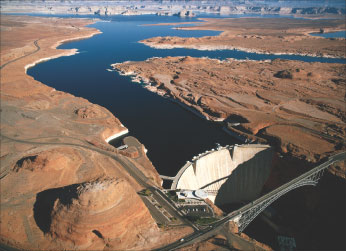
Such should, I think, be the response to a new paper in GRL next week by Greg McCabe and David Wolock on the Colorado River and climate change. The Colorado is the primary water source for much of the Southwestern United States. It’s already stretched to the limit. And McCabe and Wolock say that climate change is likely to mean a lot less water in the river.
There’s significant uncertainty in the models about whether precipitation in the Upper Colorado River Basin goes up or down as a result of anthropogenic climate change. But increasing temperature means more evaporation, which means less of whatever water falls from the sky actually ends up in the river. The average flow under a 2 degrees C warming is 17 percent less, according to the analysis by McCabe and Wolock. That’s consistent with previous studies, which have shown decreases of anywhere between 8 percent and 45 percent. (See “is coffee good for me or not” above. This coffee is consistently “not”.)
The really interesting bit of the new study is the way the authors used the tree ring record and a river management model to estimate the percentage of the time the flow in the Colorado would be insufficient to meet the requirements of the Colorado River Compact.
During the 20th century, the river failed to deliver enough water to meet compact requirements 7 percent of the time. If you take the 20th century record, slap a 2 degree C warming on top, that rises to 37 percent of the time. But if you take the driest period in the tree ring record and slap global warming on top of it, that rises to a whopping 77 percent of the time!
More reading:
- Warming may create substantial water supply shortages in the Colorado River basin, McCabe and Wolock, Geophys. Res. Lett., 34, L22708, doi:10.1029/2007GL031764. full paper for GRL subscribers, abstract (maybe, I was getting an error on the abstract link Saturday)
- nice summary by Brad Udall of the various Colorado River climate change studies
- Past peak water, Hoerling and Eischeid
- Christensen and Lettenmaier, A multimodel ensemble approach to assessment of climate change impacts on the hydrology and water resources of the Colorado River

 Per capita income in Kenya is $1,200. Climate change does not currently rank high on the list of pressing concerns of the residents of Nairobi, according to a
 Cleaning off my desk this evening, I found an interesting paper I’d printed and set aside to read weeks ago by