
We had a tad of snow when I awoke yesterday morning. Jimbo up in Los Alamos did a bit better.

As if drought, famine, rising sea level inundating coastal cities and the cancellation of international ski competitions were not enough, my colleague Dan McKay in this morning’s paper catalogues a previously unmentioned and potentially devastating consequence of global warming: It could harm Albuquerque’s famed balloon fiesta, “the world’s most photographed annual event.”
Worrying about the balloon fiesta may sound silly, but City Attorney Bob White said Wednesday that the concern is real, and that global warming could affect the wind conditions that allow ballooning to flourish above Albuquerque.
“As we do damage to our rivers and airshed, the Rio Grande box is something that is very important” that could be harmed as well, White said.
The “box” refers to a pattern of winds that blow in different directions at different altitudes. A pilot can take off from the balloon fiesta field in one direction, rise to a higher altitude and fly back over the field.
There’s a phrase that’s never appeared in the Googleverse. Until now.
From Saturday’s Washington Post:
“We have to deal with greenhouse gases,” John Hofmeister, president of Shell Oil Co., said in a recent speech at the National Press Club. “From Shell’s point of view, the debate is over. When 98 percent of scientists agree, who is Shell to say, ‘Let’s debate the science’?”
The interesting bit here is where I tip my hat for the link to the story: NEI Nuclear Notes. The nuclear industry seems remarkable enthusiastic about the scientific consensus on climate change. Perhaps it is because, as Roger Pielke Jr. recently noted, “There is no such thing as decisions driven by science. Decisions are always driven by values.”
If you’ve ever wondered where those “secret” underground bunkers are where they keep all our nukes, the Nuclear Notebook guys, Hans Kristensen and Stan Norris, have poked virtual pushpins into a Google Earth map. (Hint to Albuquerque readers: some are right under your nose, and I don’t mean at the Ghost Mall.)
More on Hans’s Nuclear Information Project site.
Never mind drought, famine, rising sea level inundating coastal cities, etc. This is serious:
High temperatures in Europe have disrupted the Alpine skiing World Cup, throwing the calendar of the sport’s premier circuit into disarray and raising questions about the future of a sport so vulnerable to climate change.
“It will very quickly be a big crisis for us if we continue canceling races in December,” said Atle Skaardal, who oversees the women’s portion of the tour for the International Ski Federation. “I think it’s very critical, not only for racing but for public skiing, which also has a big impact on racing. We all have to hope for colder temperatures and snowfall in Europe.”

In which I get references to The Graduate, Richard Feynman and Rumpelstiltskin into the same story.
Nanotechnology enthusiasts love to cite a classic exchange from the 1967 film “The Graduate.”
Mr. McGuire, an older businessman, is trying to explain the future to a young Benjamin Braddock. “I want to say one word to you. Just one word,” McGuire says. “Plastics.”
McGuire turned out to be right. Plastics are now ubiquitous. Nanotechnology enthusiasts think their vision— of disruptive, world-changing technologies made possible by manipulating matter at the tiniest of scales— will be much the same.
But the joke’s subtext also applies. “Plastics” was a 1960s buzzword, a bandwagon everyone wanted to jump on. Make “nano” your one word and you get the idea.
I love a parade, so Lissa and I went downtown last night to watch the Twinkle Light Parade. It was fabulous – lowriders decked out in Christmas lights with those wacky hydraulic bouncy thingies, marching cheerleaders cheering for Christmas cheer (Go Christmas!), a motorcycle cop with his bike decked out. And Santa!
But the surreal bit was early Saturday afternoon, when I rode through downtown on my bike ride. There, parked down Third Street like a giant non-sequitur, was Santa’s float, awaiting the great man’s arrival.
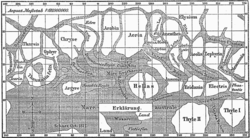
On University of New Mexico geographer Maria Lane’s fascinating work on the late 19th and early 20th century mapping of Mars (sub. req. or you gotta watch the ad):
Schiaparelli, Lowell and a host of others in the late 19th century were using advanced new telescopes to study Mars every two years as Earth made its closest approach to the red planet. But the telescopes did not yet have cameras. The astronomers’ data was recorded as sketches that were then turned into published maps.
And therein lies Lane’s explanation for the remarkable mistake.
The late 19th century was a time of exploration on Earth, and the map was the tool through which the Earthly explorers’ discoveries were shared with an eager public.
When Schiaparelli turned his eye to Mars, his first map adopted the visual conventions of the earthly map makers. Dark areas were not colored the ruddy reds and browns Schiaparelli saw through his telescope, but were instead shaded blue, like the oceans on a map of Earth.
This raises all kinds of interesting questions about the way scientific imagery both contributes to, and is a product of, the cultural landscape of its time. The full paper, which is great read, is here.
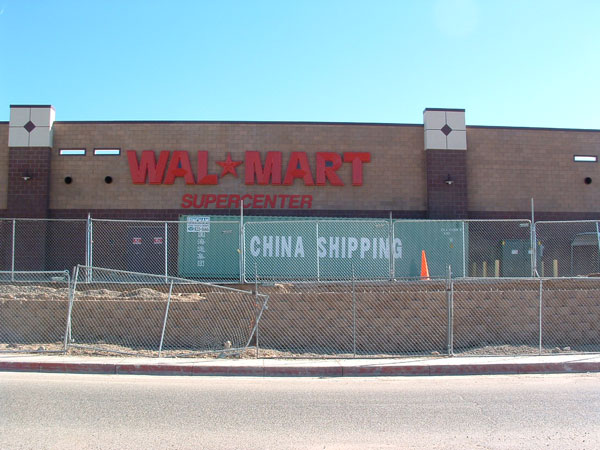
I didn’t have my camera with me this morning when I rode by the Wal-Mart up on Carlisle, so you’ll have to forgive this Inkstain file photo to illustrate today’s update on the onrushing Christmas consuming season. When last we tallied up the temporary shipping containers filling the parking lot behind this particular Wal-Mart superstore, it was a few weeks before Thanksgiving 2005, and there were 27.
This morning’s is just a rough count, because they’re so clogged up I couldn’t see them all, but my approximate tally as of Nov. 24, 2006, is 40. That’s a lot of stuff. Get out there and buy!
