
O’er the left field wall
Royals score insurance runs
Quiet at the park.
Seventh Inning Poetry
Pitcher, catcher, first
Bases loaded double play
Now it’s time to sing.
Drought in the West
Roger Pielke Sr. links to an interesting new paper about Holocene drought in the Rocky Mountain West, and makes a good point:
A reoccurrence of prehistoric droughts today would result in enormous social and environmental consequences.
Water in the Desert
I did a couple of water-themed bike rides this weekend, one intentional and one accidental.
I didn’t have the camera with me today, so you’ll have to take my word for it, but my chums and I rode up to the snow on the east side of the Sandias. By the cheap altimeter on my bike computer, it was at 8,400 feet (~2500 meters), a few patches of snow on the north-facing slopes. Given that this has been the driest winter here, and one of the warmest, since forever, I can only assume it was cold enough up there to have snowed while we were getting those few showers Friday and Saturday. It won’t be there long. My bike gizmo said it was 71 degrees F up there (22 C).
The water piece of that ride was accidental. Who knew we’d see snow?
But Saturday, I set out in search of it, riding up along the city’s flood control channels to see what ends up in our river after the first rain in a long time. It wasn’t pretty.


For those not familiar with Albuquerque’s geography, a large portion of the city spreads east from the Rio Grande toward the Sandia Mountains, neighborhoods built across old alluvial fans. The geomorphological implication is that water flowed across them once, but no more. A network of concrete channels has been built that funnels all of the area’s runoff into one big concrete drain that runs the length of town, dumping its contents into the Rio Grande at the north end of town.
There are no permanent streams, but even when it’s dry, there’s always a bit of water in the drain, runoff from leaky sprinklers and car washes and the like. When it rains, especially the first rain after a dry spell, the drain funnels off a toxic soup of ground up lead wheel weights, motor oil, lawn care products, etc. The term of art for this is “non point source pollution.”
The first picture is the water coming out of one of the laterals into the main drain. It looked pretty clean, but as I rode up along the drain I could see more and more crud. But the time I got to the spot where the drain turns into the river (second picture), it was icky. You can see from the hydrograph that it peaked at around 200 cubic feet per second Saturday morning, but the pulse didn’t last long.
Mission accomplished, I wandered back through the north valley, which created a strange sort of cognitive dissonance. That’s the third picture. Remember this is a desert, and that we’ve had 0.41 inches of rain in the last six months. And yet the valley’s lush. Ditches are running full, people are irrigating their acreage, the trees along the ditchbanks are transpiring like there’s no tomorrow. An odd site in the desert.
No Dogs
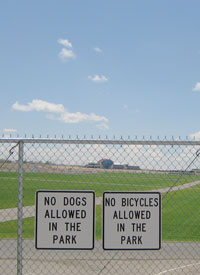 We know where we stand.
Beethoven and the Minnows
Breakfast with Beethoven this morning while reading an excellent article by my colleague Tania Soussan on the last decade’s history of water struggles on the middle Rio Grande. For readers outside the newspaper’s circulation area, the problem of climate variability hammered us in the mid to late 1990s when a two-decade pluvial switched off and things got dry:
Ten years ago this month, drought hit the Middle Rio Grande, delivering a wake-up call to a region that had been enjoying a stretch of winters with abundant rain and snow.
“It was kind of a rude awakening,” said Steve Hansen, assistant regional manager for the U.S. Bureau of Reclamation. “We weren’t even thinking about (water). We were just kind of wet and happy.”
In Praise of Benny Peiser
All four regular readers of this blog (Hi Mom!) are no doubt aware of my occasional consternation with Benny Peiser and his bollocksed-up reading of climate science. But despite that, I’ve been an enthusiastic consumer of Benny’s CCNet for years. I started reading it when I was writing a lot about near-earth objects – asteroids and the like – and very much in the thrall of the journalistic opportunities offered by the “Holy shit, we’re all going to die!” school of NEO thought. The range of discussion on CCNet has long been helpful in calming my journalistic impulses in that regard.
On climate, I think Benny has earned his critics’ scorn because of his enthusiasm for outliers in the face of a broad consensus about key questions about current and future climate. So I generally treat his posts on climate science as a quick way to track the outliers on one fringe and don’t pay too much attention, aside from the occasions when my annoyance, against my better judgment, boils over.
But one of the problems in the climate wars is the scientized way we all argue about the climate science while spending little time on the rather intricate questions of societal effects. Both sides have their views on this, but the discussion is engaged very little. That’s the set of questions on which Benny’s contribution is of great value to me – the questions of what impact climate variability and change had in the past on human societies and might in the future. I’m interested in this, because drought (variability) has been a defining characteristic of the development of human societies where I live. In that regard, Benny’s posted a couple of noteworthy items recently
No Record
Some doofus at the local rag wrote a story yesterday about how we were on the brink of setting a record for the driest six months in Albuquerque history.
Hah! I slipped in and out of sleep a couple of times early this morning to the gentle patterings of rain on the roof, and awoke to 0.13 in the backyard rain gauge. With the same at the official airport station between four and seven a.m., we’re now up to 0.41 inches since Nov. 1. Only the second-driest half year on record now.
Ocotillo
Lissa picked up an Ocotillo last fall at the going-out-of-business sale at Rowland’s Nursery. We’re well beyond its natural range, but it’s always been one of our favorite plants, and we see people have some success here with them. Today, Lissa noticed it had leafed out.

Also, L shot a picture of the Harison’s rose (she notes it’s got just one “r”).
On Changing Drought
Chris de Freitas, quoted in the Calgary Sun:
“The fear-mongering about more droughts and more floods is pure hype and pure speculation and is not based on science.”
(Hat tip Benny Peiser for the link.)
Dai et al., Journal of Hydrometeorology: Vol. 5, No. 6, pp. 1117–1130
Together, the global land areas in either very dry or very wet conditions have increased from ~20% to 38% since 1972, with surface warming as the primary cause after the mid-1980s. These results provide observational evidence for the increasing risk of droughts as anthropogenic global warming progresses and produces both increased temperatures and increased drying.