
Very late to the party, I finally got around to assembling what we know about that May 4 streak in the sky.
Stuff I Wrote Elsewhere
Attacking in a bicycle race— riding off the front of a pack of cyclists, heading into the wind— is either a fool’s errand or the sign of a champion, or both.
Tony Geller said he’ll always remember his riding buddy, Bill McLain, as “the guy who attacks all the time, any time.”
Out in front by himself or herself, a rider has to work harder against the wind.Protected in a pack, a rider expends less effort. But a race can’t be won from the middle of the pack. So in the mid-1990s, when he raced the old “Tuesday Night Crits”— short weekly contests among local racers, McLain would bolt from the pack as soon as he could to see who was strong enough to go with him.
His attitude, Geller recalled, was that if you were a strong rider, it was your obligation to attack, to push the race. And if you were a weak rider, you had nothing to lose.
“He would be off the front in the first lap or two,” said Geller.
But when McLain died May 6 of complications from melanoma at age 48, the tributes that piled up on the nmcycling.org Web site weren’t about his skills on the bike. They were about the contributions he made, large and small, to his community.
Even if you’re not a cyclist, it’s really worth reading the tributes to Bill over at the NMCycling forum. They’re beautiful.
Bird of Paradise
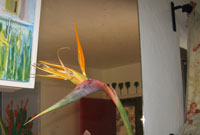 The house I grew up in had a beautiful bird of paradise in the front yard. I took it, like much that surrounds us as children, for granted (water to the fish), but in retrospect I recognize it as the most beautiful plant I’ve known.
Last Monday, at Albuquerque High School’s graduation, each student was handed a bird of paradise, the class flower of the graduates of 2006. The flowers seemed somehow unwieldy piled up in on a table to the left of the stage, neat and orderly but not quite matched, very much like the rows of students in their green caps and green gowns – neat and orderly, but not at all matched.
I did not expect the emotions I felt as I watched Nora pick up her flower, and the bird of paradise is the least of the thing. But I will let it stand in for something richer and more complex and difficult to articulate, and say simply that it adds a fond touch.
ENSO Forecast
The latest ENSO forecast from the U.S. government’s Climate Prediction Center shows continued uncertainty:
Most of the statistical and coupled models predict ENSO-neutral conditions in the tropical Pacific through the end of 2006 (Fig. 5). However, the spread of these forecasts (weak La Niña to weak El Niño) indicates considerable uncertainty in the outlook for the last half of the year.

East of the 100th Meridian
I threw on my raincoat a little while ago so I could go for a quick walk before bed. I had to. We’ve had more rain here in Indianapolis in the last eight hours (0.90 inch) than we’ve had in Albuquerque in the last six months (0.41 inch). I can’t remember the last time I’ve gone for a walk in the rain.
The Latest Models
Weather forecasting using astrology. (Hat tip Aaron.)
ENSO’s Predictive Value
I’m traveling this week (see here), so my attentions are elsewhere. But with time to kill this morning, I was cruising some scientific back alleys and found this fascinating bit of business in GRL. It seems that ENSO, the best tool available for seasonal forecasting in some regions of the world, may not be working as well as it used to:
The interdecadal variation of the relationship between ENSO and summer precipitation in China has been examined based on observed monthly rainfall data and NOAA ERSST data from 1951 to 2003. Results show that the relation has weakened during the past two decades, and the significance of ENSO as a predictor has also decreased.
Bill McLain
When I was first thinking about getting a road bike for cross-training (I was a runner at the time), I was quizzing my neighbor Bill McLain about what to get. Bill looked me over and asked, “How tall are you?” When I told him – six feet – he said, “I think I have a bike in my garage that might work for you.” I got the old frame repainted (Bill insisted – he knew a bike should look nice) and Bill built it up for me out of old hand-me-down parts – my first serious bicycle.
It would be wrong to say Bill changed my life. We change our own lives. But Bill helped.
My first bicycle race was his Moriarty Record Challenge – one of the great bicycle events around. Bill organized the Tuesday Night Crits, where I got my first taste of the hurly burly of racing in a crowd. One night when I pulled up to the crit starting line a little early, Bill walked over to me and said, “Word of advice.” And he tapped his hands on the drops, the curved lower part of the bike’s handlebars. “You really want to be down here,” he said. A little thing, a bit of soft help. And as I dropped off the back of the pack, racing home alone (nothing more pathetic than racing a crit by yourself) Bill said to me as I rolled past “Having fun, John?” And I was, a great deal.
In March, I was out helping out at the Route 6 road race, our season’s kickoff. Bill was there, running the show, as always, the empresario of New Mexico bike racing. He was very sick, and I guess it was the meds that made him cold, terribly cold. I gave him both my coats. How can you not give a dying man your coat?
Bill died this afternoon. I have no special claim here. His teammates, his family, his friends all have lost much more than I. But that’s the point, really. I’m several ripples distant on the pond, and he changed my life too.
Snowpack and Groundwater
A new paper in JGR-Atmospheres raises some significant questions about snowmelt and groundwater in the western U.S. in a CO2-warmed world. Sam Earman of the Desert Research Institute and colleagues used isotopic analysis to try to tease out the relationship between snowmelt and groundwater recharge. They found that, while 25 to 50 percent of precipitation falls as snow, snow is responsible for 40 to 70 percent of groundwater recharge at their study sites. Given the clear evidence of declining snowpacks in the west (see here), the implications are significant:
On the basis of these results and presently accepted scenarios for alterations in precipitation in the western United States over the next 50 years (significantly decreased snowpack due to increased atmospheric CO2), investigations of how climate change may affect groundwater resources are needed.
No answers here, just interesting questions.
Ninth Inning Poetry
Shanks’ fine outfield grab
Means little to the outcome.
Life in Triple-A.
(Hat tip Duke City Fix for the link to free Isotopes streaming baseball.)