
Johnny_Mango is on the beaver trail.
A New Hockey Stick
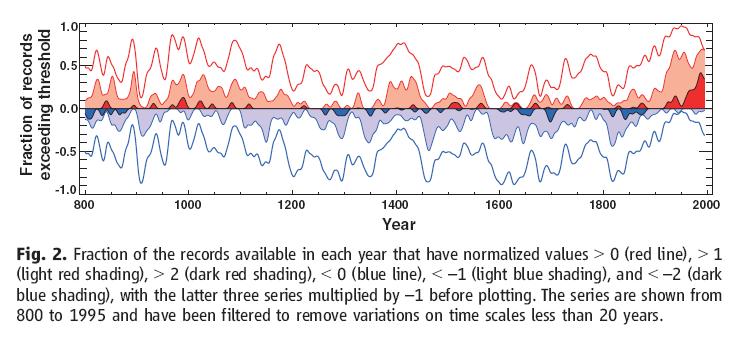
Timothy Osborn and Keith Briffa have a new paleoclimate reconstruction coming out in tomorrow’s Science with a familiar shape but an interesting new twist:
Global Cooling
The usual caveats apply: just a single number, more to understanding climate change than surface temp., etc. NASA’s GISS team has posted its global January number, with fodder for everyone to misinterpret. On one side, you could argue it’s cooling. (You’ve got to be careful in picking your starting year to make that case, but that does’t stop people from regularly doing it.) On the other side, you could argue that the five warmest Januaries in history globally have come in the last five years. Cherrypickers, have at it. Or you could just ignore the arguments and lay in a stockpile of salty snack foods in preparation for the winter Olympics.
Wait! Could we make a case that global warming threatens the winter Olympics?
More Deutsch
George Deutsch, the 24-year-old J-school political appointee working in NASA public affairs whose 15 minutes of fame included trying to explain the Big Bang “theory” to the space agency, never graduated from Texas A&M, as his resume had claimed, according to Andrew Revkin.
Surprises
Here’s a result that runs counter to the conventional wisdom:
The largest study ever to ask whether a low-fat diet reduces the risk of getting cancer or heart disease has found that the diet has no effect.
Big study, therefore strong result. I love surprises.
Daybook
health 1: So the whole reason for all this blogation today is that I’m home sick. I’m not in terrible shape, but took a clue when a friend at work yesterday covered up his mouth and backed away uncomforably as I hacked.
health 2: I hurt my knee Saturday. My bad knee on which I’ve spent so much frickin’ time and energy. I hurt it at a math competition. I was a spectator. There’s a joke in there somewhere. I pretty much freaked out completely. Now I’m in an uncomfortable netherworld between denial and hypochondria. I think it’s fine.
reading 1: Jared Diamond’s The Third Chimpanzee. Diamond’s funny. Collapse took some key ideas in Guns Germs and Steel and ran with them. Guns Germs and Steel, in turn, took some key ideas from The Third Chimpanzee. It’s like he keeps writing the same book over and over again, slowly zeroing in. (I like all three books.)
reading 2: For class tomorrow, Pacific and Atlantic Ocean influences on multidecadal drought frequency in the United States, by McCabe, Palecki and Betancourt. They use statistical magic to connect drought in the United States with decadal-scale ocean patterns in both the north Pacific and the North Atlantic. Their bottom line is that the current pattern of both matches up nicely with conditions that in the past have included widespread U.S. drought.
word of the day: mufti – I’m thinking of the second definition, i.e. civilian garb worn by a member of the military.
A Little Help from One’s Friends
If you can’t help a friend now and then set up a trail of Google crumbs to pediatric care in North Carolina, then there’s really no point in having a blog, is there?
Answering Roger’s Question
Roger Pielke Sr., in a post about the climate models’ difficulties in getting clouds right, poses this question:
How can international climate protocols, such as Kyoto, be established when the climate response to human climate forcings (and even natural forcings) is not adequately understood?
The short answer is that we make decisions all the time, large and small, in the face of uncertainty. We do it based on our understanding of the uncertainties, which we hope scientists have done a good job explaining to us. And we do it based on other values and considerations. The science can help us here, but it’s not the only input into the process.
Continue reading ‘Answering Roger’s Question’ »
More Floods, More Droughts
Gao et al. in a study this week in GRL modelling precipitation in Europe under increased greenhouse gases:
Changes in extreme precipitation events and dry spells suggest not only shifts, but also a broadening, of the precipitation distribution, with an increased probability of occurrence of events conducive to both floods and droughts.
Stuff I Wrote Elsewhere
Lest readers of this blog think my only journalistic avocation is climate: LANL May Begin Building Nuke Pits
By John Fleck And Michael Coleman
Journal Staff WritersWASHINGTON— Federal officials on Monday proposed expanding nuclear weapons manufacturing at Los Alamos National Laboratory, part of a sweeping plan to develop new nuclear weapons for the first time since the end of the Cold War.
By 2012, they hope to be able to make 30 to 40 new plutonium nuclear weapon cores per year, according to the Bush administration’s fiscal year 2007 budget request.
The government’s top nuclear weapons official cautioned that the new program remains primarily a research effort for now, aimed at finding ways to build safer and more reliable nuclear weapons. But the spending plan delivered to Congress on Monday includes, for the first time, a long-term spending plan for moving the weapons from the drawing board to production.
(Michael was the one in Washington. I just have a telephone, a pdf reader and an inordinate fondness for federal budget documents.)