
Land Use and Climate

Some old literature I was reading the other night carried shades of Roger Pielke Sr.’s argument that land use changes are important to climate change:

Notwithstanding the apparent uncertainty of the seasons, it is found that the mean temperature of particular localities is very constant, provided we compare observations made at different periods for a series of years. Yet, there must be exceptions to this rule, and even the labours of man have, by the drainage of lakes and marshes, and the felling of extensive forests, caused such changes in the atmosphere as raise our conception of the important influence of those forces to which even the existence in certain latitudes of land or water, hill or valley, lake or sea, must be ascribed.

That’s from Charles Lyell’s “Principles of Geology,” published from 1830-1833. Lyell was a leader in the community of geologists trying to make sense of why there were fossilized sea creatures on the tops of mountains, and why there was fossilized jungle flora and fauna in places were no jungles today exist. He therefore spent a lot of time trying to understand how climates could change. He ascribed the changes in climate to changes in physical geography – sea basins pushed up to form mountain ranges, for example. That, he assumed, drove climate change, and did so on vast time scales. (Lyell, like Darwin, was part of that first generation of scientists who realized they had “deep time” to play with, and busied themselves making the most of the opportunity.) Anthropogenic land use changes notwithstanding, Lyell didn’t expect climate to change very quickly:

(H)owever great, in the lapse of ages, may be the vicissitudes of temperature in every zone, it accords with our theory that the general climate should not experience any sensible change in the course of a few thousand years, because that period is insufficient to affect the leading features of the physical geography of the globe.

Deutsch on the Big Bang

From Andrew Revkin’s story in yesterday’s Times:

The Big Bang is “not proven fact; it is opinion,” Mr. Deutsch wrote, adding, “It is not NASA’s place, nor should it be to make a declaration such as this about the existence of the universe that discounts intelligent design by a creator.”

It continued: “This is more than a science issue, it is a religious issue. And I would hate to think that young people would only be getting one-half of this debate from NASA. That would mean we had failed to properly educate the very people who rely on us for factual information the most.”

Monthly Report

Everybody’s yammering about the warm January in the U.S., with the entire country seeing positive temperature anomalies (hat tip Mike Mann for graphic and discussion of global climate change implications of all this)

January 2006 US temperature anomalies

If you look at the map linked above, you’ll see that Albuquerque, at 3.8 degrees F above average, is in a region that saw smaller anomalies than most of the nation. We tied for 14th in National Weather Service records going back to the 1880s. Seven of the warmer Januarys have come since 1990.

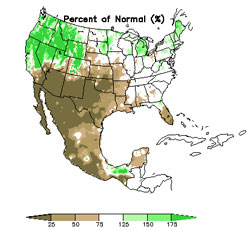
The map of January precip anomalies looks a bit different, but downright dire here. No single month matters completely, but a look at the 90-day map should be enough to startle you:

90-day precip anomalies, January 2006
(Source: Climate Prediction Center, NOAA)

Expect more of the same. The CPC announced yesterday that we’ve officially crossed the La Niña threshold as a result of cooling in the equatorial Pacific. La Niña, which has really been lurking in the wings for a while, tips the odds toward the sort of map you see above – dry across the southern US and Mexico.

WikiFun

I’m taking a class on drought from Dave Gutzler at UNM this semester. Last week’s topic was the strengths and weaknesses of the Palmer Palmer Drought Index, the widely used standardized measure of drought. It’s a graduate seminar, which last week meant me leading the discussion on Palmer. Since I did a bunch of work preparing, I updated the Wikipedia entry on the topic. Leveraging the commons includes giving when it’s something you’ve got that can easily be shared.

Sen. Wonk, D-N.M.

I say this with the greatest affection. Jeff Bingaman is a wonk.

From Cornelia Dean’s story in yesterday’s New York Times on a briefing on Capitol Hill attempting to explain what science is:

(T)he briefing’s subject apparently struck a chord. More than 100 committee staff members, Congressional aides and at least one senator, Jeff Bingaman, Democrat of New Mexico, crammed into a basement meeting room.

Voodoo Science

Well down in a tortuous thread, a commenter asks why a new and different explanation for surface warming of our planet is not being considered in our ongoing global discussion of climate change.

I won’t begin to try to detail the explanation, but at the risk of being unfairly pejorative in my description of it, I’ll simply say that the only place it seems to show up is on a Geocities page and in the frankly marginal journal Energy and Environment. (By “marginal,” I mean that E&E is not a scientific journal at all, is not peer reviewed by scientists, and is, by the editor’s admission, a vehicle for her political agenda.)

In my work as a science journalist I am frequently confronted with ideas of this sort. They involve a bright individual who approaches me with an insight that suggests that the conventional scientific understanding of some question – gravity is the most common – is completely wrong. Sometimes it’s the scientist him or herself that approaches me, and sometimes an enthusiastic supporter.

It is possible that these new ideas will turn out to be useful. But invariably, upon scrutiny by a scientist with expertise in the field (remember I am not that person), they turn out to have missed or misunderstood something fundamental.

It is my way to try to be polite. As a journalist, I have an obligation to listen to as many people with as many different ideas as I can. But there has to be a cutoff point, or I’d waste a lot of time on this stuff. Here’s my simple way of triaging: has this new idea gained any traction in the scientific community? If it hasn’t, then I’m not going to waste much time on it.

Four years ago, at an American Physical Society meeting, I listened to a talk by Los Alamos physicist Emil Mottola offering a radically different explanation for how black holes work. After the talk, one of the physicists in the audience followed him into the hall excitedly and said, in essence, “I think you’re completely wrong, but this is really interesting!” And a cheerfully spirited exchange ensued. If the statistical proporties governing radical new scientific ideas are to be believed, the odds clearly favor Mottola being wrong. But at least he’s out there gaining some small amount of traction among the folks working on the question.

Life is short, and there are far more than enough useful challenges to the scientific orthodoxy that do gain enough traction to be interesting to spend time on those that don’t.

Schwarzenegger, California and Climate

There’s an op-ed in the 21 January New Scientist from California Gov. Arnold Schwarzenegger laying out his case for action on greenhouse gas reductions:

In California, we are already seeing potentially severe impacts: shrinking of our snow pack in the Sierra Nevada mountains, which reduces our annual water supplies; erosion of our coastline; flooding of farmlands in the Central Valley; and a wide variety of health impacts related to changes in seasonal temperatures.

The snowpack/temperature piece of is being ably explored by Phil Mote and his various coauthors (see here for a bunch of Mote’s other work). But Schwarzenegger’s comments on flooding popped out because of a new paper in GRL by Edwin Maurer of Santa Clara University on the effect of warming on conditions in California during an El Niño.

Continue reading ‘Schwarzenegger, California and Climate’ »

Othello

Playing Othello with Nora is pretty much a win-win for me.

If I win, I get the visceral pleasure of victory. If she wins, I get the pride that comes with watching your child succeed.

Othello board, white wins

To be honest, I much prefer kicking her ass. She played white this evening, and of course I’m a very proud parent.