
Wandering through my newly acquired baseball encyclopedia, I was looking at the records of some of baseball’s greats, and it got me wondering about baseball’s worst. Who, for example, is the worst pitcher in baseball history? It’d be easy to pick on someone like Bill Abernathie, who pitched two innings for the Cleveland Indians back in 1952, gave up four hits and three runs, and disappeared from major league baseball. But that’s cheap. The problem is that there’s a long tail on the right side of the curve of ballplayers who never made it to the major leagues. What I’m really interested in is the worst good pitcher – good enough to stick around. So what should be the benchmark? Ten seasons? 200 games? I found a discussion on a baseball message board that suggested 1,000 innings. What do you think?
Reviews of “Collapse”
I very much liked Jared Diamond’s Collapse, but as a non-specialist in the fields he writes about, I approached this work (like Guns Germs and Steel) with a bit of trepidation.
So I was pleased this morning to run across this collection of reviews from the latest issue of Current Anthropology.
Daybook
weather: Looks like this morning’s overnight low of 40 set a record for Dec. 26 – 5 degrees F warmer than the old record of 35. It got down to 37 at my house, according to my new Christmas weather station. (update 10:19 a.m. – Doh! It’s the 27th, the record’s 40 set in 1923, so we just tied it.)
book: Who is/was a better pitcher – Roger Clemens or Sandy Koufax? No question my my nostalgic mind – “Swung on and missed, a perfect game!”. But according to to the stats gremlins of the ESPN Baseball Encyclopedia, who calculate an adjustment based on home park and offensive production of the day, it’s Clemens.
word(s) of the day: “loose box” – it’s a British phrase for “a stable or stall in which a hourse is kept without a tether”. (source: Oxford Dictionary of Current English)
Suburbs?
Coco explains why Corrales et al. weren’t really suburbs of Albuquerque back in 1750.
Suburban-style development grew around existing villages after the first and second world wars as agriculture declined and land was sold or lost to taxes.
Beavers in the Bosque
My friend George, who commutes to work by bike very early in the morning, has seen beavers in the bosque a couple of times, at dawn on the west end of the Alameda Bridge where the Corrales drain empties into the river. I’ve never seen ’em, though I’ve seen gnawed tree trunks many times. But today, riding along the river trail down near the botanical gardens, Joe and I saw this:
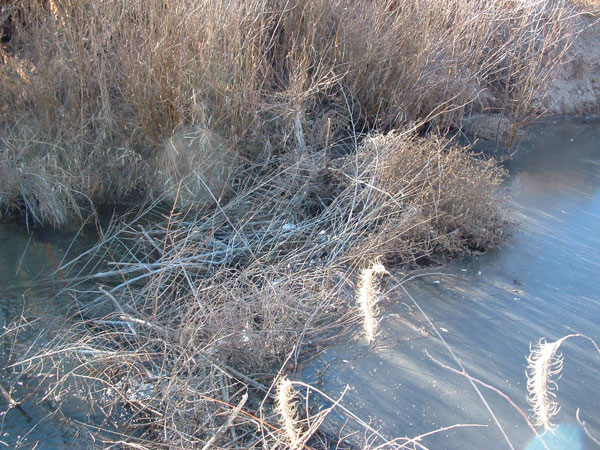
It’s in the drain along the east side of the river, and I could have sworn it was a half-assed little beaver dam.
Lissa and I went back this afternoon with camera in hand for a closer look, and now I’m not so sure. I want it to be a beaver dam. I could see some bits of wood sticking out of the water that looked gnawed, but up close there were clearly some sticks that had been cut off cleanly, like with a clippers.
Happy Christmas Parties
With help from Nora, the Easy-Do Parties lady wishes you and yours an electric Christmas.
Our Festival of Getting Lit Up
There’s been much curiosity in our household about this Festival of Illumination thing. How will we certify that Albuquerque really has lit up 3 million (5 million?) luminarias to convince those Guiness World Record sticklers? Some sort of Santa-borne spy satellite? The honor system? Isabel Sanchez has the goods (sub. req.) in this morning’s paper:
The London-based accountant of extremes— and measurer of yodels and rodent mail— rejected the festival’s application because Guinness doesn’t have a category for luminarias.
Stuff I Helped Write Elsewhere
With Tania Soussan, the latest (sub. req.) on our meager snowpack and prospects for the future. The current conditions:
The upper Rio Grande, Rio Chama, San Juan and Cimarron river basins have less than a third of the normal snow water equivalent for this time of year, according to the Natural Resources Conservation Service’s Snotel network.
The Sangre de Cristo Mountains are at 24 percent of normal, the Jemez at 15 percent and the Gila at 9 percent.
“If you look historically, this is a real slow start to the season,” said Tom Pagano, a snowpack forecaster at the Natural Resources Conservation Service in Portland, Ore.
The forecast:
With a growing La Niña in the Pacific, federal forecasters say odds favor dry weather across the Southwest for the next several months.
More Hurricanes
The question of whether global warming is bumping up hurricanes gets another good airing in today’s Nature, with two strong arguments against the suggestion that Kerry Emanuel made in August in Nature (sub. req. for the Nature links) of a global warming-hurricane link.
Just as Emanuel’s initial work was seized upon by the left (“As this season’s hurricanes slam into our coastlines, MIT scientists have hit us with a dose of reality: global warming is to blame.”) I expect this new bit of work questioning the global warming-hurricane link to be seized upon by the right. (My prediction: a new Tech Central Station piece coming soon to supplant their previous discussion.)
But this is really too important for cherry-picking. The scientific back-and-forth suggests this is really very unsettled, and the political opportunists on both sides ought to back off. Further study is clearly needed.
Weapons of War
From the “50 and 100 years ago” feature in this week’s Nature (sub. req):
A recent survey shows that the study of physics in American public high schools has been declining for more than half a century… why [does our youth] turn away from a career in science? We can only grope for the answer. Perhaps they sense, better than their elders, that too much of our scientific talent is engaged in the unproductive task of developing weapons for war. Is there much inspiration to devote one’s life to this end, when we are rapidly approaching the borderline of total destruction?
That is from a 1955 plea by Milton W. Rosen of the Naval Research Laboratory on behalf of human space flight.