
There was a joke I read somewhere about the dorky appearance of a cyclist in tights varying with the square of the distance from the bike. Yeah, that seems about right. And the baseball bat doesn’t help.
Britain in the Freezer
I missed this paper (Nature, subscription required) when it came out last month. It’s pretty interesting. Ruth Curry, from the Woods Hole Oceanographic Institution, and her colleagues measured changes in salt and fresh water in the Atlantic:
The oceans are a global reservoir and redistribution agent for several important constituents of the Earth’s climate system, among them heat, fresh water and carbon dioxide. Whereas these constituents are actively exchanged with the atmosphere, salt is a component that is approximately conserved in the ocean. The distribution of salinity in the ocean is widely measured, and can therefore be used to diagnose rates of surface freshwater fluxes, freshwater transport and local ocean mixing – important components of climate dynamics. Here we present a comparison of salinities on a long transect (50 S to 60 N) through the western basins of the Atlantic Ocean between the 1950s and the 1990s. We find systematic freshening at both poleward ends contrasted with large increases of salinity pervading the upper water column at low latitudes. Our results extend a growing body of evidence indicating that shifts in the oceanic distribution of fresh and saline waters are occurring worldwide in ways that suggest links to global warming and possible changes in the hydrologic cycle of the Earth.
That’s a bit dense, but there’s a “holy shit” buried in there for those of you in Britain and elsewhere in Europe. Y’all are being warmed by a big-ass current flowing up the Atlantic, bringing warm water from the tropics. The “Wally Broecker hypothesis” is that global climate change caused by greenhouse gases could cause the conveyor belt to shut down. Bingo. European ice.
Geoffrey Lean, in The Independent, gives an altogether too breathless take on Curry’s work:
Britain is likely to be plunged into an ice age within our lifetime by global warming, new research suggests.
“Likely” seems all too strong a word, if my understanding of the science is correct, but “strong possibility”, especially given Curry’s apparent empirical support for Broecker’s hypothesis, doesn’t seem far from the mark.
People and Climate
Another library gem:
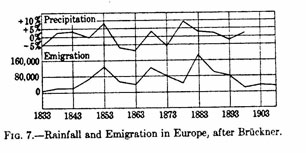
That’s from the 1914 book “The Climatic Factor As Illustrated in Arid America”. The analysis that goes with the graph seems, with our centuries’ worth of hindsight, a bit naive. The argument is that when it rains too much in Europe, crops fail, so people move to America. The link between climate and human culture is more complicated than the graph’s neat correlation would indicate. But what’s so amazing is not that the author was simplistically wrong, but that he was posing these great, penetrating questions that rightly supposed that the climate-culture link would be huge and important and worth our time.
Leonardo and the Tree Rings
I found a little gem in the library this afternoon in Isis, a journal “devoted to the History of Science and its Cultural Influences”. My old college mentor Joe Maier introduced me to Isis, so it felt a little nostalgic pawing through its pages.
What interested me was a little trifle published in the back pages of the December 1945 issue entitled “When was tree-ring analysis discovered.”[1]
I’ve been following back footnotes from George Webb?s scientific biography of A.E. Douglass[2], and Webb mentions the marvelous factoid that it was Leonardo (What was it an old colleague used to say? “Great story. Better if true.”) who first suggested the possibility that tree rings could be used for the study of climate.
(Click through to read the rest, it’s really long.)
Continue reading ‘Leonardo and the Tree Rings’ »
Planet GNOME Test
Prodded by Glynn and aided by the fact that Dave Camp was smart enough to write it down and publish it when he figured out how to do it, I changed my RSS feed so the whole entry now shows up, meaning the whole entry is now published on the planet. This is a good thing, except that lately I’ve been rather blathering on with some very lengthy posts (I’m using the blog to work out ideas), and I don’t want to bore folks unnecessarily. So my idea is to figure out how to make stuff in the “read more” MT bit (additional entry text, I believe it’s called) not show up in the RSS feed. Here’s a test to see if this works.
Continue reading ‘Planet GNOME Test’ »
Bananas
I returned from a meeting out of the office today to find two bananas on my desk. One had a sticker on it suggesting that fresh fruit can reduce my risk of cancer. Seemed reasonable, so I ate the banana.
Unintelligent Design
An interesting new group has emerged in Ohio: the Unintelligent Design Network: “Although life was designed by an all-powerful creator, he is in reality pretty dumb and not very good at it. ”
(From Dave Thomas.)
Committing Journalism
I’m not a political journalist, so maybe it’s a little bit easier for me to make fun of the whole process without feeling too much shame or accountability. But I sure am enjoying Joshua Micah Marshall giving voice to the vague discomfort he feels at the way the thing is done. This morning it was the bizarre way in which one covers the Democratic debate “in person” by watching it on a big-screen TV with a bunch of other journalists. Why not just stay in your hotel and watch it on TV there?
Seeing it in person would certainly add something to one?s reportage. But you never see it in person. Generally how it works is this: You?re in a big complex and there?s one large hall set aside for the actual debate. In that room you have the candidates, a few of their handlers, the moderator/questioners and the audience. Oftentimes you?ll have a tiny handful of journalists there too — but only ones from the highest echelon of the elect. Maybe a Koppel or a Mitchell — folks like that.
Everyone else is in a big room somewhere nearby with a bunch of long school room tables arranged as they might be for an SAT test in high school. And space after space at those tables is occupied by journalists with laptops open, a phone at each station, perhaps some other paraphernalia nearby or a parka, watching the debate on a series of big TVs.
In other words, they?re watching the debate on TV just like you are. Only they?re doing it in a big room with all the other journalists.
Now, this can be kind of fun, because you get to see a lot of other people you know, and a number you haven?t seen in a while. And you get a very good sense of how other reporters think everybody did. But that can be a pretty skewed view, an echo chamber in the making in ways you can probably imagine, even if you don?t spend much time talking to the really egregious above-it-all conventional wisdom types.
Partisan Science
Something I wrote elsewhere, in which I invoke the work of the incredibly interesting Roger Pielke Jr..
ATMs and bad UI
Seth Nickell on bad ATM user interfaces:
Despite the fact that most ATMs only handle money in multiples of $20, they still require you to enter the “cents”. So asking for $40 entails the button sequence 4-0-0-0. I almost always withdraw $40, so I perform this series of presses without a lot of higher brain involvement. Unfortunately, this ATM fixed a “bug” in the way 95% ATMs work: they only let you enter whole dollar values.
The ATM’s I’ve been using say on screen, at the end of the transaction – “Be sure to take all bills.”
Is this a problem? I can understand Seth’s rather comical tale of losing his card, but do people regularly forget to take their money?