Two things we do with water

Westbourne River, in a pipe

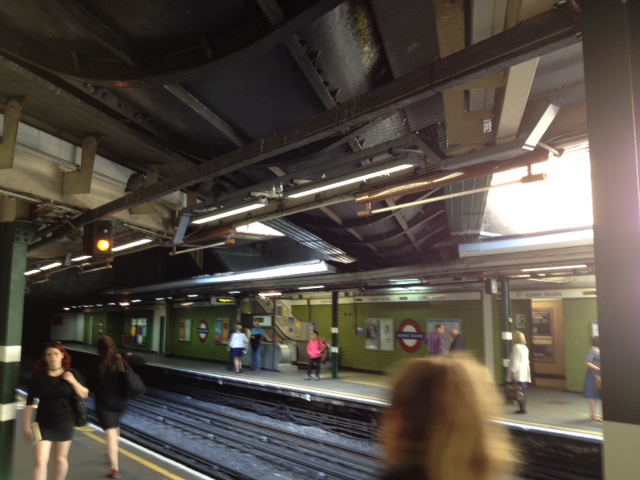
There’s a huge steel pipe running above the trains in the Sloane Square station on the London Underground. Depending on the historical time period you’re talking about, you could call it the River Westbourne or the Ranelagh Sewer. As Paul Talling explains:

As this area developed into the desirable location it is today, the final stretch of the increasingly filthy Westbourne was culverted between 1827 and 1854 and renamed Ranelagh Sewer.

The Ranelagh/Westbourne dumped into the tidal Thames where the Chelsea Bridge is today, across from Battersea Park. The outfall was immediately adjacent to what was, until 1856, the intake for the Chelsea Waterworks Company which, John Snow wrote in his 1855 On the Mode of Communication of Cholera, “supplies some of the most fashionable parts of London”.

More on Snow later. Suffice for now to point out that it was Snow’s insights linking cholera to something icky in the water that changed modern medicine and public health.
Walbrook Wharf

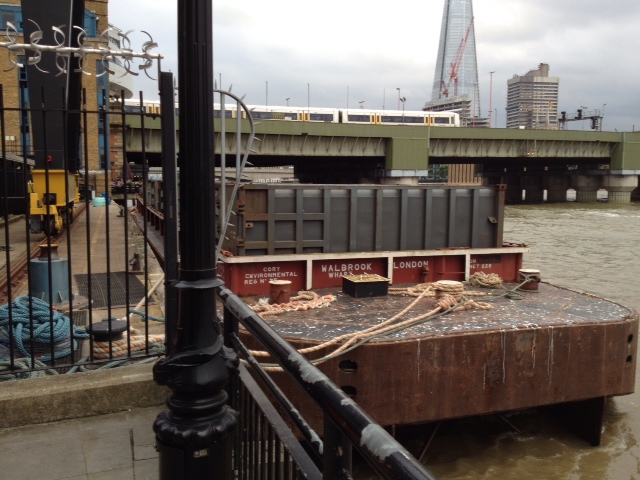
Walbrook Wharf

“[C]ities,” wrote Steve Duncan, “are organic growths that re-use and build on their past. Therefore almost nothing in an older city is going to be perfect, because the systems and infrastructure in use are so often leftover from an earlier period of growth.” Early London grew up around the Westbourne and a host of what are now lost rivers – the Fleet and Walbrook especially in the area of town Lissa and I are staying – and then fouled them completely, and the Thames for good measure. You have to dump your shit somewhere.

So the old river courses were culverted over and then repurposed as sewers. Around the time Snow was doing his thing, the repurposed sewers were linked into a network that shunted the shit further downstream, while the Chelsea Waterworks people moved their intake upstream. It’s an imperfect system, but you work with what you’ve got, right?

We’re no drainers, but Lissa and I did find the end of the Walbrook the other night. It was the river that flowed through the old Roman London (the walled city, hence “wall brook”). Its outfall today is at Walbrook Wharf, where container ships fill daily with London’s garbage for the trip to Essex. Seems fitting.

Rivers and human geography

Water draws me:

There are no “rivers” proper in the part of Southern California where I grew up. Perhaps that’s why I’m so drawn to water. Or maybe it’s just part of the human condition? I can imagine an evolutionary benefit to being drawn to water. Whatever. Wherever I am, I end up walking to the water, along it, looking up it and down it, trying to understand where it’s coming from and going to.

In his London: A Social History, Roy Porter explains that London’s was founded at its particular spot along the Thames because it was the closest place to the sea along the big tidal river where there was good access to the river banks, the first gravel beds where boats could easily land and people could cross. And of course water to drink, and fish in, and dump waste in, though it was some time before the region’s inhabitants sorted out the uncomfortable incompatibility of the various uses to which they were putting the river. It is ever thus.
Lissa and I are off have a look for ourselves. As time permits, I’ll report back what I find.

Stuff I wrote elsewhere: politics and the nuclear labs

From the morning paper, an attempt to frame and make sense of the questions Congress will face in coming years and the views of New Mexico’s Senate candidates thereon:

Nuclear weaponry is big business in New Mexico.

More than 20,000 people work at Sandia and Los Alamos labs, two of the nation’s three nuclear weapon design and maintenance research centers, and the companies and government offices that support their work.

With budgets totaling $4.6 billion per year in taxpayer funding, the two labs are an economic force that cannot be ignored by members of the state’s congressional delegation. And while efforts to diversify the labs’ missions have waxed and waned over the years, nuclear weapons work remains the core of their mission and the largest single part of their budgets.


Stuff I wrote elsewhere: Maya drought

From the morning paper:

With drought draped across all of New Mexico and much of the United States to our east and west, it’s an interesting time to think about the prehistoric Mayan city of Chichén Itzá.

Its fate is a reminder that drought isn’t simply something climate does to us. Drought’s effects are defined in large part by how resilient we are in response.


Thinking about California headwaters

Cynthia Koehler, writing in the Sacramento Bee last week, offers another example California water’s wicked problem. While all the attention is focused on the Sacramento Delta, are the critical headwaters of the state’s great river systems being given short shrift?

California’s farms, commerce, industry and 38 million residents rely in large part on water that flows from headwaters forests – many of them on public land from the Feather River to the Owens Valley to Hetch Hetchy.

Whether remote or right in our backyards, the headwaters of California’s rivers and streams are essential to our water security. These forests capture and hold snow in the winter. Their soils soak up water from snowmelt like enormous sponges, providing a natural cleansing filter, replenishing aquifers, and moderating floods and high flows as the water moves downhill toward its many users. Headwaters forests are the savings accounts for water security in California and the West.

Today, these watershed regions are at risk. Emerging threats include severe drought, higher levels of insect infestations, invasive species and excessive erosion. Wildfires like those now blazing around the state bring massive post-fire washouts of sediment – clogging rivers and streams. Many headwaters are also weakened by past forest management legacies.

This is a great example of what John Bass recently called “the scope of the water geography to be implicated“. The set of problems Californians are grappling with when they deal with the “Bay-Delta problem” has been circumscribed by the processes being used to discuss them. Specifically, the Ba Delta Conservation Plan is a product of state and federal endangered species law, and the boundaries of the problem – the export of water from the delta and the resulting health of the delta’s endangered critters – has been tightly circumscribed. All the energy, as a result, is focused there. But as Bass argues, and as Koehler’s piece points out, the issues are broader.

don’t call it “drought”

I’ve long thought “drought” is a troublesome word, implying abnormal when we’re really talking about dry part of the normal range of variability.

My colleague Rene Romo has a marvelous quote that sidles up to that point in an excellent story today about the problems of southeastern New Mexico farmers and ranchers:

Woods Houghton, the Eddy County agriculture extension agent, said the county lost roughly 30 to 40 percent of its farmland output this year due to drought.

“I always tell people in Eddy County we are in perpetual drought interrupted by moisture,” Houghton said. “But the last two years have been more severe than anything I’ve seen in the last 32 as county agent.”


Coming clean

It would be wrong to say I harbored a dark secret lo these many years. Because it was only yesterday afternoon that I realized, “Wait, I’m just like Lance Armstrong! I was a doping cyclist!” At least, it appears I might have been.

OK, not entirely just like Armstrong. Like Armstrong, I’m maybe a bit of a narcissistic dickhead (I’ve got a blog, right?), but in my brief bike racing career, I had neither natural talent nor the willingness to train very hard. One year, participating in the local time trial series (the Race of Truth), I was quite literally the slowest licensed bike racer in Albuquerque.

Tuesday Night Crits

Tuesday Night Crits

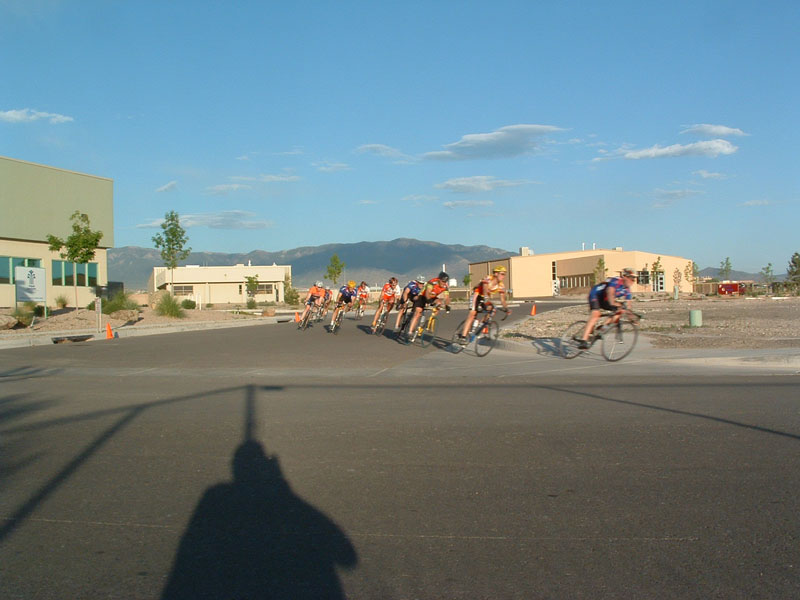
But in a close reading yesterday of the regulations in place at the time of the fateful June 1, 2004 Tuesday Night Crits Cat 4 race, I realize that Armstrong and I have something more disturbing and sinister in common than I’ve been willing to acknowledge.

My affaire le dope dates to the late 1990s, when a physician wrote my first prescription for albuterol, an asthma inhaler. It was handy to have in the pocket of my cycling shirt as a hedge against the occasional bout of exercise-induced asthma. But when I first tasted the forbidden fruit of albuterol during a lung function test in the doctor’s office, I couldn’t help but notice that simply using the inhaler even when I wasn’t having an attack increased my lung capacity some 10 percent. What’s not to like?

You can see where this is going:

By using a USA Cycling license, you agree to know and abide by the applicable rules and regulations of USA Cycling and the UCI, including the anti-doping rules and procedures as set forth by USADA, the UCI or WADA and that you agree to submit to any drug test organized under the rules by the UCI, USA Cycling, USADA, or the official anti-doping authority of a foreign country where you are competing.

In the case of albuterol, the guidelines say this:

The dosage of albuterol or formoterol that may be used in sport without a TUE may translate into a wide range of “puffs”. You should examine your inhaler closely to determine the dosage. If you need to take more than the non-prohibited dosage you must apply for a TUE.

“TUE” is a “Therapeutic Use Exemption” – formal permission ahead of time, certified by a doctor, that you need the drug. If it please the Court of Arbitration, I hereby stipulate that I had no such certification, and that I sometimes took two puffs. Ignorance of the rules is no excuse. I have nothing to say in my defense other than, as a pathetically slow cyclist, it was a rush to be able to finish on the same lap as the leaders in the the Category 4 race, the slowest division on offer.

So when I came off the final turn that Tuesday night in perfect position, second wheel in the chase group with a perfect lead-out in the sprint for fourth place, I might have been a cheater. I might not have been. It’s possible my puffs fell below the 1,600 microgram threshold wherein you’re free to just puff away. But it was my responsibility as a licensed bike racer to make that determination, and I failed.

I’m pretty sure it was Tony Geller who lead me out, pulling off so I could sprint home the final 150 meters. And behind me, it was Jerry Kiuttu who I cheated out of a fourth-place finish (pdf).

Like Armstrong, I could argue that I’ve never failed a doping control. Cat 4? Seriously. But still, Jerry, I’m so very sorry.