Forecast fibbing

When do you not want your forecaster telling you everything she knows?

Tom Pagano, who used to do our Rio Grande forecasts for the NRCS and now is a sort of global wandering river forecaster without portfolio, explains from the vantage point of a passenger sitting at Gatwick:

Imagine a parallel universe without bias on the departure board, where half the planes leave early and half leave late. Passengers would check the board and perhaps some would decide they have enough time to get another coffee. It would be clearly upsetting to come back “on time” and discover the plane already left. People also get very mad when buses or trains run ahead of schedule.

If you’re interested in the forecasting problem, especially what happens at the interface between forecaster and information user, Tom’s blog is a consistently fascinating read. (You can learn more about what Tom does, and how he does it, in my book.)


US-Mexico water talks stalling – what I learned from a new water blog

Chris Austin, the long time brains behind the invaluable Aquafornia (done in partnership with the Water Education Foundation), has a launched a new blog aimed at diving deeper into the weeds. I’ve already learned stuff from it that I didn’t know, such as this:

Negotiations with Mexico: Regarding bi-national negotiations with Mexico on Colorado River issues, the question was do the states want to put forth the effort to keep working on this, especially given that the sides are quite far apart? Yes, the states decided that they wanted to keep trying to work out issues. Since then, further negotiations have occurred with Mexico and it appears the two sides are still quite far apart. Mexico has asked for a break in negotiations; they understand the U.S. position and need now some time to consider options. It appears that if any successful negotiations occur, it won’t be the comprehensive solution Metropolitan was hoping for, but instead something scaled down.

Added to my RSS reader? Check.

Sandhill cranes as seasonal forecasters – is this just bullshit?

Tom Stienstra at SFGate recently wrote that California can expect an  early, wet winter. How do we know this?

There’s a saying, “Birds never lie.”

If so, the best weather forecaster in the West, the migratory sandhill crane, is predicting an early winter with plenty of rain and snow.

Over the years, the timing of the migration of sandhill cranes south to the San Joaquin Valley has predicted winter weather, both wet and dry. Early migrations have meant big winters. Late migrations, the opposite.

I did extensive research (by which mean a few minutes on Google and Google Scholar and an email to the author, whose out-of-office reply says he’s off for two weeks camping and fishing and stuff). The ever-reliable Alex Breitler reported in August that early crane arrival means the cranes are doing well. The only thing I could find consistent with Stienstra’s argument about the cranes’ forecasting acumen was a bunch of other bloggers enthusiastically quoting Stienstra. I also wrote to the smartest climate/phenology person I know, who had never heard such a thing, and was puzzled at the assertion.

Anybody know if there’s anything to this, or is it just bullshit?

Shale gas, groundwater and real estate values

Here’s a counter-intuitive result from Lucija Muehlenbachs and colleagues about the effect of shale gas drilling on neighborhood property values:

While shale gas development can result in rapid local economic development, negative externalities associated with the process may adversely affect the prices of nearby homes…. We find that proximity to wells increases housing values, though risks to groundwater fully offset those gains. By itself, groundwater risk reduces property values by up to 24 percent.


“Mind the gap”

mind the gap

mind the gap

The bird in Regent’s Park seemed goose-like enough. But too small, and with the dark and light bits in the wrong places. I grabbed my pocket guide. “Unlike much larger Canada Goose, black extends over breast and body is grey (not brown).” Ah yes, the  Barnacle goose. Check.

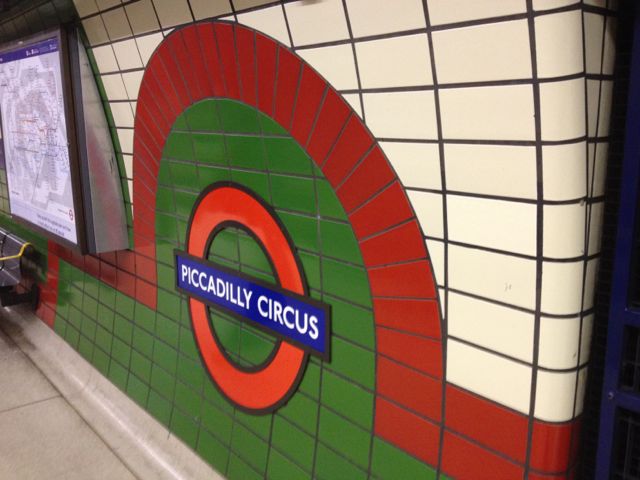
In London’s Underground, a cheery female voice reminds you as the train arrives at many stations to “Please mind the gap between the train and the platform.” The “gap” in question is the space created between a straight train car and a station platform built on a curve. Or, in some cases, a height differential created by the use of differing train car standards. (Of course the WikiFolks offer a lovingly detailed discussion.) It’s a small gap. I doubt I would have noticed if not for the announcement. But there it is.

And so it was, to sum, a vacation of finding pleasure (and fascination) in the small gaps between home (the US) and a new place (the UK). The shared cultural history and (relatively) common language mean things match up closely, but not exactly. Exploring the differences was a treat.

Rothko, the Tate Modern and my dad

Rothoko at SF MoMA, cc licensed by Notnarayan

Rothoko at SF MoMA, cc licensed by Notnarayan

Sometime during the mid-1970s, when I was a young teenager, Dad took us to see a Mark Rothko retrospective at the Los Angeles County Museum of Art. I must be cautious here in recalling the extent to which I was moved by a beginning-to-end look at the Russian-American painter’s work. “What you end up remembering,” Julian Barnes wrote, “isn’t always the same as what you have witnessed.”

I’ve written before about being the son of an artist, the particular gift of viewing art as a verb – a thing not that has been done, but rather a thing that people do. But I came slowly to this notion, to thinking deeply about the connections between the things on the walls of museums and the act of painting that was so much a part of family life growing up. And so there was a time during my teenage years when I made the shift from what I remember as annoyance at being dragged through museum after museum of what I came to call “art by dead people” and the real living art in that Rothko retrospective. Never mind that Rothko was dead by that point. In its modernity, there was life, not a thing but a thing made by a person. You could see in the arc of time captured by the show, Rothko working out an idea. (Do I remember this? Did Dad tell me, show me this?) In the retelling of my life with art, that Rothko show stands out with a handful of other collisions between art and my youthful self.

Thus it was that I found myself last week in a dimly lit room upstairs at the Tate Modern, filled with paintings from Rothko’s famed Four Seasons commission, tears streaming down my face. Dad’s still alive, but in the twilight of his dementia cannot share things like this any more.

A few months ago, as I was wheeling Dad out of the hospital, he asked my sister, Lisa, who the nice man was who was pushing his wheelchair. Lisa, who has an easy grace about these things, cheerfully told him it was John, his son. He seemed delighted to know he had a son.

the parakeets of London

Battersea Park, September 2012

Battersea Park, September 2012

Lissa first spotted a parakeet last week out by Greenwich, a flash of green knifing into trees above the garden path we were walking. It was just a glimpse followed by a fruitless search through the trees to identify the source of the squawking, followed by a visit to my Pocket Guide to the Birds of Britain:

Native of India, introduced into Europe (first noted Kent 1969). Scarce but firmly established in south-east England (especially London area).

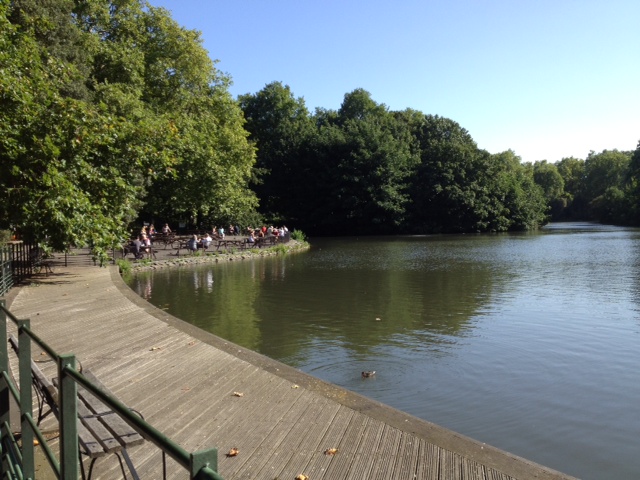
Then yesterday, sitting by the water in Regent’s Park, a flock swooped back and forth between an island and the horse chestnut tree beneath which we sat giving us a serious good look. Eventually they settled in the tree on our side, squawking and raining down horse chestnuts, half eaten, on the walk in front of us.

There’s a seriousness here (befitting an island nation) about discussions over invasive species in general and the ring-necked parakeet in particular. In 2006, the bird was one of the 20 most common birds in London’s Big Garden Birdwatch. Is it time to start culling parakeets? the Guardian asked in 2009.

But in greater London, where immigration has always been a complicated topic, it’s also hard not to see metaphor in the conversation. The only nature here is built nature, like the lake in Regent’s Park (vestigial mimicry of the old River Tyburn) over which our parakeets swooped yesterday afternoon. In his essay “London’s Overthrow,” (part of my introduction to the modern version of the city) China Miéville goes out with “urban birder” David Lindo. Lindo wants to share the natives, the black-headed gulls, but indulges Miéville’s “non-specialist’s fascination with the unlikely parakeets”:

‘They nest in holes,’ Lindo says. ‘There’s anecdotal evidence that they oust our native hole-nesters, like starlings, stock doves and nuthatches. And’ — he pauses grimly — ‘there’s a shortage of holes in Britain as it is.’

For all of us. Everyone knows there’s a catastrophe, that few can afford to live in their own city. It was not always so.

Miéville clearly doesn’t mean this the way I’m spinning it. It’s London’s wealth that’s closing off the native holes – “that few can afford to live in their own city” – not the immigrant parakeets. Maybe my reaction to the vehemence of the debate over parakeets or the attack of the invasive grey squirrel, the metaphor I’m drawing, is bollocks (geez I love doing this). Just hard not to notice Britain’s passion for fending off the critters that don’t belong here.

In my backyard in Albuquerque, the European house sparrow is one of the most common feeder birds. But I’ve only spotted them here once.

The Broad Street Pump

There’s an odd little monument in Broadwick Street, a couple of blocks over from the Carnaby Street shopping district. It’s an old water pump, with the handle removed, across the street from a pub named after 19th century London physician John Snow.
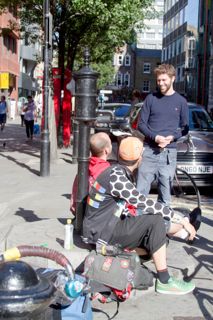
Hanging out at the Broad Street Pump

Hanging out at the Broad Street Pump, by L. Heineman, September 2012

When Snow lived in the neighborhood, it was known as Broad Street, and its pump is something of an icon in epidemiology and water. So this afternoon, Lissa and I made a pilgrimage.

The pump served the neighborhood where Snow lived. When cholera swept through the neighborhood in 1854, Snow sleuthed out the apparent fact that most of the people who died got their water from the pump, and persuaded the local Board of Guardians to remove the pump’s handle, after which the cholera outbreak ended. The conventional science of the time blamed disease on “miasmas” – essentially stinky gases from sewage, trash and corpses. The germ theory of disease had not yet taken hold. It is tempting to squish down the Broad Street pump story in the retelling in a way that makes it seem the linchpin in determining that it was germs, passed in contaminated water, that caused cholera. Remove the handle, end the outbreak, science triumphant.

In fact, the Snow story is more rich and complex than that. He’d been quietly working on his version of the germy water hypothesis for years, eventually conducting one of the first large-scale controlled epidemiological analyses ever done. Parts of London at the time were served by two water systems, one that took water from a stretch of the Thames potentially contaminated with sewage, one which took water from upstream. From David Vachon’s helpful history, here is Snow’s explanation of what we would now call “epidemiology”:

No fewer than three hundred thousand people of both sexes, of every age and occupation, and of every rank and station, from gentle folks down to the very poor, were divided into two groups without their choice, and, in most cases, without their knowledge; one group being supplied with water containing the sewage of London, and amongst it, whatever might have come from the cholera patients-the other group having water quite free from such impurity.

The people drinking poop-contaminated water were far more likely to get cholera than those getting clean water from upstream, Snow found. So when the Broad Street epidemic happened, Snow was already well on his way to collecting the data in support of his hypothesis.
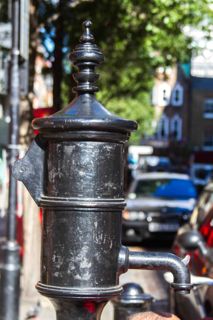
Note lack of handle on the replica of the Broad Street Pump, photo by L. Heineman, September 2012

Snow and the other public health officials of the day eventually even found the source of the outbreak – a baby who died of the disease in the neighborhood, and whose mother had washed the baby’s poopy diaper in a pail that she dumped in the house’s cesspool, located just a few feet from the Broad Street pump. But even with all that, the scientific establishment of the day continued to believe the miasmatic theory of disease. Here’s Vachon:

When John Snow died of a stroke on June 16, 1858, his theory about the spread of cholera had not gained any ground. The miasmists still prevailed.

There’s a replica of the pump today on the now-renamed Broadwick Street, across the street from a pub named after John Snow.

Many thanks to the folks behind the lovely UCLA School of Public Health John Snow web archive for the background used to write this post.
Layers of history

The geography of human history comes in layers. We are often drawn to the same spots over time for the same reasons, building on what came before – often literally “on”, as in “on top of”. Or we come to the same spot because that’s where the people already are.

laying Ethernet cable, York Minster, September 2012

But the historical layering of my own country, the United States, is thinner than here in Great Britain, especially the layering in the US southwest. It’s reasonable to think I could dig down in my backyard at home and find that my house, built in the 1950s, was the first human habitation built on that spot. You can find places in the Rio Grande Valley that have more layers, especially Pueblo communities. But they’re relatively fewer. So I’ve been fascinated by the historical layering here.

In the east end of York Minster, the great cathedral in northern England, you can go down into a crypt below the church’s eastern end. The church is medieval, built in the 1200s and 1300s (building cathedrals was a long game). The crypt still has the rounded Norman arch work predating the great Gothic minster, and in a hole in the floor you can see down to the footing of a Roman column below. Historic preservation, a relatively recent cultural adaptation in the communities I’ve lived in, has been going on here since the late 1700s.

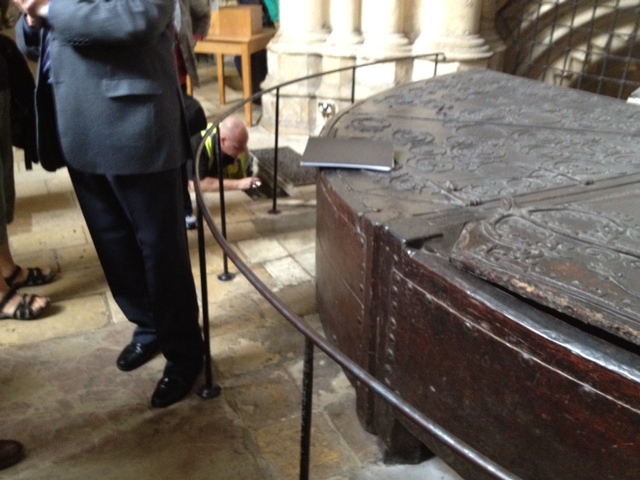
Upstairs, as our tour guide John (a devotee of history’s layers) explained the 13th century wood case used to hold the clerics’ cloaks, two workmen in bright safety vests crawled the floor on either side. They were feeding Ethernet cable through a channel in the floor that went beneath the cloak case. One of the characteristics of this sort of historical layering is that one does the thing one does today atop the old. So York Minster is still a working church, with the tourists kicked out of the quire for evensong and tours halted for prayer. And Ethernet.

Two things we do with water

Westbourne River, in a pipe

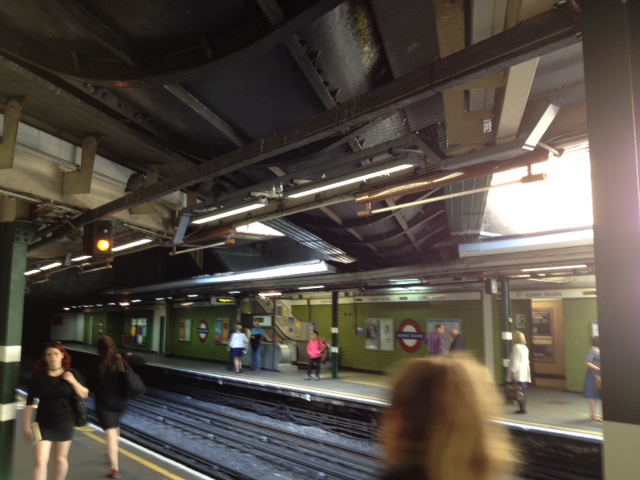
There’s a huge steel pipe running above the trains in the Sloane Square station on the London Underground. Depending on the historical time period you’re talking about, you could call it the River Westbourne or the Ranelagh Sewer. As Paul Talling explains:

As this area developed into the desirable location it is today, the final stretch of the increasingly filthy Westbourne was culverted between 1827 and 1854 and renamed Ranelagh Sewer.

The Ranelagh/Westbourne dumped into the tidal Thames where the Chelsea Bridge is today, across from Battersea Park. The outfall was immediately adjacent to what was, until 1856, the intake for the Chelsea Waterworks Company which, John Snow wrote in his 1855 On the Mode of Communication of Cholera, “supplies some of the most fashionable parts of London”.

More on Snow later. Suffice for now to point out that it was Snow’s insights linking cholera to something icky in the water that changed modern medicine and public health.

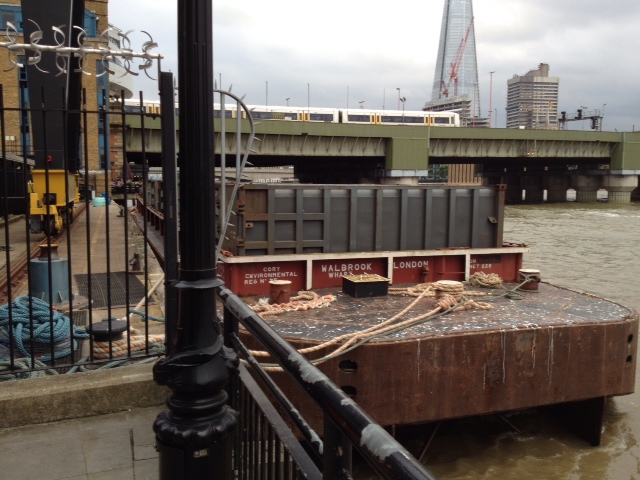
Walbrook Wharf

Walbrook Wharf

“[C]ities,” wrote Steve Duncan, “are organic growths that re-use and build on their past. Therefore almost nothing in an older city is going to be perfect, because the systems and infrastructure in use are so often leftover from an earlier period of growth.” Early London grew up around the Westbourne and a host of what are now lost rivers – the Fleet and Walbrook especially in the area of town Lissa and I are staying – and then fouled them completely, and the Thames for good measure. You have to dump your shit somewhere.

So the old river courses were culverted over and then repurposed as sewers. Around the time Snow was doing his thing, the repurposed sewers were linked into a network that shunted the shit further downstream, while the Chelsea Waterworks people moved their intake upstream. It’s an imperfect system, but you work with what you’ve got, right?

We’re no drainers, but Lissa and I did find the end of the Walbrook the other night. It was the river that flowed through the old Roman London (the walled city, hence “wall brook”). Its outfall today is at Walbrook Wharf, where container ships fill daily with London’s garbage for the trip to Essex. Seems fitting.