Rate hikes and public infrastructure

One of democracy’s great shortcomings, on display these days especially in California, is that we want the government to provide the stuff that we want, but we’d just as soon not pay for it:

Local officials say they need the money to upgrade outdated water-treatment facilities, sewer lines and water mains. In some cases, improvements are required just to comply with the law.

No matter how justified they say the rate hikes are, however, some elected officials have found it hard to follow through in the face of public protests.


Stuff I wrote elsewhere: wastewater reuse

My search for folks working the solution space alights on the growing enthusiasm in New Mexico for wastewater reuse:

In other states, especially water-short Arizona and Southern California, cleaning up sewage and reusing it in new and creative ways is becoming common. And in less obvious ways, by returning sewage effluent to New Mexico’s rivers, or using it to water our golf courses, for example, reuse has long been common in New Mexico.

But Rio Rancho’s experiment, about to get under way beneath a nondescript cinder-block building above the city’s Loma Colorado neighborhood, is a step toward what could be a New Mexico first.


Colorado River models: wrong but useful

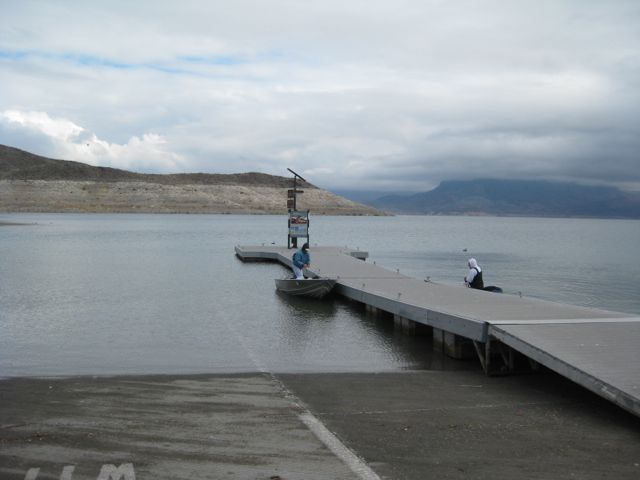
Lake Mead, December 2011

Lake Mead, December 2011, by John Fleck

Climate scientist Tamsin Edwards triggered a fascinating discussion when she chose the famous George Box quote – “all models are wrong, but some are useful” – as the name for her new blog. In a delightful exchange on Twitter (which I followed in real time and which Edwards quotes extensively in the blog post linked above), Peter Gleick chastised Edwards for choosing “All Models are Wrong” for the title of her blog, arguing that it “buys into ‘everything is uncertain’ meme.” Edwards pushed back, and I tend to agree with her argument – that acknowledging and thinking well about uncertainties is incredibly important for the climate discussion to move forward.

I’m reminded of the problem exemplified by the news coverage (mine included) of the US Bureau of Reclamation’s Colorado River Basin Study:

A new federal study released in conjunction with the conference forecast that the Colorado could have 9 percent less water on average by 2050 as a result of climate change, with persistent drought growing more common.

That 9 percent figure has become the study’s frequently repeated headline number. It’s significant in part because the Bureau of Reclamation, which in the past has been criticized for not including climate change risk in its long term water management modeling, ponied up this time. But is it the right way to think about this?

A new paper* by B.L. Harding and colleagues (researchers working on the Basin Study) makes a more subtle argument (and takes a dig at my profession for the way this question has been treated):

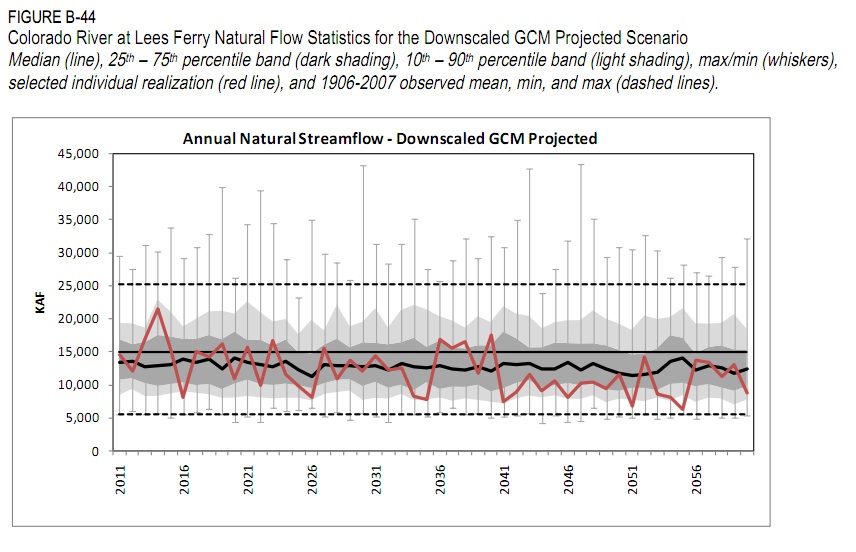
By the middle of the century, the impacts on streamflow range, over the entire ensemble, from a decrease of approximately 30% to an increase of approximately the same magnitude. Although prior studies and associated media coverage have focused heavily on the likelihood of a drier future for the Colorado River Basin, approximately one-third of the ensemble of runs result in little change or increases in streamflow.

If the models come up with such a broad range of answers, then by definition most of them are “wrong” in some sense. But they still seem to be quite useful here, just in offering something other than a prediction.
Suraje Dessai and colleagues wrote a really interesting book chapter back in 2009 (pdf)** on “the claim – explicit or implicit – that decision-makers need accurate, and increasingly precise, assessments of the future impacts of climate change in order to adapt successfully.” This is exactly the sort of thing we have seen here in the western United States – a push to refine the modeling to give us a better handle on the effect of climate change on the Colorado River. There’s nothing wrong with that other than the notion that we’re trying to settle on a number.

The point of Harding et al. is that we shouldn’t expect to know something meaningful by simply averaging across all the model runs and offering up a single numbers. If you dig into the bowels of the Basin Study report (pdf, see especially figure B-44), you can see the models spitting out not a single number, but a range of possible futures. (The majority of them are drier futures.)

These models are useful precisely because they help us think about the range of uncertainties that the region’s water managers face. From Dessai et al.:

We suggest that decision-makers systematically examine the performance of their adaptation strategies/policies/activities over a wide range of plausible futures driven by uncertainty about the future state of climate and many other economic, political and cultural factors. They should choose a strategy that they find sufficiently robust across these alternative futures. Such an approach can identify successful adaptation strategies without accurate and precise predictions of future climate.

To the extent that we communicate this with anything other than a genuine respect for the uncertainty, we do the public and the policymakers who have to figure out how to manage the Colorado River a disservice.

* The implications of climate change scenario selection for future streamflow projection in the Upper Colorado River Basin; B. L. Harding, A. W. Wood, and J. R. Prairie, Hydrol. Earth Syst. Sci. Discuss., 9, 847-894, 2012w, doi:10.5194/hessd-9-847-2012

** Climate prediction: a limit to adaptation? Suraje Dessai , Mike Hulme , Robert Lempert and Roger Pielke, Jr., in Adapting to Climate Change: Thresholds, Values, Governance, eds. W. Neil Adger, Irene Lorenzoni and Karen L. O’Brien. Published by Cambridge University Press, 2009
Water: we’re good at building stuff

Beginning with the 1808 Gallatin Report and extending through the twentieth century, it seems that whenever water policy commissions recommended water developments, such as canals, dams, irrigation projects, and other infrastructure, the recommendations were usually heeded, though sometimes many years after the fact. In contrast, the recommendations that did not involve concrete and cash—such as proposing to change the terms of development, modify economic incentives, and alter the institutions of governance—have not fared as well, even though such recommendations have been piling up for nearly as long….

Janet Neuman: “Are We There Yet? Weary Travelers on the Long Road to Water Policy Reform

Tree rings as history tool

In my my tree ring book, I focused nearly entirely on their use in studying climates. But tree rings are good for so much more, as in this example:

Earlier this week, Royal Commission staff visited the Conwy valley, to work with Margaret Dunn, the director of the Dating Old Welsh Houses project in evaluating the final batch of houses, which will now be tree-ring dated by Dr Dan Miles and Dr Martin Bridge from the Oxford Dendrochronology Laboratory. Working in partnership with the Royal Commission, Dating Old Welsh Houses is a community-based history project focused on dating historic houses in the counties of North-west Wales and then compiling their house histories. In the last three years over sixty houses have been successfully dated by the partnership project and revealed some remarkable results. Contrary to the traditional view that North Wales was an architectural backwater in terms of houses, the results of the project show that the characteristic Snowdonian house took shape in the early sixteenth-century much earlier than previously believed.


How much water is there in the Colorado, and who needs what?

As we await the release of the next release from the Bureau of Reclamation’s Colorado River Basin Water Supply and Demand Study, a story by Chris Woodka nicely captures the tension as basin states try to influence the process by telling the Bureau what their long terms needs are:

“I think the question is: ‘What is the result of overdevelopment of Colorado River water, and who suffers the consequences?’ ” said John McClow, an attorney who represents the Gunnison River basin on the Colorado Water Conservation Board.

McClow said the task is difficult because sharing the information with other states could hurt Colorado’s position in ongoing negotiations with other states.

It’s a classic game theory problem. States that acknowledge the river’s limitations and therefore limit their own water use risk losing supply to states that don’t.

Arizona’s cost of moving water could be about to go up

The coal-Central Arizona Project link always seemed a bit of a Rube Goldberg policy apparatus to me. Its Goldbergness seems about to unravel.

Felicia Fonseca at the AP reports today on the potential costs of a retrofit to the Navajo Generating Station, up the hill from Glen Canyon Dam. The plant is part of a Byzantine deal to get water through the Central Arizona Project, which pumps Colorado River Water uphill to Phoenix and Tucson. The original plan was to build a series of power dams in the Grand Canyon to provide the electricity to move the water. That idea created one of western water’s great WTF moments, and the Grand Canyon dams were scrapped back in the ’60s. Instead, the government built a coal plant to generate the cheap electricity to move the water. Cheap, dirty electricity:

Requiring a coal-fired power plant on the Navajo Nation to further regulate pollution would not, by itself, force the plant’s retirement, but it could significantly increase water rates for agricultural users and American Indian tribes, a study released Wednesday found.

Stuff I wrote elsewhere: first steps for Navajo-Gallup pipeline

From the morning paper, the US Bureau of Reclamation has taken a big step toward construction of the Navajo-Gallup Pipeline, which is a big deal around these parts:

Jason John, head of the [Navajo] nation’s Water Management Branch, called the request for bids on the pipeline “a huge milestone” in bringing water supplies to the traditionally underserved communities in western New Mexico, where residents have to haul water to their homes in tanks in the beds of their pickup trucks.

“We’re starting in that area because there’s an immediate need for water in that area,” said U.S. Bureau of Reclamation project manager Pat Page.

Stuff I wrote elsewhere: Elephant Butte

Elephant Butte Dam was one of the first big concrete dam’s in America. It currently doesn’t have much water behind it. My column:

An enthusiastic crowd wandered the top of Elephant Butte Dam on Jan. 7, celebrating, with good reason, the structure’s role in New Mexico history. But it must have been hard to ignore the distance down to the water on the dam’s upstream face.

When they are brimful, with their outlets roaring, big dams like Elephant Butte are triumphal. But the big empty behind the dam, like we see this January in what looks like is shaping up to be a second consecutive year of drought on the Rio Grande, taunts our frailty.

The Jevons Paradox and greywater reuse

Hey lazyweb – anybody know if someone’s looked rigorously at the question of greywater use in the context of a Jevons-like paradox?

Putting together some notes for a talk this weekend to the Xeriscape Garden Club of Albuquerque (Sat. 10 a.m. at the Garden Center if you’re in town), I’ve been thinking anew about the question of greywater use – running a second plumbing system from the sinks and other non-poopy waste producers in your house out to the garden.

It seems obvious that this is a winner, because you’re making use of the wastewater rather than just throwing it away. Except that in many settings, it’s not thrown away, but rather returned via the sewage treatment plant for use by others. Here’s the new National Research Council report on reuse:

[E]xtensive reuse has the potential to affect the water supply of downstream users and ecosystems in water-limited settings.

The NRC is talking about larger-scale reuse, but the principle is the same. If you’re on the coast, and your sewage outfall goes directly into the ocean, greywater reuse seems like a no-brainer. But in desert communities like Albuquerque, it’s a more complicated question. My sewage goes back into the Rio Grande, where it is used by others. A gallon I divert from my wastewater stream to water my garden is one less gallon we remove from the Rio Grande at the north end of town, and one less gallon we return at the south end of town. There may still be good reasons for doing this – energy, system losses, treatment costs, etc. But “saving” that gallon of water is not one of them.

So here’s the Jevons question. For those not familiar, in brief, the Jevons paradox is the notion that, as energy technology gets more efficient, rather than simply dropping our energy consumption, we at least in part do more of whatever it was we were doing with the energy. So as lighting got more efficient and therefore less expensive, one of the things we did was light up a lot more of our spaces.

What if, by using greywater, I figure that since I’m using water that’s kinda “free” in the context of both money and supply, I figure I can use more in the garden?