Why I Ride

Seen on the bike today:

  • A new beaver dam taking shape in the riverside drain, just south of the Interstate 40 bridge.
  • A pair of bicycle cops pulling over a cyclist on the riverside trail. (If you ride the trail on the weekends, you know Singing Guy. Wears headphones, sings very loudly and very badly. I can only guess his crime is to be really annoying. To that, at one time or another, we must all plead guilty.)
  • The Black-crowned Night-heron. Bosque Bill took a nice picture of him the other day. He’s been hanging out in the riverside drain south of the Bueno chile plant. Lissa and I walked down last night looking for him, had no joy. This morning, on my ride south, there was no sign of him. But on the way back up, at maybe 10:45 a.m., he was just sitting there on the same log you see in Bill’s picture, oblivious to passing cyclists, looking for passing fish. You don’t get a sense of scale from Bill’s picture, but this is a very big bird. (For more great pictures of the birds of the Albuquerque bosque, check out Bill’s site.)

River Beat: Water Level Update

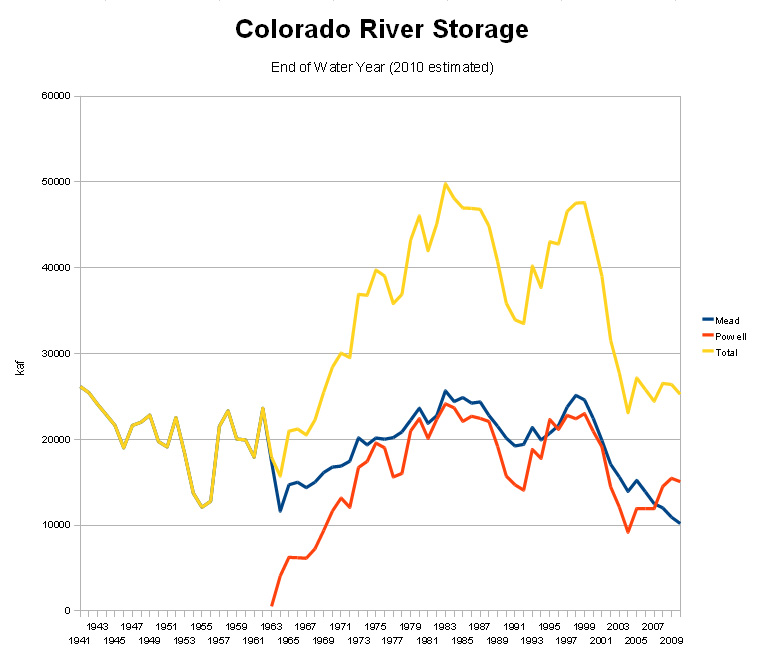
At the end of the beneficent water year of 1983, Lake Mead, the giant reservoir behind Hoover Dam that manages water for the benefit of Nevada, Arizona and California, held 25.7 million acre feet of water.

At the end of water year 2010, according to the latest forecast, there will be less water than that in Lake Mead and its twin, Lake Powell, combined (25.3 maf). The forecast calls for Mead to finish September (the end of the “water year”) with 10.2 maf, the lowest storage since the reservoir was first filled in the 1930s. (The end-2010 number is from the latest USBR 24-month study, which came out Wednesday.)

Storage in Lakes Mead and Powell, data courtesy USBR

Storage in Lakes Mead and Powell, data courtesy USBR

River Beat: Huntington Beach, CA, Poseidon Desal

David Zetland calls the cost of desalination the “backstop price” for water. Once the cost of other sources rises sufficiently, coastal residents will just build desal plants because it’s cheaper. While the fungibility is not complete (i.e. we don’t all live on coasts), water trades could allow people who live inland to play too.

This matters in context of the Colorado River because of the idea that coastal residents could use desal to free up some of the river’s water for those of us upstream. Or maybe California could start using desal as part of its effort to be less of a frickin’ Colorado River water hog.

But the context in this excellent Tracy Wood piece on the proposed Poseidon plant in Huntington Beach, CA, and the reader comments that follow, suggest that the market is not as free as Zetland might hope. First here’s Wood:

The state Water Resources Control Board may begin regulating desalination plants and how much brine they can discharge into the ocean. But work on that won’t start until later this year, said Jonathan Bishop, the state water board’s chief deputy.

Any plants affected by the upcoming regulations will be given time to comply.

Before breaking ground next year, Poseidon also must get permits from the state Lands Commission and the Coastal Commission.

So you have, first, the regulatory environment. And that raises the specter of politics. I don’t mean that in the pejorative way that word is often used, but simply that the regulatory system is subject to the political involvement of those who think this project is a bad idea. Here’s a commenter who goes by the “name” CLG_MAG:

Rest assured, folks, there is opposition out here, and we’re going to be there, front and center, when the matter comes before the Coastal Commission, Regional Water Board, and the State Lands Commission. We also learned from the Carlsbad project’s history — namely that Poseidon plays a bit loose and fast with the facts. This time, not only will the public be ready, but the agencies will too. We all know it’s easy to buy off the local government, but with everything that’s gone on at the State level and in the litigation, I can guarantee Poseidon’s going to have nothing but trouble getting the Huntington plant through the years of regulatory hurdles that loom on the horizon.

Wood for Heat?

It’s hard to know how we’re doing to be able to address large scale global energy decarbonization needs when we’re still dealing with problems like this:

Rising electricity prices are increasing the use of wood for heating in South Eastern Europe to alarming levels, posing a serious threat to health and the environment, experts warned.

Governments in South East Europe are largely unable to address the problem of energy poverty, understood as the incapacity of people to heat their own homes, warned Stefan Bouzarovski, a lecturer in human geography at the University of Birmingham in the UK.

LDS Church Protests Vegas Water Deal

Given the remarkable role of the Church of Jesus Christ of Latter Day Saints in western U.S. water history, it’s at least of symbolic importance that the church is among those who have filed protests against Las Vegas, Nevada’s proposal to build a pipeline to pump water from the Snake Valley to the growing gambling metropolis.

The Mormons pioneered water development in the arid western U.S., literally beginning irrigation on the first day they arrived in what is now Salt Lake City and playing a central role in the century of water development that followed.

Brandon Loomis in the Salt Lake Tribune explains the church’s concern about the Snake Valley Project:

The church protests cover wells proposed for Spring Valley, where it operates the Cleveland and Rogers ranches and three associated grazing permits.

“In January 2010, the church protested four proposed well locations out of concern that those specific wells could negatively impact water rights used in ranch operations,” church spokesman Scott Trotter said in a written statement.

The Mormon water story is especially interesting in the Little Colorado Valley, an outpost on the edge of 19th century Mormondom that was a particularly harsh and unforgiving environment (among many harsh and unforgiving environments that the Mormons successfully inhabited – that’s of what’s long fascinated me about the Mormon water story).

For more on how they did it, I recommend William Abruzzi’s work, nicely summarized here.

River Beat: 2010 snow season all over save the melting

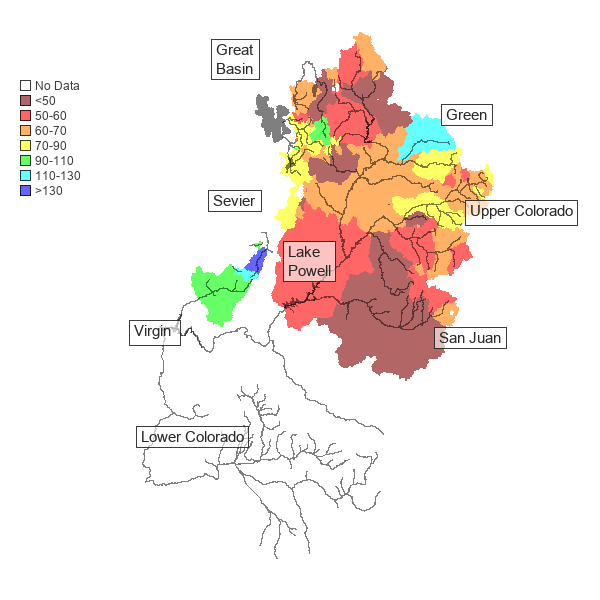
The June 1 Colorado Basin forecasts are out, and, as expected, there’s been no miracle. The inflow into Lake Powell looks pretty much exactly like it did a month ago, minus the chance of a miraculous late snow rescue or the flip side chance of some sort of terrible collapse:

Lake Powell Inflow, courtesy CBRFC

Lake Powell Inflow, courtesy CBRFC

The blue bar is average, the red dots show the forecast month by month, with the June 1 forecast rightmost. The line and red triangles are the 90 and 10 percent levels – the chance, essentially, that it will suddenly get a whole lot wetter or drier than the median forecast.

The rising blue line is average inflow, and the green line below it is this year’s actual. You can see that, as of June 1, inflow to Powell is about 2 million acre feet below average. That is an awful lot of water. Just a reminder that, including this year, 9 of the last 11 years have been below average on the Colorado.

Endangered Species, Endangered Ecosystems

I had a hugely lucky moment this morning while I was riding my bike down by the river.

The bike trail parallels one of the riverside drains, small canals that flank the Rio Grande through the Albuquerque reach. Out of the corner of my eye, I spotted an enormous bird, lunging at something in the water. By the time my gaze settled, the big black-crowned night-heron had a fish in its mouth.

The night-herons live around here, but they’re relatively reclusive, so I felt lucky not only to see one, but to see one in action. We’ve also had an osprey around this spring, which along with the great blue herons that live up and down this stretch of river and the bald eagles that winter here are top-of-the-food-chain critters.

My favorite blue heron story is a very early morning bike ride on a very cold morning. It was just after sunup, and my friend and I had stopped on the Alameda Bridge, a pedestrian-bike bridge over the Rio Grande up at the north end of town. It was winter, the river was low, and there was a great blue sitting in the middle, in shallow water, absolutely still. All of a sudden, its neck snapped down, and it came up with a fish.

Rio Grande silvery minnow, Aimee Roberson/FWS

Rio Grande silvery minnow, Aimee Roberson/FWS

That’s a bit of a ramble, sorry, to get to the Endangered Species Act. Here in the Middle Rio Grande, the Rio Grande silvery minnow is the endangered little fish that sits at the fulcrum of the politics of water, development and ecosystems. We’ve sufficiently modified our river that it bears little resemblance to the ecosystem that once flourished on the broad valley floor of what is now central New Mexico.

People here who complain about the ESA like to complain about “that damn little fish”, but it’s worth noting the actual language of the Act:

The purposes of this Act are to provide a means whereby the ecosystems upon which endangered species and threatened species depend may be conserved…. (emphasis added)

Which means that one of the points of ESA protection is so that my night-heron, and the osprey and bald eagles, have something to eat.

I originally wrote above that we had “screwed up our river”, rather than merely “modified” it, but that’s a value judgment. Many people prefer it this way. In fact, given that much of our societal infrastructure in the greater Albuquerque area, from the old farms in the valley to the way we’ve built our city, depends on the engineered river we have now, it seems fair to argue that people prefer it this way, which was one of the points I made in a piece earlier in the week. There’s no a priori right way to run a river, but rather a series of tradeoffs:

Different people value water and the natural world in different ways. We use our political system to sort out the resulting disagreements. This is how we ended up with the Rio Grande we have — heavily engineered, designed first and foremost to move water for human use and prevent flooding. That is largely what the people who live here, acting through their political institutions, seem to have wanted.

All this is an extremely round-about path to a terrific New York Times riff by Felicity Barringer on tradeoffs and the ESA. It’s about California and its damn fishes, but her points apply equally here. She’s writing about federal judge Oliver Wanger, who has been tasked to sort out the competing interests of not only fish v. humans, but also the interests of humans who depend on fish:

In a courtroom hearing in late March, he said, “The economic pain and hardship has been no less to the fishing industry that relies on salmon than has been the economic consequence to the Central Valley agricultural community.”

He has also referred to the Supreme Court’s landmark ruling in Tennessee Valley Authority v. Hill, which declared that the primary purpose of the Endangered Species Act was “to halt and reverse the trend toward species extinction, whatever the cost.”

Judge Wanger reframed the decision, writing, “This case involves both harm to threatened species and to humans and their environment. Congress does not nor does T.V.A. v. Hill elevate species protection over the health and safety of humans.”

It’s worth noting that the canal in which my night-heron was dining is not natural river. It’s human plumbing, designed to drain shallow groundwater and carry agricultural runoff. And for the record, while the night-heron flew off quickly, it was pretty clear from its size that the fish in its mouth was not a silvery minnow.
Is this a Godwin?

Because of my interest in energy, I follow news about Sasol, the South African company that makes liquid fuels out of coal. Sasol news is a good tracer of what’s going on in the coal-to-liquids field, which is important because of CTL’s role as an economic backstop to petroleum as vehicle fuel. Lots of important global energy and greenhouse gas implications associated with CTL.

Bloomberg reported yesterday that Sasol signed a big deal with Tata to build a CTL facility in India, which I tweeted, which drew this response:

godwin_tweet

Does this require invocation of Godwin’s Law, or is it just a really bad ad hominem argument?