And Then It Rained

Malcolm on the rains in Australia. The blessings of La Nina?

Fortunately, things have definitely improved. The latest weekly report from the Catchmtent Authority shows that we have remained above 55% capacity for a couple months now and it is even ticking up slightly of late. The next mark of interest is 70%, which is considered fairly comfortable levels (100% being both obviously better and achievable — we were at 100% capacity back in 1998) for the future of the city’s supply.

Beginnings


I have always held a certain ambivalence toward my nation’s national anthem. For my parents’ generation, having participated in a war for our nation’s survival, it is a deep and important talisman. But to my generation, its theme (war) places it at the center of an unresolved struggle, making it an uncomfortable national icon. It’s not entirely clear what we’re celebrating when we stand respectfully at the start of baseball games, but the ritual has always made me uncomfortable.

Yesterday on the radio, though, I heard the most remarkable and stirring version of the song. Performance Today, the wonderful classical music program on public radio, set it up thus: A tape of a radio announcer telling his audience that the New York Philharmonic’s regular conductor was ill, and the orchestra would be led that day by his assistant, Leonard Bernstein. It was November 1943, the darkest heart of the war, and we were hearing the debut of that most American of artists, leading the Philharmonic in the National Anthem. You can hear the audience singing along – badly, as audiences always do, lagging the orchestra slightly, but there’s an energy to the thing that is palpable, as if the singing of this song matters in a way that my generation could not possibly understand.

To listen: Performance Today – click on Hour 1 at the top of the page, the segment starts at 14 minutes in

Dave Finds The Solution Space

Regular Inkstain readers will no doubt be aware of my ongoing search for “the solution space” – public policy options that unite those with disparate views in search of solutions to thorny problems that can actually be implemented – that are robust to underlying political disagreements.

My friend Dave is pushing something in this regard that is both innovative and brilliant – starting at the local level, a bottom-up initiative to unite concerns that are both international and genuinely local:

I’d like to call on the Carrboro Town Council to ban waterboarding in Carrboro. We simply can’t have that kind of water wasting going on with this drought. No water for lawns, no water for suspected terrorists.

More on this win-win synergy here.

The Adaptation Discussion

Daniel Hall, drawing in part on the excellent reporting of Peter Spotts in the Christian Science Monitor, had a nice post today about pressure on the developed world to adapt to climate change, and on the mechanisms to pay for it:

U.S. CO2 emissions are around 6 billion metric tons per year.  If permit prices were around $20 per metric ton — a not unreasonable guess based on modeling work of other similar bills by the EIA — and all permits were auctioned the government would raise more than $100 billion a year.  I think the bill actually auctions around one-quarter of permits initially, so this might be more like $25 or $30 billion a year early on in the program.  Either way, there is certainly a ready and sufficient source for adaption funding; the question then is whether wealthy countries are truly willing to write the checks.

Rain in Bali

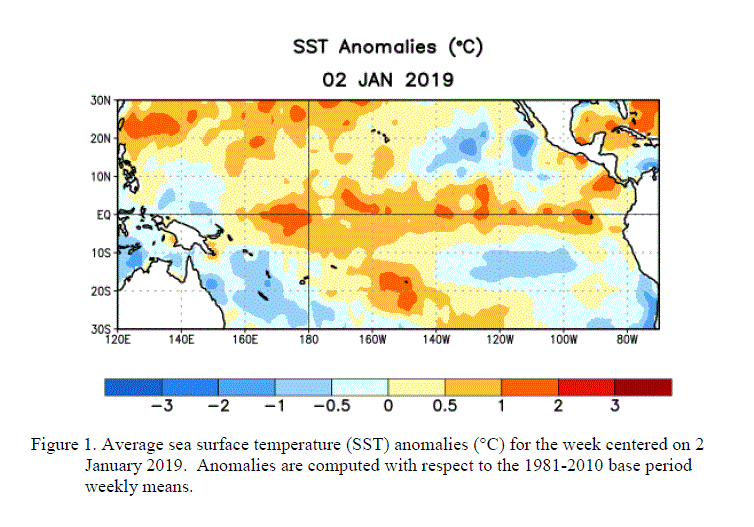
The monthly ENSO diagnostic discussion from the U.S. government’s climate prediction center, out today, shows a strengthening La Niña, likely to persist into the spring. That means rain in Bali:

Expected La Niña impacts during December-February include a continuation of above-average precipitation over Indonesia and below-average precipitation over the central and eastern equatorial Pacific. For the contiguous United States, potential impacts include above-average precipitation in the Northern Rockies, the Pacific Northwest, the Ohio and Tennessee Valleys, and parts of the Great Lakes region. Below-average precipitation is expected across the South, particularly in the southwestern and southeastern states.

That said, here it looks like a wet weekend.

Gas Prices Settle

Gas prices have settled a bit around the $3 per gallon level. And, contrary to last week’s confusing post on this question (hey, I’m a newbie on this whole energy economics thing), apparently this enormous price of oil by the barrel means refiners are not making enough money to send their kids to private school and also make the payments on the condo in Vail. From TWIP:

[N]et income and margins for large refiners were lower in the third quarter of 2007 than in the third quarter of 2005 and 2006. In fact, net income for this group of companies during the third quarter (in real terms, adjusted to Q307 dollars) was very similar to net income over the 2000 through 2004 period.

Graphical Whiplash

Easy-Do Parties ElectricallyApologies for the graphical whiplash. I had some issues (*cough*hackedagain*cough*) that were most easily dealt with by changing themes. I promise to get the Easy-Do Parties lady back in her proper place at some point soon.

In Search of the Climate-Energy Solution Space

Kansas coal plantI ran across two interesting comments in the blogworld yesterday in response to the new McKinsey report on U.S. greenhouse emissions opportunities. The report lays out a lot of enticing cost-benefit analyses of various greenhouse gas emissions options throughout the U.S. economy.

The first came from Grist commenter Sean Casten:

I agree – great message, but it hugely understates the potential to increase generation efficiency. Maybe that’s just because they didn’t know to look for it, but I get nervous by any report sponsored by a bunch of utilities (National Grid and DTE were listed among their sponsors). But this is nitpicky – overall, great report.

The second came from veteran science journalist Charles Petit, on the Knight Science Journalism blog:

Better attention to efficiency and smart investment in renewables, etc., could trim up to 28 percent of the nation’s greenhouse emissions with little upfront cost and a fast, quickly profitable payback. This is not news to people at, say, such national labs as Oak Ridge, Berkeley, Livermore, etc. who have been cranking out fruitless and similar studies for years. Maybe these biz suits will give such findings more street cred.

I think Petit gets it precisely right and Casten gets it precisely wrong.

Different people with different interests, beliefs, values and viewpoints will have different views of the definition of the climate problem, the energy system, and the costs and benefits of various approaches to dealing with it. That’s one consequence of climate change being a wicked problem. What’s increasingly interesting to me is not what any one player views as “the correct” solution to the problem, but rather what is the solution space that can draw sufficient support from those with those different interests, beliefs, values and viewpoints to actually happen.

In that regard, Casten is wrong to be suspicious that energy companies were involved in the preparation of the McKinsey report. He should rather embrace it. It doesn’t mean he has to agree with the answers they came up with, but the fact that he seems to like the report despite their involvements means he ought to embrace their participation. Any solution space that doesn’t include those interests is likely doomed to failure.


The Christmas Tree Thing

Holiday Inn Movie PosterI’m unclear on antipodal Christmas rituals, but apparently this is another area the Australian drought is being felt:

With the Christmas tree season beginning this weekend, growers reported their crops would be up to 75 per cent smaller than previous years because of dry conditions last year. But decent rains this year have been good news for next year’s batch of trees, which are growing well.