
China Drought

China’s state news agency is reporting drought on the Yangtze:

Falling water levels in China’s Yangtze River have left 1 million people short of drinking water, state media reported Monday. A severe drought has caused the water level in China’s longest river to plunge over the last two weeks, severely cutting water-pumping capacity, Xinhua News Agency said.

Shapingba Waterworks, one of the largest suppliers of drinking water to the industrial southwestern city of Chongqing, said only one of 10 pipes used to pump water from the Yangtze was in operation, Xinhua reported.

I don’t know much about China’s climatology, but a look at LDEO’s Standardized Precipitation Index page doesn’t look much like “severe drought” to me. Any of you climate geeks know a good source of China weather/climate data on relevant time scales?

Water and Energy

For a variety of reasons, I’ve been starting to pay attention of late to the water-energy nexus. Which is why this drew my eye:

According to news reports, Tampa is reviewing a request from Port Sutton EnviroFuels LCC for up to 500,000 gallons of freshwater per day to run Florida’s first Ethanol production plant. The facility today would be the city’s fifth-largest water customer, bigger than Tampa General Hospital, the University of South Florida or Busch Gardens. It is planned for the plant to transition to reclaimed water as the primary water source in the future.

Consumptive water use by ethanol plants largely comes from evaporation during cooling and wastewater discharge.

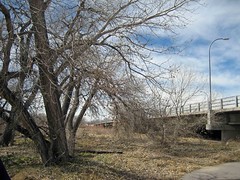
Bridge bridge


Bridge bridge

Originally uploaded by heinemanfleck.

It’s too early yet (Feb. 25, 2007) for the cottonwoods to be leafing out, but it seems worthwhile for phenological purposes to note when things aren’t happening as well as when they are – to sort of bracket the phenomenon. This is from a nice midday bike ride with Miguel, down around the junk yard loop. It was taken where the bike trail goes under the Bridge Boulevard bridge. I like it that Albuquerque has a Bridge bridge.

Two weeks ago, there were cranes aplenty in the fields down at the Old Schwartzman farm, but we didn’t see any today. That’s one of the clues that we’re on the cusp of spring – cranes gone, cottonwoods not yet ready to go, temperatures up in the mid-40s (~7 C), that middle ground where I’m not quite comfortable shedding the winter cycling gear, but then I end up zipping and unzipping the jacket and switching back and forth between heavy and light gloves, trying to get comfy.

Not that I’m complaining. It was a lovely ride.

Adaptation

From Happisburgh, on Britain’s eastern coast, an interesting story about the way adaptation decisions end up being made not at some global level, but one crumbling seawall at a time:

Ronan Uhel, a top official at the European Environment Agency in Copenhagen, said the situation in Happisburgh shows that governments and insurance companies have finally started letting the public know that it will have to do more than buy fuel-efficient cars and better light bulbs to fight global warming.

He said citizens are being shown they can’t keep building homes on islands and near lowlands and coastlines, especially in vulnerable areas where it no longer makes sense to rebuild offshore barriers.

In countries like Britain, “a national debate is just starting about what is an appropriate policy of adaptation to climate change,” Uhel said in an interview. “People are just beginning to realize the risks of global warming and the big lifestyle changes that may be needed to brace for them.”

Late last year, a new law took effect in England and Wales whereby the government decides whether it makes sense, economically and environmentally, to rebuild barriers.

For Happisburgh, 135 miles northeast of London, the answer was no.

“Basically, whatever we do to reduce greenhouse emissions we’re going to face about one meter (3.3 feet) sea level rise on the east coast of England in the next 100 years,” Clive Bates, a top official at the British government’s Environment Agency, told The Associated Press.

Report on Nothing Terribly New

Map of Arid Lands

Tom Yulsman, in the comments below, raises an interesting question about yesterday’s release of the National Research Council Colorado River report:

[N]othing in the NRC report sounded terribly new. We knew that droughts much worse than what we’ve experienced in the last 100 years have occurred in the past, we knew that the river is over-appropriated, and we basically knew that global warming could make drought even worse.

Tom’s right about this. There was nothing in the report’s central findings that I hadn’t already reported, by me and the rest of the throng of Wallace Stegner wannabes writing about water in the West. But that is not meant to be a criticism. In fact, it’s a great report, and I went to some lengths to give it a good ride in this morning’s paper.
Tom’s got his own take on it, but he’s got an interesting point. By definition, the charge of a panel like this is to assemble the existing science. There’s not supposed to be anything new in it. So why is this “news”? Continue reading ‘Report on Nothing Terribly New’ »

A Gloomy Water Future

The NAS Colorado River report was released this morning:

Recent studies of past climate and streamflow conditions have broadened understanding of long-term water availability in the Colorado River, revealing many periods when streamflow was lower than at any time in the past 100 years of recorded flows. That information, along with two important trends—a rapid increase in urban populations in the West and significant climate warming in the region—will require that water managers prepare for possible reductions in water supplies that cannot be fully averted through traditional means. Successful adjustments to these new conditions will entail strong and sustained cooperation among the many entities involved in Colorado River water management and science programs.