People and Climate

Another library gem:

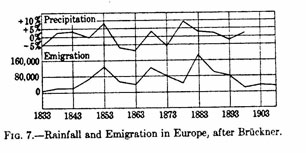
Graph showing correlation between emigration and rainfall in Europe, 1833 - 1903

That’s from the 1914 book “The Climatic Factor As Illustrated in Arid America”. The analysis that goes with the graph seems, with our centuries’ worth of hindsight, a bit naive. The argument is that when it rains too much in Europe, crops fail, so people move to America. The link between climate and human culture is more complicated than the graph’s neat correlation would indicate. But what’s so amazing is not that the author was simplistically wrong, but that he was posing these great, penetrating questions that rightly supposed that the climate-culture link would be huge and important and worth our time.

Leonardo and the Tree Rings

I found a little gem in the library this afternoon in Isis, a journal “devoted to the History of Science and its Cultural Influences”. My old college mentor Joe Maier introduced me to Isis, so it felt a little nostalgic pawing through its pages.

What interested me was a little trifle published in the back pages of the December 1945 issue entitled “When was tree-ring analysis discovered.”[1]

I’ve been following back footnotes from George Webb?s scientific biography of A.E. Douglass[2], and Webb mentions the marvelous factoid that it was Leonardo (What was it an old colleague used to say? “Great story. Better if true.”) who first suggested the possibility that tree rings could be used for the study of climate.

(Click through to read the rest, it’s really long.)
Continue reading ‘Leonardo and the Tree Rings’ »

Planet GNOME Test

Prodded by Glynn and aided by the fact that Dave Camp was smart enough to write it down and publish it when he figured out how to do it, I changed my RSS feed so the whole entry now shows up, meaning the whole entry is now published on the planet. This is a good thing, except that lately I’ve been rather blathering on with some very lengthy posts (I’m using the blog to work out ideas), and I don’t want to bore folks unnecessarily. So my idea is to figure out how to make stuff in the “read more” MT bit (additional entry text, I believe it’s called) not show up in the RSS feed. Here’s a test to see if this works.
Continue reading ‘Planet GNOME Test’ »

Bananas

I returned from a meeting out of the office today to find two bananas on my desk. One had a sticker on it suggesting that fresh fruit can reduce my risk of cancer. Seemed reasonable, so I ate the banana.

Committing Journalism

I’m not a political journalist, so maybe it’s a little bit easier for me to make fun of the whole process without feeling too much shame or accountability. But I sure am enjoying Joshua Micah Marshall giving voice to the vague discomfort he feels at the way the thing is done. This morning it was the bizarre way in which one covers the Democratic debate “in person” by watching it on a big-screen TV with a bunch of other journalists. Why not just stay in your hotel and watch it on TV there?

Seeing it in person would certainly add something to one?s reportage. But you never see it in person. Generally how it works is this: You?re in a big complex and there?s one large hall set aside for the actual debate. In that room you have the candidates, a few of their handlers, the moderator/questioners and the audience. Oftentimes you?ll have a tiny handful of journalists there too — but only ones from the highest echelon of the elect. Maybe a Koppel or a Mitchell — folks like that.

Everyone else is in a big room somewhere nearby with a bunch of long school room tables arranged as they might be for an SAT test in high school. And space after space at those tables is occupied by journalists with laptops open, a phone at each station, perhaps some other paraphernalia nearby or a parka, watching the debate on a series of big TVs.

In other words, they?re watching the debate on TV just like you are. Only they?re doing it in a big room with all the other journalists.

Now, this can be kind of fun, because you get to see a lot of other people you know, and a number you haven?t seen in a while. And you get a very good sense of how other reporters think everybody did. But that can be a pretty skewed view, an echo chamber in the making in ways you can probably imagine, even if you don?t spend much time talking to the really egregious above-it-all conventional wisdom types.

ATMs and bad UI

Seth Nickell on bad ATM user interfaces:

Despite the fact that most ATMs only handle money in multiples of $20, they still require you to enter the “cents”. So asking for $40 entails the button sequence 4-0-0-0. I almost always withdraw $40, so I perform this series of presses without a lot of higher brain involvement. Unfortunately, this ATM fixed a “bug” in the way 95% ATMs work: they only let you enter whole dollar values.

The ATM’s I’ve been using say on screen, at the end of the transaction – “Be sure to take all bills.”

Is this a problem? I can understand Seth’s rather comical tale of losing his card, but do people regularly forget to take their money?

The Pageant of Democracy

The Journal sent me to the Albuquerque City Council meeting last night. This is representative democracy at the very retail level. It was a hoot.

There was a time in my career where I spent many a night covering the pageant, from the Walla Walla city council meetings and the school board, to Pasadena. In many ways it was what first drew me to the business. Reporters love to whine about having to cover government meetings (and I whined too, of course), but deep down I have always loved them.

Here’s why.

At last night’s meeting there were a bunch of people from the arts community, pitching for a new sliver of sales tax. The conductor of the symphony spoke, and a buddy of mine who tries to make movies for a living.

There was a group of guards from the jail, with their wives and husbands and little baby boys and girls, there to ask the council for some sort of improvement in their health care benefits.

There were anti-nuclear activists concerned about radioactive waste (that’s why I was there). And to counter them, some technical types who think the waste in question is safe.

And there was this, uh, interesting woman who spoke on pretty much every issue before the council, tieing them all to the illegitimacy of the federal government and the true righteousness of the Free Republic (I’m a little unclear on the details here, the Freemasons are also somehow involved, she was a bit hard to follow).

Everyone got to say their piece, and the council gave some what they wanted and disagreed with others, but it was all passionate and genuine and so very face-to-face.