
Spencer Weart at the American Institute of Physics has written a new book on the history of the science of climate change and has, along with it, produced an encyclopedic web compendium on the subject. Waaaay hypertext.
Why Mars, Part III
My rather imprecise discussion earlier of space science left some people with the impression that I was speaking in support of President Bush’s Moon-Mars initiative. Nothing could be further from my feelings on this issue.
First, there is, in fact, no Bush initiative. This is words, not deeds, and the deeds will be interesting and worthy of debate at some future point, but the words are just hot nothings. Doing something of this sort takes money and a plan, and the Bush Adminstration has offered neither. So perhaps this is best ignored. But the idea, as vaporous as it is, is at least in play, and therefore is worth addressing.
For a number of decades we have been flying astronauts round and round in low earth orbit. There has been a scientific fig leaf of microgravity experiments and the like, but the only real justifiable research one could argue that we have been conducting was self-referential – sending humans into space to learn about sending humans into space. And what is it that we have learned? That it is expensive, dangerous, and not terribly useful. In short, if we have learned anything, we have learned that sending humans into space is, at least as we understand today how we might do it, a bad idea.
During that same time, we have launched unmanned probes to Venus, Mars and the gas giants that have returned a trove of amazing and useful scientific data. Compare and contrast.
The program’s defenders point to the unique skills a human in space offers that a robotic probe lacks. Look, they say, at the remarkable Hubble servicing missions, which could not have been done by a robotic satellite. I grant that this is true, but ask at what cost? For the money we’ve spent on shuttle flights, we could have lobbed up a new Hubble once a year. So what if one of them, or two or five breaks. We’d have a whole bunch more!
There’s a great story often retold here in the high desert country of the U.S. southwest about Garcia Lopez de Cardenas, the first European to see the Grand Canyon. It was 1540, and he and his party were hunting for the fabled lost cities of gold. We see the great canyon for its majesty and intrinsic beauty. For Cardenas, it was in the way. His reaction, in essence, was, “Crap, guess we can’t go that way.” The retelling of the Cardenas story is usually accompanied by a sort of mockery. “What a fool, could he not see?” But I think that misses the point. There was a time three centuries later when technology and the need of this continent’s European immigrants had reached the point where the canyon made a different sort of sense. And today, with tough rubber-skinned inflatable boats, radios and the prospect of helicopter rescue, and our post-20th century aesthetic, it makes perfect sense. But I await the making of that case with respect to Mars.
Penance
Drawn like a moth to flame, I could not resist this morning reading the Associated Press account of the truly bizarre appearance yesterday of celebrity musical entertainer Michael Jackson in a California courtroom. As is my rule, my penance has been to search out two important stories about far away places and issues about which I would normally not be likely to read.
One: The Cost of AIDS Tests (reg. req.)
Five big drug companies yesterday announced a deal to cut the costs charged in the developing world for a key test used to calibrate AIDS treatment. The AIDS death toll worldwide makes pretty much any problem we could imagine – drunk driving? terrorist attacks here? Saddam’s chambers of torture and death? famine? – look like chlid’s play.
Two: polio (reg. req.)
When’s the last time you heard talk about polio? Me too. Turns out that the disease, while largely eliminted from the industrialized west and on the wane everywhere, has undergone a bit of a resurgence in recent years, and there’s a concerted effort in a number of places – Afghanistan, Egypt, India, Niger, Nigeria and Pakistan in particular – to whack it back down.
Dirty Hummer
Still no sign of that elusive first dirty Hummer.
Hunger
Hunger
My perhaps overly glib defense of NASA?s Mars rover missions drew a couple of good challenges worth addressing. Adrian Custer challenged my assertion that the $820 million NASA?s spending on Mars is ?chump change.?
On the world hunger question, jfleck is wrong that $820 million is chump change. If you look at the whole budget for applied research in agricultural sciences it’s not very big. Take the next rover mission, move it to agricultural research and you might very well find ways to increase agricultural productivity in africa by a few percentage points. Doesn’t even really need research, more of a question of paying for outreach. And a million bucks pays for a whole lot of salaries, cars, gas and meetings.
Yeah, Adrian, that?s a really good point. Not that there?s necessarily a one-for-one correspondence here ? ?Let?s take $X million from NASA and spend it on anti-hunger agricultural stuff? ? but Adrian is right that some dent could be made with perhaps less money than I was willing to admit. This is from Dec. 12 Science, a review article about the global food situation suggesting policy approaches to deal with it:
Crop yield growth has slowed in much of the world because of declining investments in agricultural research, irrigation, and rural infrastructure and increasing water scarcity. New challenges to food security are posed by climate change and the morbidity and mortality of human immunodeficiency virus/acquired immunodeficiency syndrome (HIV/AIDS). Many studies predict that world food supply will not be adversely affected by moderate climate change, by assuming farmers will take adequate steps to adjust to climate change and that additional CO2 will increase yields. However, many developing countries are likely to fare badly. In warmer or tropical environments, climate change may result in more intense rainfall events between prolonged dry periods, as well as reduced or more variable water resources for irrigation. Such conditions may promote pests and disease on crops and livestock, as well as soil erosion and desertification.[1]
My premise about the benefit of research money for global food issues looks wrong from this perspective:
In addition to being a primary source of crop and livestock improvement, investment in agricultural research has high economic rates of return . Three major yield-enhancing strategies include research to increase the harvest index, plant biomass, and stress tolerance (particularly drought resistance). For example, the hybrid “New Rice for Africa,” which was bred to grow in the uplands of West Africa, produces more than 50% more grain than current varieties when cultivated in traditional rainfed systems without fertilizer. Moreover, this variety matures 30 to 50 days earlier than current varieties and has enhanced disease and drought tolerance. In addition to conventional breeding, recent developments in nonconventional breeding, such as marker-assisted selection and cell and tissue culture techniques, could be employed for crops in developing countries, even if these countries stop short of transgenic breeding. To date, however, application of molecular biotechnology has been mostly limited to a small number of traits of interest to commercial farmers, mainly developed by a few global life science companies.
Although much of the science and many of the tools and intermediate products of biotechnology are transferable to solve high-priority problems in the tropics and subtropics, it is generally agreed that the private sector will not invest sufficiently to make the needed adaptations in these regions with limited market potential. Consequently, the public sector will have to play a key role, much of it by accessing proprietary tools and products from the private sector.
One big thing that seems to work is the simple-sounding solution of helping folk build good roads:
Government expenditure on roads is the most important factor in poverty alleviation in rural areas of India and China, because it leads to new employment opportunities, higher wages, and increased productivity.
But there?s good reason to think that having us waltz in with our cool new food-growin? technology may not be the most effective approach:
Smallholder farmers in the tropics have skills and social networks that give us cause for optimism for future soil quality and food security. Many are managing their soils sustainably and productively. Although they tend to be limited in labor resources (i.e., have low “human capital”), they compensate in forms of collective action and networking (i.e., “social capital”). This means that they adapt technologies to their local needs (using indigenous knowledge and innovation) and avoid labor-demanding and expensive practices. Interventions that use community-based approaches that empower farmers to manage their own situation therefore hold the greatest promise for maintaining soil quality and ensuring food security.[2]
So there?s something to be said, apparently, for listening to the folks we?re trying to help.
1. Rosegrant, M.W. and S.A. Cline, Global Food Security: Challenges and Policies. Science, 2003. 302(5652): p. 1917-1919.
2. Stocking, M.A., Tropical Soils and Food Security: The Next 50 Years. Science, 2003. 302(5649): p. 1356-1359.
AIDS, Astronauts and Federal Science Spending
An astute reader, who I very much respect, called me out on the “why Mars” question.
His question: “why this, over feeding the hungry, curing cancer, or stopping AIDS?”
First, if his argument is to have any merit, it has to apply to all basic science. Astronomy, geology, archaeology, paleontology, etc., all have the same lack of immediate practical import that makes them vulnerable to this argument. Mars is only the most visible precisely because it is so noticeable, which is to say, because it is so cool. But we do them all for the same reason, to use our treasure to satisfy our curiosity. (For that matter, his argument is easily extended to funding of the arts, which puts him on a slippery slope that he might not want to start down.)
I’ll split feeding the hungry from the other two, because it’s not clear that rearranging federal research spending has anything to do with solving the problem of hunger. The entire cost of the Mars missions, $820 million, is chump change aganst the hunger problem. As for research into cancer and AIDS, the effective doubling of the NIH budget over the last five years has left us with research funding that is essentially maxed out. Pumping more money into those endeavors has reached the saturation point. AIDS and cancer need time and smarts right now. Those research communities are pretty well funded. (There’s what I think is a dangerous diversion going on right now in infectious disease research as we demand “homeland security”, but that’s a separate question.)
To say we’re wasting the money because we’re giving it, as Verbal says, to “a dysfunctional, wasteful organization” ignores the complexity of NASA. I would agree if he were to describe the human spaceflight program that way, but the robotic satellites have been hugely successful at a tiny fraction of the cost. The entire Mars missions, the both of them, full life cycle costs, are of order about the same price as a single shuttle flight these days. Well, come to think of it, the shuttle isn’t flying these days, which makes the per-flight cost infinite, but before last year’s deadly boo-boo, that’s about what they were running. While the humans in space thing is a continuing disaster, bureaucratically as well as in terms of the body count, I think the NASA folks sending up satellites and robots to do science are doing things pretty damn well.
There’s an argument to be made, on which Verbal and I might agree, that within the basic research budget of the federal government, maybe Mars probes are not the most cost-effective of basic science tools. That’s tougher, but in judging the benefits we get, looking at the grinding load on JPL’s web servers suggests some important public desire is being satisfied here.
There’s also a separate argument Verbal hints at but doesn’t go to, which is the amount of federal research money spent on military technology. Defense R&D is larger than the non-defense stuff we’re talking about here, and is probably worth pulling into this discussion.
So Verbal, if you’re arguing that we should not fund basic research, and spend money on health research instead, I’d say we already we’ve reached a level of significantly diminishing returns. If you say we should not fund basic research, and fund hunger instead, I’d say we’d blow our wad in a week, end up with no basic science and make nary a dent in the hunger problem.
But if you wanna just shift stuff around within the basic research portfolio, I know some archaeologists who would be ecstatic. They pretty much just need gas money and the cost of a new trowel, and $820 million buys a lot of those.
(The AAAS has a helpful compendium of federal research spending data that illuminates these issues.)
Why Mars
I don’t have a lot of patience, frankly, with the “Why Mars” question. If someone doesn’t get it when you say, “because it’s cool”, then there’s little hope for a deeper conversation.
“Because it’s cool” isn’t really the complete answer, of course, just a shorthand for the richness of of the human experience of gathering new knowledge, but if people don’t get the “cool” part, they’re probably not going to get the deeper issue of the centrality of acquisition of knowledge to the human experience.
I’m reminded of this by friend Jim, who passed along a link to Oliver Morton’s crack at this. I didn’t know Morton’s work before, but now I’m a fan. It’s a long version of something Morton did for Newsweek on the question, and it nicely encapsulates the curiosity that drives the Mars people:
This piece doesn’t talk about life: it just talks about some of the reasons why Mars fascinated people more than most other things in the sky. So it’s an indirect answer to so-whatters: it explains why others find the subject interesting, but doesn’t try to justify that interest.
The piece is great, and Morton gets huge bonus points for a wonderfully turned Garbo/Lucille Ball metaphor. Go read it.
Overheard at a Party
“The first time I got drunk was on Southern Comfort.”
Pause.
“My date lost her wig.”
Liggett and Berlioz in the Hills of Italy
With winter set in, I’ve been riding some of my miles in the gym on a stationary bike, and I’m still trying to settle in on the best way to do it. Outdoors, riding is play. Indoors is a little uncertain, but must not become work.
They’ve got TV’s in the gym – usually one on CNN and the other on one of the network morning shows – and a tuner thingie that let’s you listen to the TV’s sound on an FM radio. So I’ve tried CNN. And I’ve tried NPR, though the reception inside the building is pretty poor. But there’s something about the distraction of words in my ear that isn’t quite working.
So today I took my CD player and listened to Hector Berlioz’s “Harold in Italy”. It’s a piece he wrote after a trip wandering the mountainous Abruzzi, and I settled in and closed my eyes and let Hector be my guide as my friends and I rode sometimes hard and fast, sometimes at leisure, through these long winding valleys, past old villages to the base of these spectacular alpine climbs, then up.
The joke in cycling is that we all hear Phil Liggett in our head, doing the blow-by-bow commentary on our town line sprints or as we switchback up a difficult hill. But the wordless play-by-play of Belioz worked a charm.
The final movement – the Orgy of the Brigands – is a frenzy, and I was hammering up through steep woods, alone by this time on the steep climb, breaking out of the trees above timberline onto a false flat near the finish line, then steep again, and I looked down at my heart monitor. I was pegged.
In my mind’s eye I won the stage, zipping up the jersey for the finish line. It was a memorable ride. I’ll have to try that again.
Rio Grande River
I just noticed an accidental joke I left in the GNOME dictionary docs.
To personalize the screenshot, I took an image of the dictionary looking up the definition of Albuquerque. It’s been this way through several generations of GNOME releases:
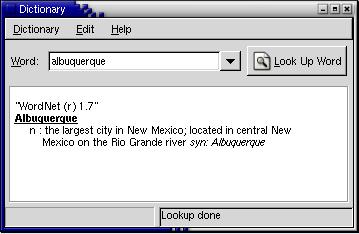
This evening when I was checking docs for the 2.6 release I noticed what the search engine had returned:
Albuquerque
n : the largest city in New Mexico; located in central New Mexico on the Rio Grande river
Rio Grande river would be, uh, redundant. Like Sierra Nevada mountains or La Bajada hill.