Adaptation v. Mitigation – Again

For those of you who insist that of course every right thinking person agrees that the need to adapt to climate change shares equal importance with greenhouse gas reductions, Roger Pielke Jr. has another example worthy of your attention. The quote is from ClimateWire:

Environmental and humanitarian activist groups plan to formally ask the World Bank to back away from plans to create a $500 million trust fund aimed at helping poor nations cope with climate change.

Hair Dye

Drought in northern India has led to a ban on hair dye:

At least 11 farmers have died from swallowing the hair dye in a drought-hit region of Uttar Pradesh state in the past three months, said Rajiv Agarwal, a senior state official.

Two-thirds of India’s 1.1 billion people depend on agriculture, and most have been left out of India’s economic boom. In parts of western and southern India, the dire economic state of farmers has been blamed for thousands of suicides in recent years.

The hair dye leads to kidney failure, said Ganesh Kumar, principal of the Maharani Lakshmi Bai Medical College.

“We have banned the sale of the cheap dye made locally in Uttar Pradesh state,” Agarwal told The Associated Press.

Wind, Solar and Economies of Scale

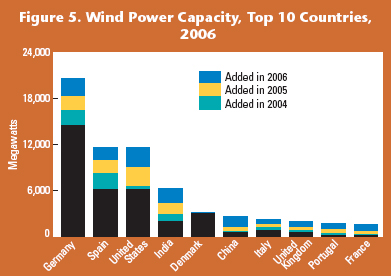
Rich Sweeney goes beyond my casual “go read it” reference to the Economist article on renewables in Germany and actually explains its implications:

Like a lot of things, economies of scale are more complex than the renewables lobby would have you believe (Joseph Romm makes the scale argument a lot, and recently Daniel Weiss made a similar claim). However, government can’t simply, and infinitely, induce cost reductions by just promoting scale (I think Stalin made a similar miscalculation). Especially when one of the production inputs is scarce, as silicon is (at least in the short run).

Diseconomies of scale are actually even more of an issue for wind, as I’ve been meaning to post for some time. The technology itself, ie wind turbines, have been around for awhile and could probably be best characterized as mature (at least for high-speed winds). So the potential for cost reduction is probably relatively limited on the capital side. The other main input, however, is finite – wind. Moreover, not all winds (?) are created equal, with some sites being much harder to get too and further away from the grid. So for wind energy, there’s a real possibility of decreasing returns to scale, depending where you are on the supply curve.

Food Trade Issues

Via Michael Tobis, a Financial Times story about growing export restrictions in response to global food shortages:

On Monday, India scrapped tariffs on edible oil and maize and banned exports of all rice except the high-value basmati variety, while Vietnam, the world’s third biggest rice exporter, said it would cut rice exports by 11 per cent this year.

The moves mark a rapid shift away from protecting farmers, who are generally the beneficiaries of food import tariffs, towards cushioning consumers from food shortages and rising prices.

Stuff I Wrote Elsewhere: Lake Monster Edition

Fun with illusions:

Thomas explained the difference between science and the sort of pseudoscience frequently debunked by the group this way:
Science, he said, looks at all of the available evidence and tries to come up with some sort of overarching explanation that explains it all. Scientists call them “theories,” but when they use the word, they mean a well-established idea: the theory of relativity, the theory of quantum mechanics, the theory of continental drift, the theory of evolution.
Pseudoscience does the opposite.
“They start out with a belief and then they cherry-pick the data to find little nuggets that support that belief,” he said.

Media Sucks: Episode CVII

Rich Sweeney wonders why you hear so damn much about gasoline prices rather than the cost of food:

[W]hy is that I can’t turn on the news without hearing, invariably in very tragic terms, about soaring gasoline prices, yet there is almost no coverage of soaring food prices?

The short answer is that the media sucks. Seriously. We’re just as short-sighted and inattentive as most folk. And in this case, the price of gasoline is obvious and easily quantified. It’s in giant letters on every single Kwik-E-Mart on every corner in town – exactly the same units of measure, easily compared from one store to the next and one day to the next. So we notice the price of gasoline. The price of a loaf of bread? Not so obvious. Not printed on giant signs on every street corner. Not quite so easily and obviously comparable from one store to the next.

We in the media are just like other ordinary folk who think about that which is the most noticeable, rather than that which is the most important.