
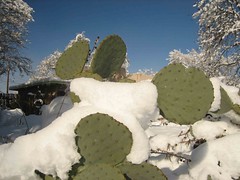
This is the sort of thing tailor-made for Us Media, and we “people of the year” are in full flower today in Albuquerque.
Storm of 2006: Water Supply Implications
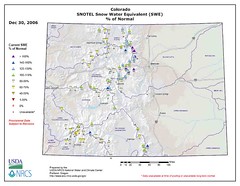
It’ll be another few days before the InterWeb data sources catch up with what the eastern two Four Corners states must call the Big Storm of 2006, but the preliminary data suggests that the water supply implications are less significant than the enormous pile of snow in my Albuquerque backyard might indicate.
Here, in terms of snowfall, December precip, etc., it’s the storm of record.: 16 inches of snow at the official weather station out at the airport, 1.13 inches of snow water equivalent, with reports ranging from 10 inches to 2 feet across the city. For us, that’s epic.
But if you look at the preliminary mountain snowpack numbers, you can see that this storm was not epic everywhere. The nature of the storm, with lots of wrap-around moisture streaming in counter-clockwise around the storm’s center and piling up along the front range in Colorado and mostly east of the continental divide in New Mexico, means that for the big water supply regions, this looks like just a normal winter storm – not at all epic.
The map above is from the NRCS Portland office. Folks there, especially Tom Pagano, have been doing a great job of improving the packaging of the data from their Snotel sites to make it more user-friendly.
How the Storm Played Out

Apologies for those outside of New Mexico for today’s digression, but we’re having a shared experience, a kind of community hug. Snowmen. People walking in the middle of the street because the tire tracks are the easiest place to walk. Cars going slow and being polite about the people walking in the middle of the street. We don’t own snow shovels. This is not part of our ordinary experience, and the extraordinary is, well, extraordinary.
The folks at the National Weather Service have put up a nice page detailing how it played out for those of us interested in the meteorological details.
Storm of the Century and Stuff
From our friends at the National Weather Service:
00
SXUS75 KABQ 300848
RERABQ

RECORD EVENT REPORT
NATIONAL WEATHER SERVICE ALBUQUERQUE NM
148 AM MST SAT DEC 30 2006

...RECORD DAILY MAXIMUM SNOWFALL SET AT ALBUQUERQUE NM...

A RECORD SNOWFALL OF 11.3 INCHES WAS SET AT THE ALBUQUERQUE SUNPORT
YESTERDAY. THIS BREAKS THE OLD RECORD OF 9.3 INCHES...PREVIOUSLY SET
IN 1958.

$$

DPORTER
12″

To measure your snowfall, pick an open area, away from the influence of buildings, trees, etc. Use a ruler or yardstick and take three separate measurements at widely separated spots. Average the results.
Sadie does not care about this level of detail. Her concern seems to be the berm growing out our back door as snow slides off the roof. She can barely get over it to go romp.
Snow Fence

The strange thing tonight, walking in the park in the snow, was how light it was.
The Mythology Around the Japanese Bomb

I usually leave the nuke stuff elsewhere, (or here – too many blogs?) but this post by Jeffrey Lewis, the Arms Control Wonk, seems relevant to the science policy discussions that go on here.
Lewis is trying to critically examine the conventional wisdom, widely reported of late, that Japan is just six months away from getting nuclear weapons if it were to decide it wants them to deter the North Korean threat. The basic argument is that the nuclear materials and technology base used for power generation in Japan could quickly be turned to the development of weapons if they chose.
Lewis argues – persuasively, I think – that the available evidence suggests the contrary, that Japan is years away from getting nuclear weapons should it decide to pursue that course. I’ll leave it to you to read Jeffrey’s argument, but suffice it to say that the trail of bread crumbs he follows to try to find the original sources and evidence for the “six months away” conventional wisdom lead nowhere. Lots of people seem to “know” this, but no one seems to know where it came from.
Having looked at the technical reasons that Japan is several years away from a deliverable nuclear warhead and the strange persistence of the “six month” idea—it is hard not to conclude that “six months” is a wonky equivalent of the Biblical Forty. “Six months” is a rough estimate—on par with “a screwdriver’s turn” as the Leventhal quote suggests—intended to make the wonk look smart and satisfy hungry journalists.
The only problem is, it ain’t true.
From the science media/policy perspective, the interesting thing here is the way the meme persists despite the lack of evidence. Over and over, it is repeated, in part because it supports a particular line of argument about the dangers of proliferation that serves the interests of those making it, both the experts and the journalists perpetuating it. A news story that says proliferation is not a risk has a lot less sex appeal, much like a story that minimizes the relative societal risk from global-warming-induced drought or, say, hurricanes.
The problem in the nuclear weapons arena, as Jeffrey’s Quixotic search shows, is that there is little peer-reviewed open literature here on which to base the discussion. Much more so than in the case of the climate wars normally discussed here, the discussion must be based on the pronouncements of the priesthood.
Climate Change and Australian “drought”
A new paper by Wenju Cai and Tim Cowan at CSIRO in Victoria argues that anthropogenic climate change can explain some, but not all, of the marked decline in rainfall over the last half century in southwest Western Australia: “An ensemble result from 71 experiments reveals that anthropogenic forcing contributes to about 50% of the observed rainfall decline…. Our result suggests that other forcing factors must be invoked to fully account for the observed rainfall reduction.”
Coltrane’s Mouthpiece

I was on thin ice with the story the other day about John Coltrane’s mouthpiece. I mean, I think I really heard it, but I don’t have it tagged in my memory as to when or where, so when I wrote it I figured it was possible that it was either apocryphal or imagined.
I was reading the liner notes this morning to Ascension, an essay by Lewis Porter, which describes a day Coltrane and a young Pharoah Sanders spent in Oakland in the early 1960s “trying out mouthpieces in pawn shops.” And then I found this:
It was during this period, in early 1961, that he met visiting tenorman John Coltrane, and the two frequented pawn shops and music stores in search of reeds and mouthpieces. Sanders’ constant search for the right reed and mouthpiece has proven to be a lifelong quest.
So maybe it wasn’t Coltrane at all, but a transmogrified Pharoah Sanders story.
Whatever. All I know is that, if I really knew how to write, I’d do a piece about the day John Coltrane and Pharoah Sanders spent wandering the pawn shops of Oakland, trying out mouthpieces.
A Greenhouse Calculation
Here’s a lazyweb word problem:
John rides his bicycle to work, thus saving a half gallon (1.9 liters) of gasoline, consuming 700 calories in the process. If John replaces those calories by eating beef, what is the net reduction (increase?) in greenhouse gas emissions? If he gets the calories from soy protein? Etc? (Ideally, the answers should be expressed in gasoline gallon equivalents, because that’s the metric regular folks can grok.)